
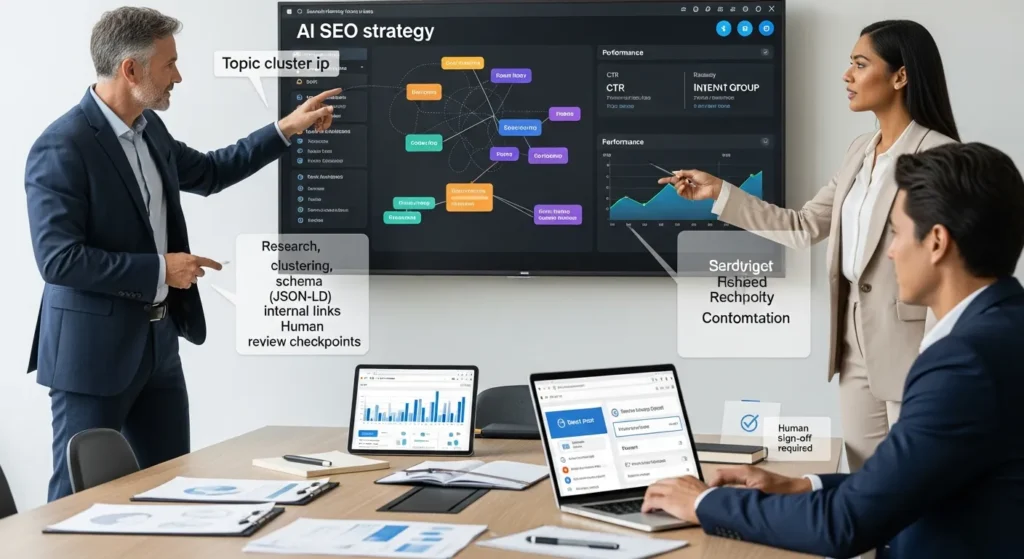
AI SEO strategy sounds like a shortcut until you watch a “perfect” AI article go live and… nothing happens. We have seen it: clean grammar, decent keywords, and zero lift. The issue is not effort. The issue is that search in 2026 rewards clarity, entity authority, and verifiable usefulness, not word volume.
Quick answer: an AI SEO strategy works when AI does the repeatable machine work (research, clustering, schema, internal links, analysis) and humans own the judgment calls (truth, voice, and risk).
Key Takeaways
- An AI SEO strategy in 2026 wins by building clear entities, supported claims, and scannable structure that search systems can trust and cite.
- Use AI for repeatable SEO work—keyword clustering, intent labeling, outlines, schema drafts, internal link suggestions, and gap analysis—while humans own facts, risk, and brand voice.
- Design an AI-assisted workflow with checkpoints (accuracy, sources, tone, plagiarism when needed) and a publish gate so automation increases speed without increasing mistakes.
- Build topic clusters (pillar + satellites) with strict internal linking rules so each page does more work and avoids thin content.
- Keep WordPress as the source of truth and use a lightweight stack for briefs, on-page checks, and schema (e.g., FAQ/HowTo/Product/Organization) to improve machine readability.
- Measure outcomes, not output: track intent-group rankings, CTR, engagement, conversions, and citations in generative results, then scale via shadow-mode pilots and small batches.
What “AI SEO Strategy” Actually Means In 2026
In 2026, AI SEO strategy means you build pages that AI systems can understand, trust, and cite. Google AI Overviews and other generative results do not “feel” your brand. They parse your entities, your claims, your supporting sources, and your structure.
Here is the cause-and-effect that matters: clear entities and relationships -> increase model confidence -> increase citations and visibility. That single chain changes how we plan content.
So we stop chasing one keyword per page. We build clusters around real-world topics your buyers care about. We label who you are, what you sell, where you operate, and what proof you have. And we make it easy for machines to extract the answer fast.
If your site runs on WordPress, this shift is good news. WordPress gives you clean page structure, flexible schema options, and editorial control. You can build authority without turning your marketing team into full-time developers.
The Parts AI Helps With (And The Parts It Should Not Touch)
AI earns its keep when the task is repetitive and rules-based.
AI helps with:
- Keyword discovery and clustering: AI groups queries by intent so one strong page can cover a whole set of searches.
- Intent labeling: “What is,” “best,” “near me,” “price,” “comparison,” and “how to” each demand a different page shape.
- Outline generation: AI can propose headings and questions people ask.
- Schema drafting: AI can produce JSON-LD drafts you review.
- Internal link suggestions: AI can spot related pages you forgot to connect.
- Content gap analysis: AI can compare your cluster to top results and spot missing subtopics.
AI should not own:
- Final claims and facts: If a model guesses wrong, your page becomes a liability.
- Medical, legal, financial advice: Keep humans in charge. Always.
- Brand voice and nuance: Generic text makes you look like everyone else.
We like this rule: AI -> speeds the process: humans -> protect the truth. If you want a reality check on how “pro” SEO looks inside WordPress, start with this guide on turning a site into a lead engine: how pros make WordPress SEO pull real leads.
Where AI Fits In A Modern SEO Workflow
AI works best as a “brain between triggers and actions.” You do not start with tools. You start with a mapped workflow.
When we build an AI SEO strategy, we design the pipeline so each step has a purpose, a checkpoint, and a rollback plan. That is how you keep speed without losing control.
Here is why: automation -> increases output -> increases risk. Guardrails reduce that risk.
Trigger / Input / Model Job / Output / Guardrails
Use this pattern for almost any AI-assisted SEO task:
- Trigger
- New product launches
- A blog topic enters your editorial calendar
- A quarterly refresh cycle starts
- Input
- Target topic and audience
- Page type (product, collection, service, guide)
- Constraints (no sensitive data, no medical advice, tone rules)
- Model job
- Cluster keywords by intent
- Draft headings and FAQs
- Propose internal links
- Draft schema markup
- Output
- A content brief your team can write from
- A draft page (often in WordPress as a draft post)
- Suggested schema JSON-LD
- Guardrails
- Human review for accuracy and tone
- Source check for claims
- Plagiarism check when needed
- Publish only after sign-off
If you already use Yoast, you can turn its checks into a simple gate in the workflow. This walkthrough on running a practical on-page audit gives you a clear checklist: a step-by-step Yoast audit you can run in one sitting.
A Lightweight AI SEO Tech Stack For WordPress Sites
Most teams do not need a giant platform. They need a small stack that covers four jobs: research, writing support, technical checks, and measurement.
A sensible AI SEO strategy stack keeps WordPress as the source of truth. Tools should feed WordPress. Tools should not replace WordPress.
Content Briefs, On-Page Checks, And Schema Support
We like a three-layer setup:
- Brief layer (planning): AI-assisted clustering, SERP intent notes, and a “what must be true” facts list.
- On-page layer (editing): readability checks, title and meta checks, internal links, image alt text, and basic technical warnings.
- Schema layer (machine clarity): FAQ, HowTo (when allowed), Product, Organization, LocalBusiness, and Article schema where it fits.
If you use Yoast, learn its signals like a tool, not like a grade. A green dot does not mean “this will rank.” It means “this meets the plugin rules.” Here is the deeper guide we point clients to: how to use Yoast like an SEO pro without chasing green lights.
Automation Options: No-Code, Light Code, And Editorial SOPs
You can automate safely if you pick the right layer.
No-code (Zapier, Make, n8n):
- Create a draft post when a new topic enters your content calendar
- Add a checklist to the draft (facts, sources, schema, internal links)
- Notify a reviewer in Slack or email
Light code (WordPress hooks and small plugins):
- Auto-populate template blocks for FAQs
- Enforce required fields (author, last reviewed date)
- Log AI-edited content changes in the database
Editorial SOPs (the underrated piece):
- One prompt template per content type
- One review checklist per content type
- One “publish gate” that a human owns
This is where many sites win: SOPs -> reduce variation -> improve quality. And yes, it feels boring. Boring is good when rankings and reputation sit on the line.
Build An AI-Assisted Content Engine That Does Not Create Thin Content
Thin content does not come from using AI. Thin content comes from publishing pages with no point of view, no proof, and no clear job.
A working AI SEO strategy produces fewer pages that do more work. Each page should answer a real question, support a product or service, and connect to related pages in a predictable structure.
Topic Clusters, Search Intent, And Internal Linking Rules
We build clusters like this:
- Pillar page: the main guide for the topic (broad intent)
- Satellite pages: each one targets a narrower question (specific intent)
- Internal link rules: satellites link up to the pillar: the pillar links down to satellites: product/service pages link to the most relevant guide
That structure creates a clean relationship map.
Cause and effect stays simple: internal links -> share context -> help crawlers and models understand your site.
You can also tighten this with technical crawling. We often run a crawl before and after big changes to catch broken links, thin pages, duplicate titles, and index bloat. Here is the plain-English primer we hand people when they ask what to use: when Screaming Frog is worth it for a WordPress site.
Human Review Checklist For EEAT, Accuracy, And Tone
Before anything ships, we want a human to confirm:
- Experience: Does the page show real-world use, photos, screenshots, results, or lessons learned?
- Expertise: Does a qualified author own the advice?
- Authority: Do you cite reputable sources where needed?
- Trust: Do you avoid exaggerated claims and add clear disclaimers?
Also check these “AI tells”:
- Vague promises and generic intros
- Repeated phrases and recycled headers
- Claims with no source
If you need a simple editing gate inside WordPress, you can use the plugin signals as guardrails. This guide breaks down how to read those checks without overthinking them: how to use the Yoast content checker the right way.
The Governance Layer: Privacy, Compliance, And Disclosure
Governance sounds like paperwork until someone pastes client data into a chatbot. Then it becomes a real business problem.
A safe AI SEO strategy sets boundaries before the first prompt. Your marketing team needs rules they can follow on a busy Tuesday.
Data Minimization, Sensitive Inputs, And Regulated Industries
We use a simple policy: do not share what you would not email.
Keep out of prompts:
- Patient data and health records
- Legal case details
- Financial account info
- Internal incident reports (security, HR)
Use redacted placeholders instead. “Client A” beats a name. “City, State” beats an address.
If you work in legal, healthcare, finance, or insurance, add a second step: a compliance review on pages that touch regulated advice. AI can help outline the content. Humans must own final wording and disclaimers.
Logging, Versioning, And Rollback For AI-Edited Pages
You want to know three things later:
- Who changed the page?
- What changed?
- When did it change?
Logging turns panic into a routine fix.
Practical options:
- Turn on WordPress revisions and keep them
- Use an editorial workflow plugin if your team is large
- Store prompts and outputs in a private doc folder tied to each URL
- Keep a rollback note for major edits (what changed and why)
Cause and effect stays clean: logs -> speed up audits -> reduce downtime when something breaks.
Measure What Matters And Iterate Safely
If you measure the wrong thing, AI just helps you ship the wrong thing faster.
A solid AI SEO strategy tracks outcomes that connect to business value, not vanity charts.
Leading Indicators: Rankings, CTR, Engagement, And Conversions
We watch a small set of signals:
- Rankings by intent group: not one keyword, but the cluster
- CTR from search results: titles and snippets either earn clicks or they do not
- Engagement: scroll depth, time on page, assisted conversions
- Leads and sales: form fills, calls, purchases, booked consults
And in 2026, we add one more question: “Do we earn citations in generative results?” That is harder to track, but you can spot it through Search Console trends, branded query lift, and referral patterns.
For off-page authority, do not chase vanity scores. Build links you can defend. This guide explains a grounded approach that avoids the usual trap: how to think about backlinks without obsessing over DR.
Pilot In Shadow Mode, Then Expand What Works
We like a cautious rollout:
- Shadow mode: run AI outputs as drafts only
- Red-team review: try to break the content (bad facts, risky claims, tone drift)
- Small publish batch: 5 to 10 URLs
- Measure for 2 to 4 weeks: look for lift and problems
- Expand: scale the parts that worked
This keeps the workflow sane. It also protects your brand.
Cause and effect stays real: small pilots -> clear learnings -> safer scale.
Conclusion
AI SEO strategy in 2026 rewards teams that act like architects, not gamblers. Map the workflow, keep humans in the loop, and treat every prompt like an internal SOP that someone will have to defend later.
If you want, we can help you set up a WordPress-first system that produces clean briefs, structured pages, and measurable growth without risking your brand voice or your compliance obligations.
AI SEO Strategy FAQs
What is an AI SEO strategy in 2026, and why doesn’t “perfect” AI content rank?
An AI SEO strategy in 2026 focuses on pages machines can understand, trust, and cite—built around clear entities, supported claims, and useful structure. “Perfect” AI writing can fail because search rewards verifiable usefulness and authority, not word volume or clean grammar alone.
Which tasks should AI handle vs. humans in an AI SEO strategy?
AI should handle repeatable work: keyword discovery and clustering, intent labeling, outline drafts, schema drafts, internal link suggestions, and content gap analysis. Humans must own truth and final claims, regulated advice (medical/legal/financial), brand voice, and risk decisions to prevent liability and generic content.
How do topic clusters and internal links improve AI SEO strategy results?
Topic clusters map entities and relationships: a pillar page covers the broad topic, while satellite pages answer narrow questions. Strong internal linking (satellites to pillar, pillar to satellites, products to relevant guides) shares context, helps crawlers and models understand your site, and reduces thin, disconnected pages.
What’s a lightweight AI SEO strategy tech stack for WordPress sites?
A practical WordPress-first stack covers planning, on-page editing, and schema clarity. Use AI for clustering and briefs, add on-page checks (titles, metas, internal links, alt text), and draft JSON-LD for schemas like FAQ, HowTo (when allowed), Product, Organization, and Article—then review before publishing.
How do you prevent thin content when using AI for SEO?
Thin content usually comes from pages with no point of view, proof, or clear job—not from AI itself. Set a brief with “what must be true” facts, require sources for claims, add real experience (examples, screenshots, results), and use a human publish gate so fewer pages do more work.
How can you measure whether an AI SEO strategy is working beyond rankings?
Track outcomes tied to business value: rankings by intent cluster, CTR from search results, engagement (scroll depth, time on page), and conversions (leads, calls, purchases). In 2026, also watch for citations or visibility in generative results using Search Console trends, branded query lift, and referrals.
Some of the links shared in this post are affiliate links. If you click on the link & make any purchase, we will receive an affiliate commission at no extra cost of you.
We improve our products and advertising by using Microsoft Clarity to see how you use our website. By using our site, you agree that we and Microsoft can collect and use this data. Our privacy policy has more details.
