
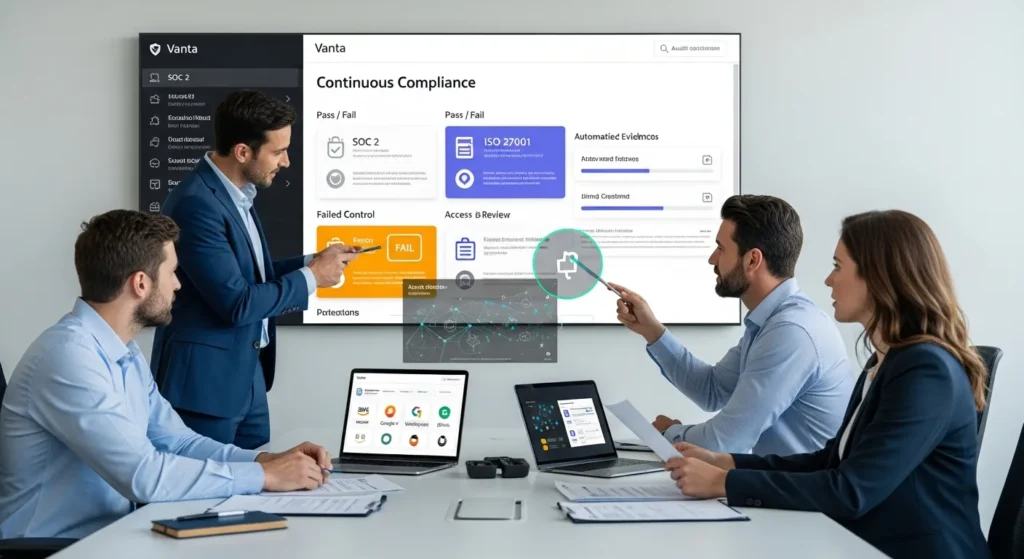
Vanta can save your team from the pre-audit panic spiral, the one where you open 47 tabs, realize half your evidence lives in Slack, and swear you will “fix compliance” next quarter. We have watched smart teams burn weeks on screenshots, spreadsheets, and last-minute access reviews, then still feel unsure about what is actually working. Quick answer: Vanta automates a big chunk of compliance evidence and control checks, but you still need real security work, clear scope, and human review.
Key Takeaways
- Vanta is a compliance automation platform that continuously checks controls and collects audit evidence for frameworks like SOC 2 and ISO 27001 to reduce last-minute audit chaos.
- Continuous compliance with Vanta means you see control failures early (like expired device policies) so you can fix issues faster and keep evidence current.
- Teams adopt Vanta most often to reduce sales friction from security questionnaires, meet customer or investor requirements, and help small security teams avoid manual screenshot-and-spreadsheet work.
- Vanta covers repeatable compliance tasks—integrations, evidence collection, policy templates, access reviews, and vendor workflows—but it does not replace your security program, auditor, or legal review.
- Implement Vanta effectively by scoping your audit boundary first, connecting only in-scope systems with least-privilege access, running in “shadow mode,” then enforcing controls once failures are under control.
- WordPress and WooCommerce businesses can still benefit from Vanta by connecting upstream systems like cloud hosting, identity (Google Workspace/Okta), support tickets, and payment flows to tighten PCI and audit scope decisions.
What Vanta Is And The Problem It Solves
Vanta is a compliance automation platform. It helps you prove security controls and meet standards like SOC 2 or ISO 27001 without building an evidence museum by hand.
Here is the problem it solves: teams treat compliance like a one-time event. A sales deal triggers a SOC 2 request. An auditor sends a list. Then everyone scrambles to pull logs, screenshots, and policy docs. That scramble creates gaps. A gap creates delays. Delays burn trust.
Vanta flips the flow. Vanta connects to your systems and runs checks continuously. Continuous checks create current evidence. Current evidence reduces audit prep time and cuts the “we need this by Friday” chaos.
A data point worth knowing: IDC reports that Vanta customers spend 82% less time per framework and attestation-related audit.
Continuous Compliance In Plain English
Continuous compliance means your controls get checked on a schedule, not only during audit season. Vanta runs automated tests across connected tools and flags failures when they happen.
A simple cause chain looks like this: an expired device policy causes a failed control, and a failed control creates audit risk. Vanta surfaces the failure fast so your team can fix it while the trail is fresh.
This does not mean “set it and forget it.” It means “see it early, fix it faster, document it automatically.”
The Most Common Reasons Teams Adopt Vanta
Teams pick Vanta when business pressure meets security reality. We see a few repeat triggers:
- Sales friction: Security questionnaires stall deals. Vanta helps you answer faster with collected evidence and structured responses.
- New markets: A larger customer wants SOC 2, ISO 27001, HIPAA, GDPR, or PCI expectations in writing.
- Investor due diligence: Investors ask how you manage access, logging, and vendor risk.
- Small security teams: A two-person team cannot chase screenshots all quarter.
- Cost pressure: Vanta positions itself as a way to reach compliance at a fraction of manual costs, while still needing ownership and follow-through.
Sources: IDC findings are published by Vanta: treat them as vendor-sponsored research and sanity-check with your own time tracking.
What Vanta Covers (And What It Does Not)
Vanta covers a lot of the repeatable work in compliance. It does not replace your security program, your legal advice, or your auditor.
Here is what that means in practice: Vanta can collect evidence and monitor controls, but your team still decides policy, risk acceptance, and what “secure enough” means for your business.
Frameworks And Reports You Will See Most Often
Vanta supports 35+ security and privacy frameworks, with common ones showing up again and again:
- SOC 2 (customer trust for SaaS and service providers)
- ISO 27001 (ISMS structure and global recognition)
- HIPAA (health data handling in the US)
- GDPR (EU privacy obligations)
- PCI DSS (card payment security)
Vanta also cross-maps controls. Control mapping reduces duplicate work because one control can satisfy parts of multiple frameworks.
Evidence Collection, Policies, And Security Reviews
Vanta connects to your tools through 400+ integrations and runs tests on a schedule. Those connections pull evidence without the usual copy-paste.
Vanta also includes:
- Policy templates and a guided policy builder
- Access reviews and user tracking
- Issue tracking patterns that fit ticket tools
- Vendor risk and security questionnaire workflows
The key cause chain here is simple: tool connections affect evidence quality. If you connect the right systems with the right permissions, you get clean, consistent audit artifacts.
The Limits: Vanta Is Not Your Security Program
Vanta can prove controls. Vanta cannot magically make weak controls strong.
If your MFA policy is loose, Vanta will show a control failure. Your team still needs to set the policy, enforce it, and handle exceptions.
Also, Vanta can suggest answers for many questionnaire items. Humans still need to verify them. A wrong answer creates legal exposure. A careless answer creates customer distrust.
If you work in healthcare, finance, legal services, or any regulated environment, treat automated suggestions like a draft. A person signs off.
How Vanta Fits Into A Real Operations Stack
We think of Vanta as a “trust layer” that sits above the tools you already run. It does not replace your cloud provider, your ticket tool, or your identity provider. It watches them, checks them, and collects proof.
This matters because tool sprawl causes blind spots. Blind spots cause surprise audit findings. Vanta reduces surprises by keeping evidence current.
Typical Integrations: Cloud, Identity, Devices, Help Desk, And Repos
Most teams connect Vanta to:
- Cloud: AWS, Google Cloud, Azure
- Identity: Okta, Google Workspace, GitHub identity
- Devices: endpoint or MDM tools
- Help desk and tickets: Jira and similar systems
- Code repos: GitHub and other version control platforms
- Vulnerability scanners
A clean integration map makes the work easier: identity controls affect access reviews: access reviews affect audit readiness.
Where WordPress And WooCommerce Teams Usually Connect The Dots
Vanta does not “plug into WordPress” in the same way it plugs into Okta or AWS, but WordPress and WooCommerce teams still benefit.
Here is the common pattern we build:
- Your WordPress site runs on managed hosting (often on AWS or Google Cloud under the hood). Cloud logging affects infrastructure evidence.
- Your team uses Google Workspace for identity. Identity settings affect account control evidence.
- Your support team uses a help desk. Ticket trails affect change records and incident documentation.
If you sell online, WooCommerce touches payments. Payment flow affects PCI scope decisions. Scope decisions affect which systems you connect to Vanta.
If you want to tighten the website side, we often pair compliance work with practical WordPress hardening: least-privilege admin roles, strong hosting logs, and clean plugin governance. Our site covers the web foundation side too: WordPress website development, WooCommerce solutions, and website maintenance services.
A Practical Implementation Plan (Start Small, Then Expand)
Before you touch any tools, map the workflow.
We use a simple frame:
- Trigger: You need SOC 2, ISO 27001, HIPAA, or PCI.
- Input: Systems in scope, data types, owners.
- Job: Connect tools, run checks, collect evidence.
- Output: Audit-ready reports and a working control program.
- Guardrails: Data minimization, human review, logging.
Start small. Run it like a pilot. You can expand scope after you see clean signals.
Step 1: Scope The Audit Boundary And Data Handling Rules
Scope decides everything.
List what data you store and where it flows. Customer emails, payment tokens, health info, employee HR files. Data type affects framework choice.
Then set rules:
- Only connect systems you need for your audit boundary.
- Limit permissions to least privilege.
- Write a “no secrets in tickets” rule if your team uses Jira or help desk notes.
A tight scope reduces noise. Noise wastes time.
Step 2: Connect Systems, Assign Owners, And Turn On Logging
Connect your identity provider first. Identity controls affect almost every framework.
Then connect cloud, devices, and repos.
Assign owners by control group. Ownership prevents drift. Drift causes failed checks.
Turn on logging and retention that matches your audit needs. If logs disappear after 7 days, you lose evidence. Evidence gaps create auditor questions.
Step 3: Run In Shadow Mode, Then Enforce Controls
Run Vanta in observation first. We call this “shadow mode.”
Shadow mode shows which controls fail without blocking your work. Your team fixes issues with less stress.
Then you enforce.
Enforcement works when you already cleaned up the obvious issues: missing MFA, unmanaged laptops, stale accounts, weak password rules.
Common Pitfalls And Risk Guardrails (Especially For Regulated Teams)
Compliance work goes sideways when teams treat tooling as a shortcut.
Here are guardrails we use to keep teams safe.
Avoid Oversharing Data And Keep Humans In The Loop
Vanta needs access to collect evidence. That does not mean Vanta needs all data.
- Connect only in-scope systems.
- Use least privilege roles.
- Do not paste PHI, card data, or confidential client content into free-text fields.
Keep humans in the loop:
- A person reviews failed controls before remediation.
- A person approves policy changes.
- A person validates questionnaire answers.
Automation affects speed. Humans affect accuracy.
Prepare For Auditor Expectations And Vendor Questionnaires
Auditors ask for specific proof. Vendors ask for specific answers. You need both.
Pick an auditor early and confirm what evidence format they like. Evidence format affects how you configure exports and reports.
On questionnaires, Vanta can draft responses. Your team still checks every claim. One overconfident answer can trigger a deeper review.
If you work in legal, healthcare, or finance, involve counsel and your security lead on any external security statement. Words create commitments.
What To Budget: Time, Internal Ownership, And Ongoing Maintenance
Vanta reduces manual work. It does not remove the need for ownership.
Budget in three buckets:
- Time: upfront scoping and connections take weeks, not hours.
- Owner: one person must drive controls, reviews, and alerts.
- Ongoing work: you still patch systems, offboard users, and close tickets.
Vanta claims it can automate up to 90% of compliance work. Real life still asks for follow-up, exceptions, and human sign-off.
What Changes After Week One
After the first week, teams usually feel two shifts:
- They see their compliance posture in one place.
- They stop guessing which control will fail next.
Vanta alerts replace manual spot checks. That changes behavior. People fix issues earlier because the system surfaces them earlier.
What “Done” Looks Like In 90 Days
At 90 days, “done” looks less like a finish line and more like steady operations:
- Integrations run clean and collect evidence
- Controls show a stable pass rate
- Access reviews run on schedule
- Audit documentation sits ready inside Vanta
- A trust center or shared reports answer customer questions faster
This is the point where compliance starts to feel boring. Boring is good.
Conclusion
Vanta works best when you treat it like a system of record for control evidence, not a substitute for security work. Clear scope reduces risk. Continuous checks reduce surprises. Human review reduces bad calls.
If you run a WordPress or WooCommerce business, you can still benefit even when Vanta does not touch WordPress directly. Your identity, hosting, support desk, and dev workflows sit upstream of your website. Those systems shape your audit story.
If you want a safe starting point, pick one framework, set your audit boundary, and run Vanta in shadow mode for a few weeks. When the signals look clean, enforce controls and keep the loop tight: alerts, tickets, fixes, proof.
Sources
- IDC Spotlight (Vanta-sponsored): The Business Value of Vanta (IDC), 2024, https://www.vanta.com/resources/the-business-value-of-vanta
- Vanta: Compliance Automation Platform Overview (Vanta), 2025, https://www.vanta.com/
- Vanta: Frameworks and Compliance Standards Supported (Vanta), 2025, https://www.vanta.com/product/compliance
- Vanta: Integrations Directory (Vanta), 2025, https://www.vanta.com/integrations
Frequently Asked Questions about Vanta
What is Vanta and what problem does it solve?
Vanta is a compliance automation platform that helps teams collect evidence and continuously test security controls for frameworks like SOC 2 and ISO 27001. It reduces the last-minute “audit scramble” by connecting to your systems, keeping evidence current, and surfacing control failures early—before they turn into audit delays.
How does Vanta support continuous compliance (and is it truly “set it and forget it”)?
Vanta supports continuous compliance by running automated checks on a schedule across connected tools and flagging issues as they happen. It’s not “set it and forget it.” You still need people to review failures, fix root causes (like weak MFA policies), and confirm evidence and questionnaire answers are accurate.
Which compliance frameworks does Vanta support most often (SOC 2, ISO 27001, HIPAA, GDPR, PCI)?
Vanta supports 35+ security and privacy frameworks, with common ones including SOC 2, ISO 27001, HIPAA, GDPR, and PCI DSS. It also cross-maps controls so one control can satisfy parts of multiple frameworks, helping teams reduce duplicated effort when they pursue more than one standard.
What does Vanta integrate with, and what should you connect first?
Vanta offers 400+ integrations, commonly with cloud platforms (AWS, Google Cloud, Azure), identity providers (Okta, Google Workspace), devices/MDM, ticketing tools (like Jira), code repos (GitHub), and vulnerability scanners. Most teams connect identity first because access controls impact nearly every framework and audit.
Can Vanta replace a security program or an auditor?
No. Vanta can automate evidence collection and monitor controls, but it can’t design your security program, make weak controls strong, or replace legal advice and auditor judgment. Your team still owns policy decisions, risk acceptance, exceptions, remediation, and human sign-off—especially in regulated industries like healthcare or finance.
How long does a typical Vanta implementation take, and what should you budget internally?
Implementation usually takes weeks, not hours, because scoping, connecting systems, assigning control owners, and configuring logging require real effort. Plan for one accountable internal owner plus ongoing maintenance (patching, offboarding, access reviews, ticket closure). Many teams run “shadow mode” first, then enforce controls once signals are clean.
Some of the links shared in this post are affiliate links. If you click on the link & make any purchase, we will receive an affiliate commission at no extra cost of you.
We improve our products and advertising by using Microsoft Clarity to see how you use our website. By using our site, you agree that we and Microsoft can collect and use this data. Our privacy policy has more details.
