
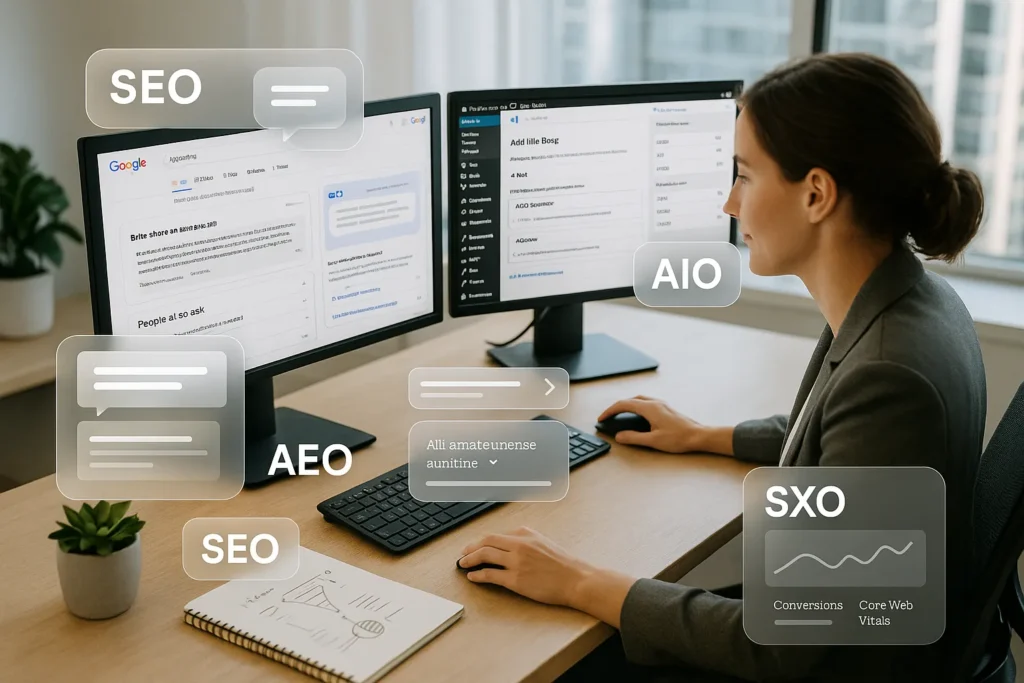
The first time a client asked us, “So… should we do GEO now instead of SEO?” we just stared at the Zoom window for a second. Overnight their reports went from ten blue links to AI answer boxes, strange citations, and voice queries from smart speakers in their kitchen.
Quick answer: SEO, GEO, AEO, AIO, and SXO are not buzzword replacements for SEO. They are five lenses that help us plan one connected search system where your brand gets found, quoted, chosen, and contacted across Google, AI assistants, and your own WordPress site.
Key Takeaways
- SEO, GEO, AEO, AIO, and SXO are five complementary lenses that create one connected search system so your brand can be found, quoted, and chosen across Google and AI assistants.
- SEO remains the foundation, ensuring your site is technically sound, rich with intent‑matched content, and trusted through quality links before you layer on GEO, AEO, AIO, and SXO.
- GEO and AEO focus on AI and answer visibility, using clear Q&A content, FAQs, and schema so tools like Google AI Overviews, ChatGPT, and voice assistants select and cite your explanations for queries like “what is SEO GEO AEO AIO SXO.”
- AIO makes your content easy for AI “readers” to parse and safely reuse by using structured headings, schema markup, and entity‑based writing, while keeping humans in charge of quality and compliance.
- SXO turns search visibility into revenue by improving page experience, clarity, and calls to action, then continuously testing and refining based on analytics, snippets, AI mentions, and conversions.
Why So Many New SEO Acronyms Are Showing Up
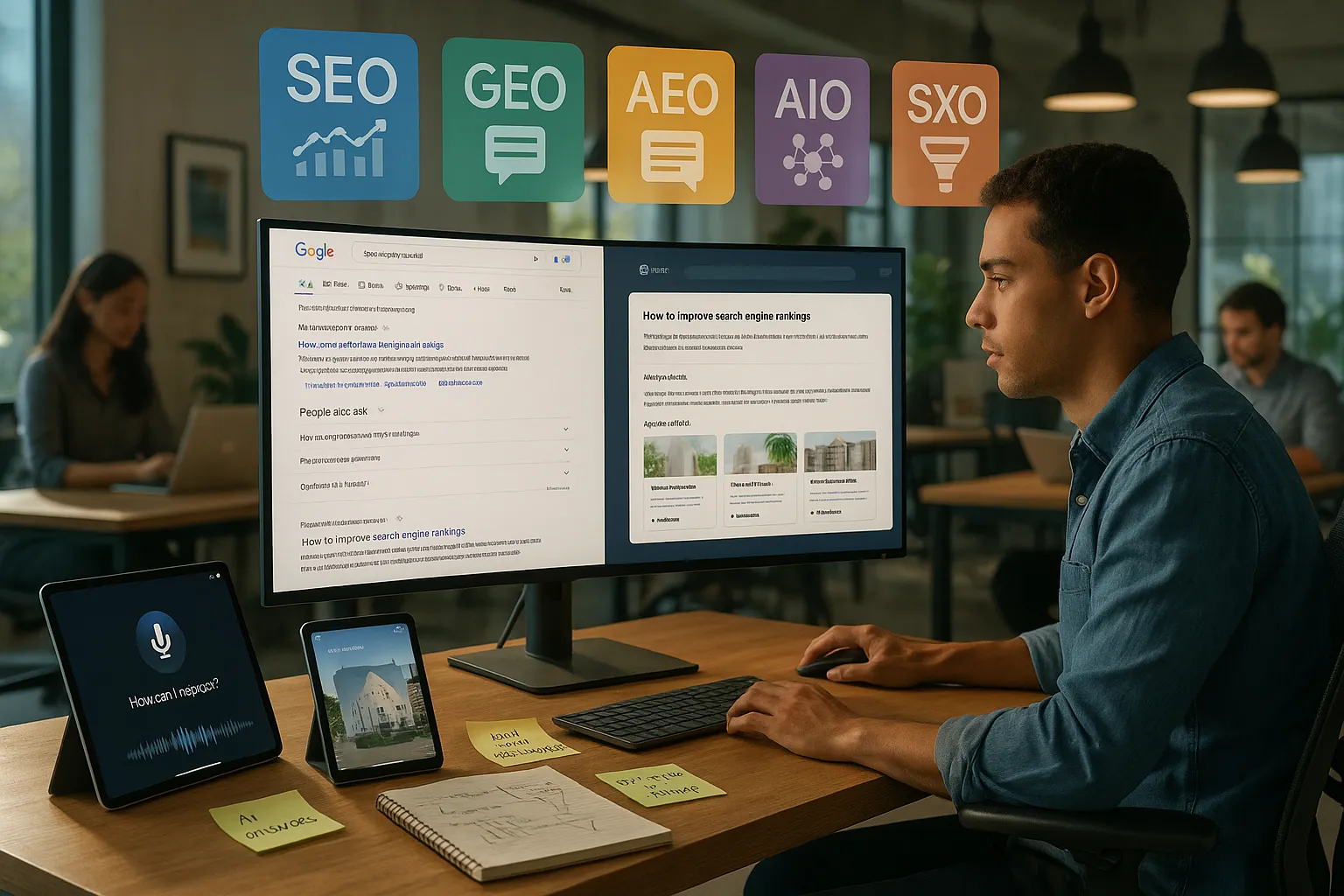
We now live in a search world where your buyer might:
- Type a classic Google query on a laptop.
- Ask Siri in the car.
- Paste a screenshot into Perplexity.
- Ask ChatGPT, then click one of the sources.
Under the hood, different engines answer in different ways. Google still runs a web index, but it also runs featured snippets, “People also ask” boxes, and AI Overviews for some users.[1] Tools like ChatGPT, Copilot, and Perplexity pull from many sites at once, then write a single blended answer.[3][4]
Marketers started using SEO, GEO, AEO, AIO, SXO as shorthand for this reality:
- SEO – classic organic rankings.
- GEO – getting cited inside AI answers.
- AEO – winning direct answer spots.
- AIO – making content friendly for AI tools and using AI behind the scenes.
- SXO – fixing what happens after the click so visitors act.
Once you see them as simple lenses, the stack feels a lot less mysterious.
Quick Definitions: SEO, GEO, AEO, AIO, And SXO In Plain English

Here is what each piece of the SEO, GEO, AEO, AIO, SXO puzzle means for real sites like yours.
SEO: Search Engine Optimization – Your Findability Foundation
SEO is how we help Google and Bing understand your site so you appear for the right searches. That covers technical health, content, and links.[1][5]
On a WordPress site, classic SEO work usually looks like this:
- Fixing indexation issues, broken links, and crawl errors.
- Researching search terms your audience actually uses.
- Writing pages and posts that match search intent.
- Earning links from relevant, trusted sites.
Without basic SEO, the rest of the stack, including GEO or SXO, has a weak base.
GEO: Generative Engine Optimization – Being Chosen By AI Answers
GEO is about getting your brand named or linked inside AI style answers on tools like ChatGPT, Perplexity, and Google AI Overviews.[1][3]
Since these engines mash together many sources, they look for:
- Clear answers to common questions.
- Structured information, like FAQ blocks.
- Strong site authority and trust signals.
Tactics we use for GEO on WordPress include long form guides, FAQ schema, and very explicit question plus answer sections. The goal is simple. When someone asks “what is SEO GEO AEO AIO SXO,” your explanation is one that the AI chooses to quote.
AEO: Answer Engine Optimization – Earning The Direct Answer Slot
AEO targets featured snippets, “People also ask” questions, and voice replies from assistants. These are answer engines sitting on top of search engines.[2][3]
AEO friendly content tends to have:
- A clear question written out as text.
- A short, direct answer in the next sentence or paragraph.
- Supporting detail below that.
On our client sites we build FAQ sections for services, product Q&A, and concise how to steps. That helps both SEO and AEO, since Google has said it looks for content that directly answers user questions.[1]
AIO: AI Optimization – Preparing Content For AI “Readers”
AIO has two sides:
- Using AI tools to research topics, cluster ideas, and draft outlines.
- Presenting your content in a way AI systems can parse without confusion.[2][3]
For the second part, we care about:
- Clear headings, lists, and tables.
- Schema markup like FAQPage, HowTo, Product, and LocalBusiness.[1]
- Entity based writing, where we name brands, places, and people.
We treat prompts as internal SOPs, not magic. Writers and subject experts still review every draft, which lines up with guidance from the FTC on truth in advertising and AI use.[6]
SXO: Search Experience Optimization – Turning Clicks Into Customers
SXO looks at life after the click. You ranked. You got featured. Someone tapped through. Now what.
Google has stressed page experience, mobile friendliness, and speed for years, and surfaces those expectations in Core Web Vitals and UX guidance.[5] SXO turns that into marketing work:
- Pages that load quickly and feel stable.
- Clear headlines and scannable sections.
- Obvious calls to action and forms that do not annoy users.
On zuleikallc.com, our WordPress website development projects always pair SEO work with SXO work, so clients are not just visible, they are contactable.
What These Acronyms Actually Change In Your Marketing

Here is the practical shift. SEO, GEO, AEO, AIO, SXO change your plan from “rank for some keywords” to “be present and trusted in every search style our buyer uses.”
In real campaigns that means we:
- Write content that solves user tasks, not just matches keywords.
- Structure pages so they answer questions in one or two sentences.
- Add schema and entities so AI engines can safely quote you.[1][3]
- Watch for traffic that now lands through AI answer boxes, not just classic results.[4]
It also changes success metrics. We still care about rankings, but we also track featured snippets, mentions inside AI tools, and conversion rates. McKinsey notes that teams using AI for content and analytics tend to see measurable gains in marketing performance when they keep humans in charge of quality and strategy.[2]
So the acronyms are not theory. They shift what you publish, how you structure it, and how often you refine it.
Translating SEO, GEO, AEO, AIO, And SXO Into Website Actions
Let us turn SEO, GEO, AEO, AIO, SXO into an action list you can use on a WordPress or WooCommerce site.
Content And Structure On Your WordPress Site
Start with one topic cluster that matters for revenue, like “WordPress SEO services” or “restaurant catering.” Then:
- Create one strong pillar page that explains the topic.
- Add supporting posts that answer narrow questions.
- Use H2 and H3 headings with clear, direct phrases.
- Add FAQ blocks with question then short answer.
This layout helps classic SEO, while also feeding AEO and GEO because answer engines can quote those short responses. Schema plugins on WordPress make it much easier to add FAQ, HowTo, and Product markup without code.
If you want a concrete model, you can study how we structure packages and content on our own site at zuleikallc.com.
Local, Reviews, And Service Pages For Trust Signals
Search engines and AI tools now look hard at trust, expertise, and real world presence. Google groups some of this under E E A T – experience, expertise, authoritativeness, and trust.[3]
On local and service pages we like to:
- Keep NAP data consistent – name, address, phone.[5]
- Link to a complete Google Business Profile.
- Display reviews, testimonials, and case studies.
- Add author bios for articles that give legal, medical, or financial guidance.
Those moves support SEO and SXO directly, while also nudging GEO. An AI answer that cites a law firm will favor sites that look legitimate and current.
Analytics, Testing, And Continuous Improvement
After the basics are in place, we treat SEO, GEO, AEO, AIO, SXO as dials to keep tuning.
We track:
- Organic traffic and top landing pages.
- Featured snippets and “People also ask” coverage.
- Conversion events, like form fills or calls.
- Core Web Vitals scores.[5]
Then we run small tests. Change a headline. Improve the intro. Tighten an FAQ answer. Run AI generated summaries only in draft at first, then publish once humans approve. This keeps AIO safe while still saving your team time.
If you prefer help, our WordPress SEO services and support plans at zuleikallc.com are built around this kind of steady tuning, not one time fixes.
Governance, Risk, And Keeping Humans In The Loop
There is a quiet risk with SEO, GEO, AEO, AIO, SXO. It becomes tempting to let AI tools write everything and push it live.
Regulators are paying attention. The FTC has warned that marketers stay responsible for deceptive or inaccurate claims, even when AI tools write them.[6] The European Data Protection Board has echoed similar caution on personal data and profiling.[7]
So we recommend a simple governance model:
- Never paste sensitive client or patient data into public AI tools.
- Keep legal, medical, and financial advice human led and reviewed.
- Log where AI helped, so you know what needs closer checking.
- Schedule regular content reviews, at least for your top earning pages.
Think of the AI stack as extra brains and hands for draft work, but your team still holds the pen on final judgment.
Conclusion
If you remember one thing about SEO, GEO, AEO, AIO, SXO, let it be this. They are five camera angles on the same scene, not five separate movies.
You still need solid SEO. GEO and AEO help you surface as the answer. AIO helps both humans and AI tools read your work. SXO makes sure the visit turns into an email, call, or sale.
Start small. Pick one strategic topic. Tighten the structure, add clear answers, improve the experience, and measure the change. If you want a partner that lives in WordPress all day and treats AI as a disciplined process, not a stunt, we are ready to help at zuleikallc.com.
Sources
- “Search Engine Optimization (SEO) Starter Guide,” Google Search Central, 2023, https://developers.google.com/search/docs/fundamentals/seo-starter-guide
- “The economic potential of generative AI,” McKinsey & Company, June 2023, https://www.mckinsey.com/capabilities/mckinsey-digital/our-insights/the-economic-potential-of-generative-ai
- “Search Quality Rater Guidelines,” Google, 2023, https://static.googleusercontent.com/media/guidelines.raterhub.com/en//searchqualityevaluatorguidelines.pdf
- “Perplexity.ai Help Center – How Perplexity works,” Perplexity, 2024, https://docs.perplexity.ai
- “Core Web Vitals & Page Experience,” Google Search Central, 2023, https://developers.google.com/search/docs/appearance/core-web-vitals
- “AI and Your Business,” Federal Trade Commission, 2023, https://www.ftc.gov/business-guidance/blog/2023/02/keep-your-ai-claims-check
- “Guidelines on automated individual decision-making and profiling,” European Data Protection Board, 2018, https://edpb.europa.eu
Frequently Asked Questions
What does SEO GEO AEO AIO SXO mean in marketing?
In marketing, SEO, GEO, AEO, AIO, and SXO are five lenses on one connected search strategy. SEO builds your organic visibility, GEO gets you cited in AI answers, AEO wins direct answer spots, AIO optimizes for AI readers and workflows, and SXO improves post-click experience so visitors convert.
How do SEO, GEO, AEO, AIO, and SXO work together for my website?
They form one system: SEO ensures you can be discovered, AEO structures content for featured snippets and voice answers, GEO positions you as a trusted source in AI summaries, AIO makes content machine-readable, and SXO turns that traffic into leads or sales through better UX, speed, and clear calls to action.
What is Generative Engine Optimization (GEO) and why does it matter now?
GEO is Generative Engine Optimization: shaping your content so tools like ChatGPT, Perplexity, and Google AI Overviews can confidently quote or link to you. Clear Q&A sections, long-form guides, schema markup, and strong trust signals increase the odds your brand appears inside AI-generated answers across search experiences.
How is Answer Engine Optimization (AEO) different from traditional SEO?
AEO focuses on earning direct answers in featured snippets, People Also Ask boxes, and voice assistants, rather than just ranking in standard results. It emphasizes explicit questions, short first-paragraph answers, and expanded detail below. Classic SEO supports visibility; AEO refines format so search and answer engines can surface you instantly.
How can I optimize my WordPress site for SEO, GEO, AEO, AIO, and SXO?
Start with one revenue-focused topic cluster, build a strong pillar page, and add supporting posts answering narrow questions. Use clear H2/H3 headings, FAQ blocks with concise answers, and schema plugins for FAQ, HowTo, Product, and LocalBusiness. Then improve Core Web Vitals, UX, forms, and track snippets, AI mentions, and conversions.
Is it safe to use AI tools for SEO GEO AEO AIO SXO content?
AI tools are useful for research, clustering topics, and drafting outlines, but regulators like the FTC stress that marketers remain responsible for accuracy and truthfulness. Keep sensitive data out of public tools, have humans review drafts—especially legal, medical, or financial content—and log where AI was used so high-risk pages get closer checks.
Some of the links shared in this post are affiliate links. If you click on the link & make any purchase, we will receive an affiliate commission at no extra cost of you.
