
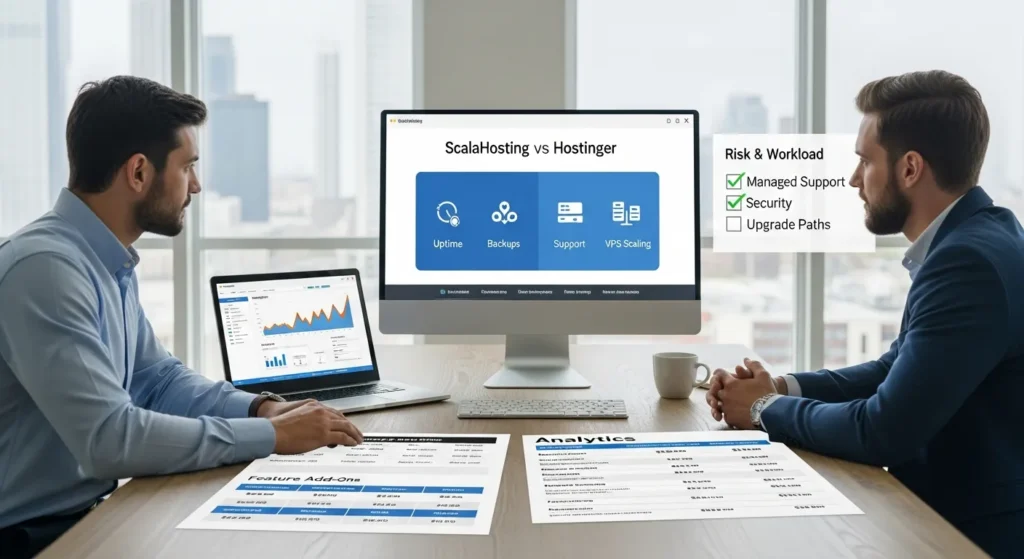
ScalaHosting vs Hostinger comes up the minute a WordPress site stops feeling “small” and starts feeling like a business asset. We have watched founders pick the cheapest plan, launch fast, then hit the wall during a promo or a random traffic spike at 2 a.m. Quick answer: Hostinger is great for tight budgets and simple sites: ScalaHosting is the calmer choice for growing WordPress businesses that want stronger support, security, and a clearer path to managed VPS.
Key Takeaways
- In the ScalaHosting vs Hostinger decision, Hostinger fits tight budgets and simple WordPress sites, while ScalaHosting is built for growing businesses that want less stress and more support.
- Both hosts advertise 99.9% uptime, but consistent performance under load matters more than “quiet day” speed—especially during promos, launches, or viral traffic spikes.
- If you expect spikes (WooCommerce sales, PR hits, ads), ScalaHosting’s managed VPS/cloud VPS options reduce shared-hosting “noisy neighbor” issues and keep checkouts more stable.
- Backups are a business risk choice: ScalaHosting typically includes automatic offsite backups more broadly, while Hostinger’s entry plans often lean weekly, which can increase data loss after bad updates.
- Hostinger often wins on intro pricing, but model renewal costs and add-ons now to avoid surprises in year two and beyond.
- Choose based on workflow and stakes: Hostinger’s hPanel suits beginners with one site, while ScalaHosting’s SPanel and staging/permissions tools better support agencies and multi-site operations.
Quick Comparison: Who Each Host Is Best For
If you need a fast decision on ScalaHosting vs Hostinger, start with one question: Are you buying “cheap hosting,” or are you buying “less stress”? Your answer usually picks the winner.
Best For Budget And Simple Sites
Hostinger fits if you want a clean setup, a low starting price, and you run a small site that can live on shared hosting for a while. Think:
- A new brand site with 5 to 15 pages
- A portfolio for a designer or photographer
- A blog that posts weekly and sells nothing (yet)
- A small service business site that mostly collects leads
Hostinger’s entry pricing is hard to ignore. But pricing creates behavior. Low intro rates push teams to launch fast, and launch fast can be a win.
Just keep your eyes open on the back end: renewal pricing often jumps, and base plans tend to include less backup coverage than people expect. That gap matters when you need a restore after a plugin update goes sideways.
Best For Managed Support And Control
ScalaHosting fits if you run a WordPress site that must stay up, load fast, and recover quickly. We put ecommerce, membership sites, and serious lead gen sites in this bucket.
ScalaHosting also tends to work better when you need “adult supervision” on the hosting side. You still own your site, but you can lean on support more.
In plain cause-and-effect terms: better support response -> faster incident resolution -> fewer lost sales and fewer angry Monday mornings. ScalaHosting positions itself closer to that outcome than Hostinger.
Sources:
- “ScalaHosting vs Hostinger (2025)”, Cybernews, 2025, https://cybernews.com/web-hosting/scalahosting-vs-hostinger/
- “Hostinger Web Hosting Review”, TechRadar, 2024, https://www.techradar.com/reviews/hostinger-web-hosting
- “ScalaHosting Review”, PCMag, 2024, https://www.pcmag.com/reviews/scalahosting
WordPress Performance And Reliability: Speed, Uptime, And Caching
Performance is not trivia. Performance changes revenue.
Here is the business chain we see all the time: slower pages -> lower conversion rate -> higher ad costs -> worse margins.
Both ScalaHosting and Hostinger advertise 99.9% uptime guarantees, and in many tests their real-world speed lands close. Some comparisons show Hostinger with slightly faster page loads, while ScalaHosting posts slightly stronger “overall performance” scores.
What we care about is repeatability. A host that stays consistent under load beats a host that looks fast on a quiet Tuesday.
Data Center Locations, CDN, And Real-World Latency
Hostinger usually gives you more data center location choices, which can help if your audience sits far from North America. Distance adds latency, and latency makes WordPress feel sluggish.
If your customers sit in the US, pick a US data center first. Then add a CDN if you serve images and product pages globally.
If you want a simple rule: closer server location -> faster time to first byte -> faster page render.
Traffic Spikes: Ecommerce, Launches, And Viral Posts
Traffic spikes expose weak hosting.
- A WooCommerce flash sale
- A big podcast mention
- A Reel that actually hits
- A “we made it to the top of Reddit” moment (fun, then terrifying)
ScalaHosting’s managed VPS and cloud VPS options tend to handle this better because dedicated resources reduce the “noisy neighbor” effect you get on shared hosting.
Hostinger can handle spikes too, but you often have to move up the ladder sooner. Shared hosting works until it does not.
If you run revenue through your site, we prefer the path where increased traffic -> stable resources -> fewer checkout errors.
Sources:
- “ScalaHosting vs Hostinger (2025)”, Cybernews, 2025, https://cybernews.com/web-hosting/scalahosting-vs-hostinger/
- “Hostinger Web Hosting Review”, TechRadar, 2024, https://www.techradar.com/reviews/hostinger-web-hosting
Security And Governance: Backups, Malware, And Account Isolation
Security decisions feel boring right up until the day they are not boring.
And if you work in legal, healthcare, finance, or anything regulated, you already know the vibe: you do not get to “wing it” with data handling.
Both ScalaHosting and Hostinger include DDoS protection on many plans. The bigger difference shows up in backup frequency, backup location, and restore confidence.
Backup Policies, Restore Workflow, And RPO/RTO Basics
Backups are governance, not a feature checkbox.
- RPO (Recovery Point Objective) answers: “How much data can we lose?”
- RTO (Recovery Time Objective) answers: “How long can we be down?”
Many small businesses accidentally accept a weak RPO when they choose weekly backups. A week is a lot of lost orders.
ScalaHosting commonly includes automatic offsite backups across plans, which reduces the risk that “server issue” and “backup issue” happen at the same time.
Hostinger includes backups too, but base plans often default to weekly backups in many comparisons. That may be fine for a brochure site. It is risky for ecommerce.
Cause-and-effect is simple: more frequent backups -> smaller RPO -> less financial damage after a bad update.
Permissions, Staging, And Client Handoffs For Agencies
If you work with an agency or you run multiple sites, you need clean handoffs.
We like setups where:
- Staging exists for safe testing
- Permissions separate “admin who can break things” from “editor who should not”
- You can clone and roll back without drama
ScalaHosting tends to feel more agency-friendly here, partly due to its tooling and managed VPS posture.
If you want a WordPress-side guide for this, we also recommend building a simple governance checklist for every site. We use one on every build we ship at Zuleika LLC.
Sources:
- “ScalaHosting vs Hostinger (2025)”, Cybernews, 2025, https://cybernews.com/web-hosting/scalahosting-vs-hostinger/
- “Hostinger Web Hosting Review”, TechRadar, 2024, https://www.techradar.com/reviews/hostinger-web-hosting
- “FTC Staff Report: Protecting Consumers from Dark Patterns”, Federal Trade Commission, 2022, https://www.ftc.gov/reports/protecting-consumers-dark-patterns
Plans And Pricing That Actually Matters: Renewal, Add-Ons, And Scaling
Most people price hosting like they price paper towels. Then renewal hits, and they do the slow blink.
ScalaHosting vs Hostinger pricing only makes sense when you compare:
- intro term cost
- renewal cost
- backups and email
- what it costs to scale
Intro Deals Vs Renewal Reality
Hostinger usually wins the first checkout. Low intro pricing helps people start.
The trade-off: many users see higher renewal rates later. That is not evil. It is just a business model. Your job is to plan for it.
ScalaHosting tends to start higher, but plans often include more “business basics” like ongoing email hosting and broader features across tiers.
A simple planning rule we use with clients:
- If you plan to keep the site for 3 to 5 years, model year-two pricing now.
- If you plan to run ads, assume you will need better hosting sooner.
Upgrade Paths: Shared To VPS/Cloud Without Rebuilding
Growth changes requirements.
- More products -> more database load
- More plugins -> more CPU spikes
- More traffic -> more caching needs
ScalaHosting gives a clearer runway into managed VPS and cloud VPS. That matters when your store grows and you do not want a rebuild.
Hostinger offers VPS options too, but the “shared to VPS” handoff can feel less linear depending on your plan.
Cause-and-effect again: simpler upgrade path -> fewer migration mistakes -> fewer surprise outages.
If you want a safe migration pattern, we usually run “shadow mode” first: clone, test, switch DNS, monitor, keep rollback ready.
Related reading on our site: WordPress website development services and website maintenance services.
Sources:
- “ScalaHosting vs Hostinger (2025)”, Cybernews, 2025, https://cybernews.com/web-hosting/scalahosting-vs-hostinger/
- “ScalaHosting Review”, PCMag, 2024, https://www.pcmag.com/reviews/scalahosting
WordPress Tooling And Day-To-Day Admin: Panels, Email, And Staging
Tooling does not sound exciting. Tooling still decides how long basic tasks take.
We care about daily admin because it turns into real payroll cost.
Control Panel Differences And Workflow Fit
Hostinger uses hPanel, and it feels beginner-friendly. It suits teams that want simple menus and a fast start.
ScalaHosting uses SPanel and WordPress-focused tooling (often branded as SWordPress in reviews). That tends to suit agencies and teams that manage many sites.
We usually pick panels based on workflow:
- One site, one owner, low change rate -> Hostinger feels fine.
- Multiple sites, staging needs, permission control -> ScalaHosting feels calmer.
Email Hosting, Deliverability, And Transactional Email Options
Email gets weird fast.
- marketing email: Mailchimp, Klaviyo
- transactional email: WooCommerce receipts, password resets
- business inbox: your team’s daily mail
Many comparisons note that ScalaHosting includes email hosting on an ongoing basis, while Hostinger often includes it free for the first year.
Deliverability depends on SPF, DKIM, and DMARC. Hosting companies do not “fix” deliverability with a magic switch. Still, a panel that makes DNS and mailbox setup painless saves time.
Also, do not send WooCommerce receipts through the same setup you use for newsletters. Use a transactional provider when volume or deliverability matters.
Related reading: our WooCommerce solutions work best when transactional email stays reliable.
Sources:
- “ScalaHosting vs Hostinger (2025)”, Cybernews, 2025, https://cybernews.com/web-hosting/scalahosting-vs-hostinger/
- “Hostinger Web Hosting Review”, TechRadar, 2024, https://www.techradar.com/reviews/hostinger-web-hosting
Support Experience: Tickets, Chat, And Incident Handling
Support is the hidden feature. You do not notice it until something breaks.
In ScalaHosting vs Hostinger comparisons, ScalaHosting often comes out ahead on chat response time and depth of help. Both offer 24/7 support, but the feel differs.
Response Times, Escalation, And What Counts As “Managed”
Words matter. “Managed” can mean:
- they patch the server
- they monitor services
- they help you tune WordPress
- they help you recover after a bad deploy
ScalaHosting tends to land closer to “we will help you fix it” for server-side issues.
Hostinger support helps too, but response time can lag in some reviews.
Cause-and-effect: faster response -> faster mitigation -> fewer refunds and chargebacks.
Documentation Quality And Self-Serve Recovery Steps
We like hosts that give clear docs because docs reduce panic.
Self-serve recovery should include:
- how to restore a backup
- how to roll back a plugin
- how to access logs
- how to reset file permissions
Even with strong support, keep humans in the loop. Do not paste sensitive customer data into chats. For regulated work, keep PHI and financial account details out of tickets.
Sources:
- “ScalaHosting vs Hostinger (2025)”, Cybernews, 2025, https://cybernews.com/web-hosting/scalahosting-vs-hostinger/
- “Hostinger Web Hosting Review”, TechRadar, 2024, https://www.techradar.com/reviews/hostinger-web-hosting
How To Choose In 15 Minutes: A Practical Checklist For Business Owners
We use this quick checklist when a client asks, “Which host should we pick today?” It keeps the decision grounded.
Your Site Profile: Store, Lead Gen, Portfolio, Or Content
Pick Hostinger if most of these are true:
- You run a portfolio, blog, or small service site
- You need the lowest start cost
- You can tolerate slower support during busy periods
- You will not cry if you rebuild later
Pick ScalaHosting if most of these are true:
- You run WooCommerce, memberships, courses, or bookings
- You expect spikes from ads, launches, or PR
- You want ongoing email hosting included
- You want a clearer path into managed VPS
Risk Tolerance: Compliance, Privacy, And Downtime Costs
Ask two blunt questions:
- What does one hour of downtime cost us?
- How many days of data can we lose and still sleep?
If downtime costs real money, pick the host that helps you recover faster.
If you work in legal, medical, finance, or insurance, add one more rule: do data minimization by default. Store less. Share less. Restrict access. That keeps hosting incidents from turning into compliance incidents.
If you want help scoping a safe hosting plan tied to your WordPress build, we do consults that connect hosting, WordPress setup, backups, and maintenance into one operating plan at Zuleika LLC.
Sources:
- “FTC Staff Report: Protecting Consumers from Dark Patterns”, Federal Trade Commission, 2022, https://www.ftc.gov/reports/protecting-consumers-dark-patterns
Conclusion
ScalaHosting vs Hostinger is not a personality test. It is a risk and workload test.
If you want the lowest entry cost for a simple WordPress site, Hostinger usually fits. If your site sells, books, collects leads at scale, or supports client work, ScalaHosting usually buys you more calm: stronger backup posture, a clearer runway to managed VPS, and support that tends to move faster.
Our rule: match hosting to business stakes. Cheap hosting feels expensive when you lose a weekend to restores.
Frequently Asked Questions (ScalaHosting vs Hostinger)
ScalaHosting vs Hostinger: which one is better for WordPress businesses?
In the ScalaHosting vs Hostinger decision, Hostinger is usually better for tight budgets and simple WordPress sites on shared hosting. ScalaHosting is typically better for growing WordPress businesses that need stronger support, more reliable backups, and an easier path to managed VPS for stability during spikes.
Is Hostinger good enough for a small site, or will I outgrow it quickly?
Hostinger is often “enough” for a small brand site, portfolio, or early blog because setup is straightforward and intro pricing is low. You may outgrow shared hosting when traffic, plugins, or ecommerce load increases—especially during promos—so plan for upgrades and renewal pricing ahead of time.
How do ScalaHosting and Hostinger compare for speed, uptime, and caching?
Both ScalaHosting and Hostinger commonly advertise 99.9% uptime, and real-world speed can be close. Some tests show Hostinger slightly faster page loads, while ScalaHosting may score stronger overall performance. For revenue sites, consistency under load matters most—stable performance during spikes beats “fast on quiet days.”
Which is safer for backups and recovery: ScalaHosting or Hostinger?
For many WordPress business scenarios, ScalaHosting is safer because it commonly includes automatic offsite backups across plans, lowering the risk of backup loss during server issues. Hostinger includes backups too, but base plans are often weekly in comparisons, which can mean a weaker RPO for ecommerce or lead-gen sites.
Do I need VPS hosting, and does ScalaHosting vs Hostinger handle traffic spikes differently?
If you run WooCommerce, memberships, courses, or frequent launches, VPS is often worth it because dedicated resources reduce “noisy neighbor” slowdowns. In ScalaHosting vs Hostinger, ScalaHosting’s managed VPS/cloud VPS options are positioned to handle spikes more smoothly, while Hostinger may require moving up tiers sooner as demand grows.
How can I avoid renewal-price surprises when choosing between ScalaHosting and Hostinger?
Compare total cost over 3–5 years, not just the intro deal. Model year-two renewal pricing, include paid add-ons (backups, email, security), and estimate when you’ll need more CPU/RAM. Hostinger often wins upfront cost, while ScalaHosting can include more “business basics,” reducing surprise extras later.
Some of the links shared in this post are affiliate links. If you click on the link & make any purchase, we will receive an affiliate commission at no extra cost of you.
We improve our products and advertising by using Microsoft Clarity to see how you use our website. By using our site, you agree that we and Microsoft can collect and use this data. Our privacy policy has more details.
