
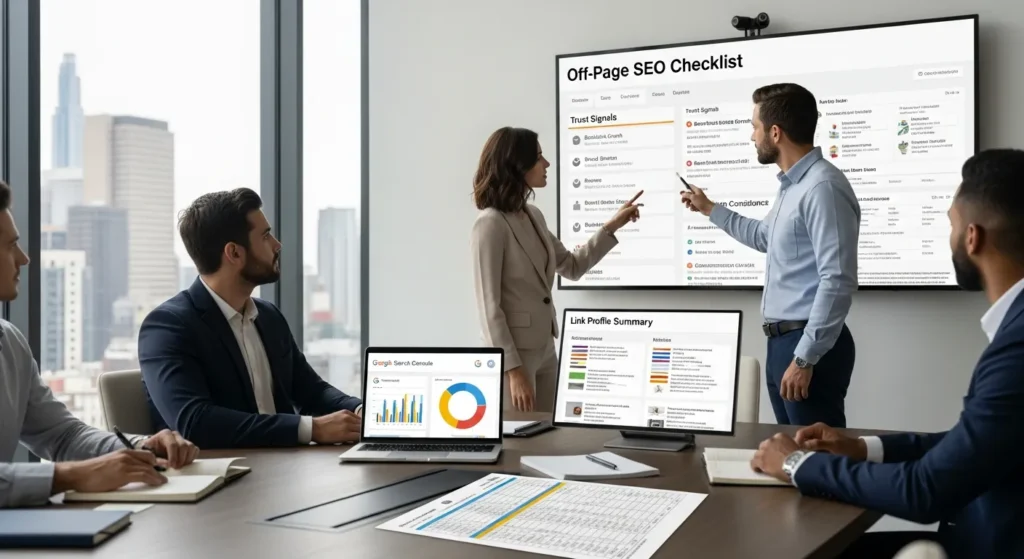
Off-page SEO checklist time. We have watched great websites sit invisible for months because nobody outside the site “vouched” for them. Then one legitimate mention from the right industry newsletter hit, and rankings moved like somebody finally flipped the power on.
Quick answer: off-page SEO in 2026 still comes down to trust signals you do not control, like links, reviews, citations, and brand mentions. Your job is to earn them with repeatable outreach, clean entity signals, and tight guardrails so you do not buy yourself a penalty.
Key Takeaways
- Use an off-page SEO checklist to build trust signals you don’t control—relevant backlinks, brand mentions, citations, and real reviews—because that’s what moves rankings in 2026.
- Set a baseline in Search Console, Analytics, and a link index before outreach so you can prove which links or mentions actually increase impressions, clicks, and conversions.
- Promote the right URLs (money pages, hubs, and linkable assets) and earn links through digital PR, partnerships, and resource pages where the editorial fit is obvious.
- Lock down entity trust first with consistent NAP, a clear About page, credible author bios, and accurate citations in the directories your customers actually use.
- Grow authority safely by prioritizing branded/natural anchor text, steady link velocity, and strict guardrails that avoid paid link schemes, spammy placements, and “guaranteed rankings” offers.
- Operationalize off-page SEO with a simple weekly workflow (prospecting, pitching, logging, and monthly link hygiene) so results compound instead of depending on someone’s memory.
Off-Page SEO Basics: What Counts, What Does Not, And Why It Matters
Off-page SEO means signals that happen off your website. Other sites mention you. People review you. Directories list you. Those signals shape how search engines judge authority and trust.
What counts in an off-page SEO checklist:
- Backlinks from relevant pages that real humans read
- Brand mentions (linked or unlinked) on credible sites
- Local and industry citations (your name, address, phone, categories)
- Reviews on platforms that matter in your niche
- Partnership signals (sponsors, associations, vendor pages)
What does not count, or tends to backfire:
- Paid link packs, private blog networks, and “DA 80” mystery sites
- Comment spam and forum profile links
- Exact-match anchor text repeated like a chant
- Random directory blasts with inconsistent business info
Here is the why. Google’s systems use links and mentions as a proxy for reputation. When a trusted site points to you, that site affects your perceived authority. When reviews mention your service quality, those reviews affect click and conversion behavior.
How Off-Page SEO Supports E-E-A-T And Rankings
E-E-A-T is not a single score you can “set.” It is a way to think about signals.
- Experience shows up when real customers talk about outcomes.
- Expertise shows up when experts cite your work, interview you, or invite you to contribute.
- Authoritativeness shows up when industry sites link to your guides or list you as a provider.
- Trust shows up when your business details match across platforms and your reviews look real.
Off-page SEO pushes these signals outward. A relevant backlink affects rankings because it passes context and credibility from one site to another.
Off-Page Vs. On-Page Vs. Technical SEO (So You Fix The Right Thing)
We see teams chase links when the real issue sits on the page or in the crawl path.
- Off-page SEO affects external reputation signals (links, mentions, reviews).
- On-page SEO affects meaning and relevance (titles, headings, internal links, content quality).
- Technical SEO affects access and performance (indexing, Core Web Vitals, HTTPS, mobile).
If Google cannot crawl or index your key pages, off-page work wastes money. If your page does not satisfy intent, links will not save it.
If you want the “inside the site” tune-up before you scale outreach, our WordPress SEO tune-up guide pairs well with this off-page checklist.
Set Your Baseline Before You Build Links
We treat off-page work like a controlled experiment. You need a baseline, or you will argue with yourself later.
Start with two questions:
- What pages matter most to revenue or leads?
- What signals already exist (links, mentions, reviews), and what is missing?
Minimum Tracking Stack: Google Search Console, Analytics, And A Link Index
You do not need ten tools. You need three lenses.
- Google Search Console: indexing status, top queries, pages gaining or losing clicks.
- Analytics (GA4 or your preferred tool): landing pages, conversions, assisted conversions.
- Link index (Ahrefs, Semrush, Majestic): new links, lost links, anchor text, referring domains.
Set a simple dashboard:
- Top 10 pages by conversions
- Top 10 pages by impressions (Search Console)
- Referring domains trend (last 90 days)
- Branded vs non-branded query trend
A clean baseline affects decision quality. You will know if a PR mention moves impressions, or if it just feels good.
Pick The Pages Worth Promoting (Money Pages, Hubs, And Linkable Assets)
Not every page deserves outreach.
We usually split targets into three groups:
- Money pages: service pages, category pages, product collections. These convert.
- Hubs: pillar pages that organize a topic and link to supporting pages.
- Linkable assets: guides, tools, calculators, templates, original data.
If you run a store, start with an ecommerce-specific plan. Our ecommerce SEO checklist helps you pick categories and collections that can rank and convert before you push link outreach.
Rule of thumb we use: a link should point to the page that best answers the query, not the page you wish would rank. A relevant page affects outreach success because editors can smell a forced link.
The Off-Page SEO Checklist (Step-By-Step)
Here is the off-page SEO checklist we run for clients when we want results without drama.
Brand And Entity Signals: Consistent NAP, About Pages, And Author Credibility
Your entity signals answer a basic question: “Are you a real business run by real people?”
Checklist:
- Use one official Name, Address, Phone format everywhere.
- Build a clear About page with team names, roles, and contact paths.
- Add author bios to blog posts that include credentials and real-world experience.
- Use Organization and Person schema where it fits.
If you serve a local area, lock this down first. Our local WordPress visibility checklist covers NAP consistency, Google Business Profile alignment, and the site-side pieces that support it.
Local And Industry Citations: Quality Directories Over Quantity
Citations still matter, mostly as a trust and verification layer.
Checklist:
- Claim the listings your customers actually use (Google Business Profile, Apple Business Connect, Bing Places, Yelp, niche directories).
- Match NAP, categories, hours, and URLs exactly.
- Add photos that look like your business, not stock.
- Monitor duplicates and suppress wrong listings.
A consistent citation affects trust because it reduces identity confusion across platforms.
Link Acquisition That Works In 2026: Digital PR, Partnerships, And Resource Links
The links that move rankings usually share three traits: relevance, editorial intent, and real audience.
Checklist:
- Pitch data, stories, or results, not “please add our link.”
- Partner with suppliers, associations, and platforms you already use.
- Look for “resources” pages that list vendors, tools, or guides.
- Offer a clean asset: a short quote, a graphic, or a step-by-step.
If you want a safer, repeatable link process, we keep a detailed SOP here: our safe link-earning process.
Content-Led Outreach: Guest Posts, Podcasts, And Expert Contributions (With Standards)
Guest posting still works when it looks like publishing, not trading links.
Checklist:
- Write for sites that match your niche and audience.
- Pitch one sharp angle with 3 bullet subpoints.
- Use a natural bio link, not keyword-stuffed anchors.
- Keep a spreadsheet of: pitch date, editor, URL, live date, link type.
Podcasts work the same way. A host affects your exposure because they introduce you to a warmed-up audience. A show notes link often follows.
If your content engine needs structure first, our content publishing checklist helps you produce pages people want to cite.
Reviews And Reputation: How To Earn Trust Without Violating Platform Policies
Reviews shape click behavior. They also shape trust signals for branded searches.
Checklist:
- Ask after a real milestone (delivery, project completion, support win).
- Make it easy with a direct link to the review platform.
- Respond to reviews with specifics, not copy-paste.
- Do not offer gifts or discounts if the platform bans incentives.
A thoughtful response affects conversions because it signals you will show up after the sale.
Social And Community Signals: Distribution, Not “Link Juice”
Social links often do not pass classic ranking value. Social still matters because it drives discovery.
Checklist:
- Post your asset where your buyers hang out (LinkedIn, Reddit, industry Slack, niche forums).
- Share a useful excerpt, not just a link.
- Answer questions and reference your guide when it truly fits.
Community attention affects mentions because people cite what they remember, and they remember what helped them at the right moment.
What To Avoid: Link Schemes, Cheap Gig Links, And Over-Optimized Anchors
We have cleaned up enough bad link profiles to say this plainly: cheap off-page SEO often costs more later.
If someone guarantees rankings, sells “guest posts on 500 sites,” or pushes exact-match anchors, treat it as a risk event.
Common Red Flags In Backlink Offers And Outreach Emails
Watch for these patterns:
- The sender cannot explain how they get placements.
- The site list looks unrelated to your niche.
- Every site has the same theme, same author photos, same “write for us” page.
- The offer includes exact-match anchor text as the default.
- The email pushes urgency or “limited spots.”
A bad neighborhood link affects trust because it associates your domain with spam networks.
Safe Anchor Text And Link Velocity Guidelines For Small Businesses
We keep this simple.
Anchor text:
- Use mostly branded anchors and plain URLs.
- Mix in natural phrases like “this guide” or your business name.
- Use keyword anchors rarely, and only when they fit the sentence.
Velocity:
- Grow links gradually. A steady pace beats spikes.
- Focus on referring domains, not raw link count.
If you are in legal, medical, finance, or insurance, add extra caution. Keep humans in the loop for outreach claims. Do not let an assistant tool invent credentials or results. The FTC’s Endorsement Guides spell out how review and endorsement disclosures should work, and it is worth following even when you think “we are too small to matter.”
Operationalize Off-Page SEO In WordPress (Without Making It A Science Project)
Off-page SEO fails when it lives in somebody’s head. It wins when it becomes a small weekly habit with a paper trail.
Workflow Map: Trigger, Inputs, Job, Outputs, Guardrails
Before you touch any tools, map the workflow like this:
- Trigger: You publish or refresh a page worth citing.
- Inputs: Prospect list, angle, proof points, author bio, suggested snippet.
- Job: Outreach, follow-ups, relationship building.
- Outputs: Live links, mentions, review count growth, referral traffic.
- Guardrails: Relevance, editorial standards, no paid link schemes, no sensitive data.
A workflow affects consistency because it removes guesswork.
Light Automation Ideas: Prospect Lists, Outreach Templates, And Link Logging
You do not need a complex stack.
- Use Google Alerts for brand mentions.
- Log prospects and links in Google Sheets.
- Create two outreach templates: one for resource pages, one for expert quotes.
- Add a WordPress form for “press inquiries” so editors can reach you.
We also recommend a monthly “link hygiene” check: verify that key links still exist and still point to the right URL.
If you publish time-sensitive updates, a newsroom approach can help you earn mentions faster. Our news-focused SEO checklist covers structure choices that make journalists and aggregators more likely to cite you.
Conclusion
Off-page SEO in 2026 rewards patience and proof. You earn authority when real sites and real customers back up your claims.
Start small: pick one page worth promoting, set a baseline, then run two outreach plays for 30 days. Keep your guardrails tight, log everything, and let the wins compound. If you want us to sanity-check your off-page plan against your WordPress setup, we do that kind of calm, practical work every week.
Off-Page SEO Checklist: Frequently Asked Questions
What is an off-page SEO checklist, and what counts in 2026?
An off-page SEO checklist focuses on trust signals that happen off your site, like relevant backlinks, brand mentions, reviews, and accurate citations (NAP). In 2026, what counts most is relevance and credibility—links and mentions from real sites with real audiences, not volume or “DA” claims.
How does off-page SEO support E-E-A-T and improve rankings?
Off-page SEO supports E-E-A-T by creating proof beyond your website. Experience shows up in customer reviews and outcomes, expertise in expert citations or interviews, authority in industry links and listings, and trust in consistent business details across platforms. These signals can lift visibility and click behavior over time.
Off-page SEO vs on-page vs technical SEO: which should I fix first?
Start with technical SEO if pages aren’t crawlable or indexable; off-page work won’t help if Google can’t access key URLs. Next, ensure on-page SEO satisfies search intent. Then scale off-page SEO. Links and mentions amplify reputation, but they rarely “save” weak pages or broken indexing.
What are the biggest red flags to avoid in an off-page SEO checklist?
Avoid paid link packs, private blog networks, comment/forum spam, directory blasts with inconsistent NAP, and repeated exact-match anchors. Also watch outreach offers that guarantee rankings, push urgency, or can’t explain placements. Risky links can damage trust by associating your domain with spam networks.
What is safe anchor text and link velocity for small businesses doing off-page SEO?
A safe approach is to use mostly branded anchors, plain URLs, and natural phrases like “this guide,” while using keyword anchors rarely and only when they fit. For velocity, grow links gradually—steady progress beats spikes. Prioritize new referring domains and editorial relevance over raw link count.
How long does off-page SEO take to work, and how should I track it?
Off-page SEO typically takes weeks to months because trust builds gradually and crawlers must reprocess signals. Track progress with a baseline: Google Search Console for impressions and clicks, GA4 for landing-page conversions, and a link index (Ahrefs/Semrush/Majestic) for new/lost links, anchors, and referring-domain trends.
Some of the links shared in this post are affiliate links. If you click on the link & make any purchase, we will receive an affiliate commission at no extra cost of you.
We improve our products and advertising by using Microsoft Clarity to see how you use our website. By using our site, you agree that we and Microsoft can collect and use this data. Our privacy policy has more details.
