
Local SEO for rehab centers is not just about rankings, it is about reaching someone who may have finally typed “help near me” at 2 a.m. with shaking hands. When we treat search results as a lifeline instead of a vanity metric, our strategy changes overnight. In this guide, we walk through clear, practical steps to help our treatment program show up where it matters most, for the people who live close enough to walk through our doors.
Key Takeaways
- Local SEO for rehab centers works best when you treat it as part of patient access, focusing on helping nearby people quickly find and contact your facility.
- Clarify your service area, target cities, and audiences (patients, families, and referral sources) so your local SEO strategy, keywords, and content match real search intent.
- Build a strong foundation with a fast, mobile-friendly, secure site and on-page local signals like city-specific title tags, headings, schema markup, and clear contact details.
- Optimize each Google Business Profile with accurate NAP, the right categories, detailed service descriptions, real photos, posts, and HIPAA-safe responses to reviews to dominate local map results.
- Support long-term local SEO for rehab centers by creating location-focused content, answering treatment and insurance FAQs, earning ethical reviews and local backlinks, and tracking calls, forms, and directions while staying compliant with healthcare privacy rules.
Why Local SEO Matters For Rehab Centers
Local SEO matters for rehab centers because most patients and families search close to home. They look for “drug rehab near me,” “alcohol treatment in [city],” or “detox center open now.” If we do not appear in those results, we lose real patients to centers that simply did a better job with local SEO.
Here is why this channel carries extra weight for treatment programs:
- Care tends to be local. Families prefer centers within a drive, especially for outpatient or family involvement.
- High intent searches. Local rehab queries often mean someone is ready to talk, today.
- Referral patterns. Doctors, therapists, and hospitals often search locally when they need a fast referral.
When we take local SEO for rehab centers seriously, we increase qualified calls, insurance verifications, and booked intakes rather than just traffic. It becomes part of our actual access to care strategy, not a side marketing project.
Clarifying Your Local SEO Goals And Target Audience
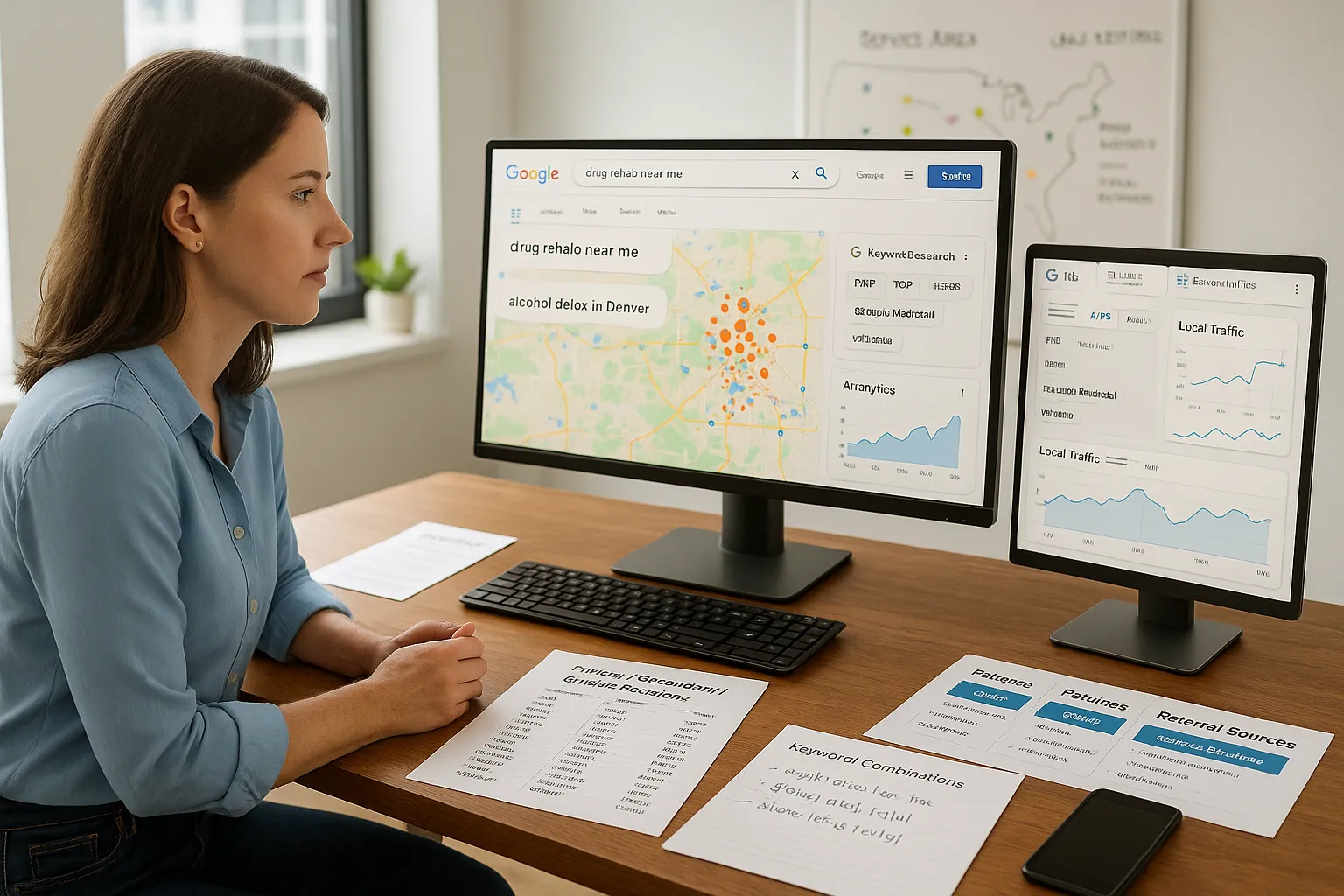
We get better results from local SEO for rehab centers when we decide exactly who we want to reach and what we want them to do.
Define Your Service Area And Priority Locations
Start by drawing a clear map of our service area. Do most intakes come from a 25 mile radius, the entire metro area, or statewide for residential treatment? Rank our cities and counties in order of importance.
We can group locations like this:
- Primary: city where the facility sits.
- Secondary: nearby cities that already send us patients.
- Growth: cities where we want more visibility.
This list will drive our keyword choices, content topics, and Google Business Profile setup.
Understand Search Intent: Patients, Families, And Referrals
Three groups search for rehab centers and each behaves differently:
- Patients look for immediate help, detox, or MAT. They search short phrases on mobile.
- Families compare programs, reviews, and insurance details. They read more pages.
- Referral sources such as physicians, therapists, and social workers scan for levels of care, admission criteria, and contact speed.
When we plan local SEO, we write and structure pages for each group so they can move fast from search result to first contact.
Choose The Right Local Keywords For Rehab Services
We want keywords that match our services, levels of care, and cities. A simple approach:
- Start with our services: “drug rehab,” “alcohol rehab,” “PHP,” “IOP,” “detox.”
- Combine with locations: “drug rehab in [city],” “alcohol detox [city],” “MAT clinic near me.”
- Add modifiers: “accepts Medicaid,” “Blue Cross,” “veterans,” “faith based.”
We can use Google Search Console or tools like Google Keyword Planner to see real phrases. Then we weave them into titles, headings, and content in a natural way.
Building A Strong Local SEO Foundation
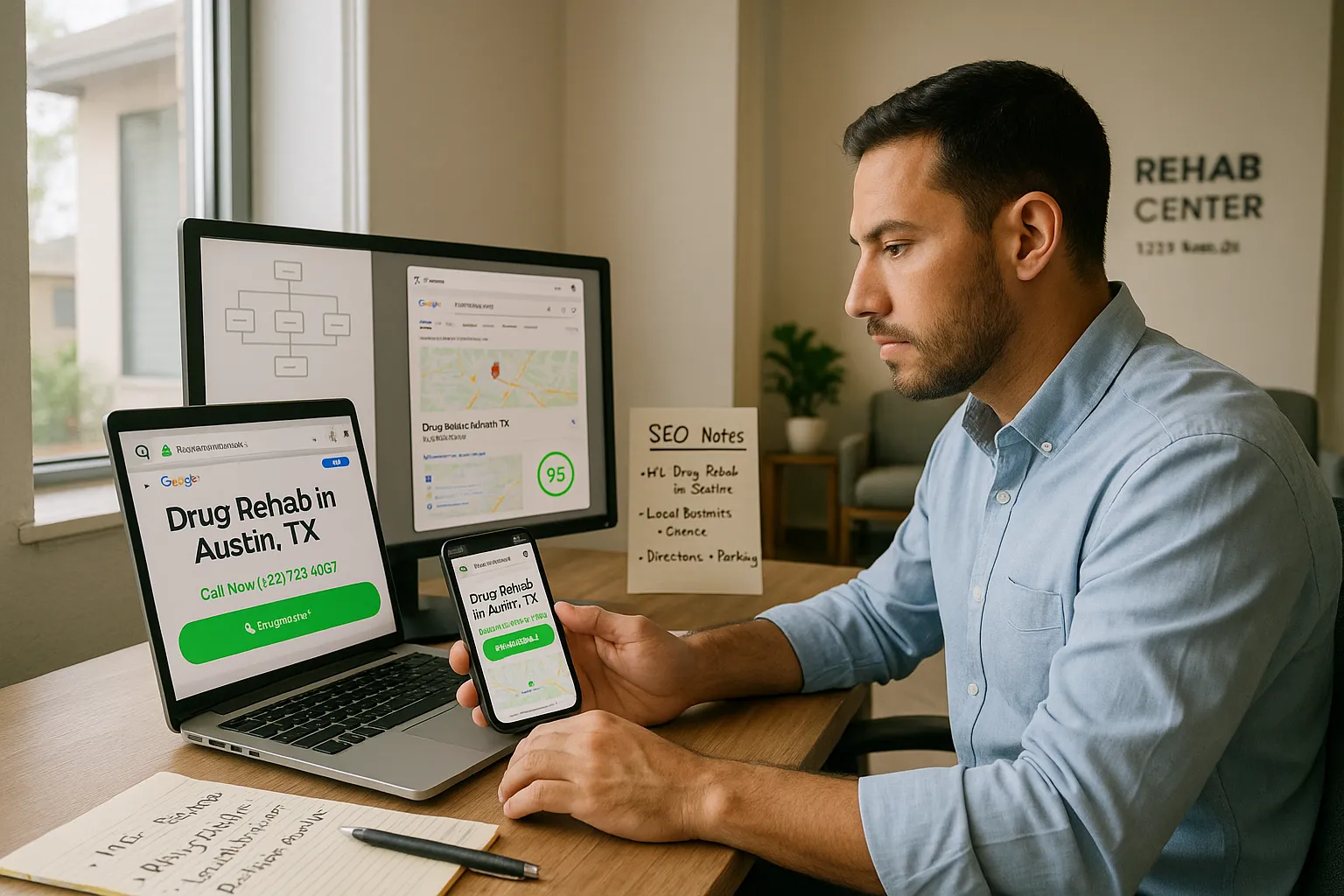
Before we chase new tactics, local SEO for rehab centers rests on a clean, trustworthy site. If the site feels slow or sketchy, families hit the back button.
Technical Essentials: Mobile, Speed, And Security
Most rehab related searches happen on phones. So we need pages that:
- Load in a few seconds on mobile data.
- Use responsive design so forms and phone numbers are easy to tap.
- Run over HTTPS with a valid SSL certificate.
We can check speed with PageSpeed Insights and fix large images, bloated scripts, or missing caching.
On-Page Basics: Titles, Headings, And Local Signals
Every service and location page should send clear local signals:
- Title tags that combine service and city: “Drug Rehab in Austin TX | [Brand].”
- H1 headings that repeat service and sometimes location.
- Local schema markup (Organization, LocalBusiness, or MedicalClinic) to help search engines connect our address, phone, and services.
Make our phone number clickable and place it near the top of mobile pages. Include directions, parking notes, and nearby landmarks to help both people and search engines understand exactly where we are.
Optimizing Google Business Profile For Rehab Visibility
Google Business Profile drives a big share of calls for local SEO for rehab centers. Many people never scroll past the map pack.
Set Up And Verify Your Profile Correctly
We claim or create a profile for each physical location, with the exact legal name used on signage. Then we:
- Pick the right main category, such as “Addiction treatment center.”
- Add a local phone number, not only a call center.
- Use the exact same address format as our website.
Verification by mail or phone confirms to Google that we exist at that address.
Optimize Categories, Services, And Business Description
We add relevant additional categories when they match real services, such as “Mental health clinic” or “Alcoholism treatment program.”
In the description, we explain:
- Levels of care.
- Populations served, like adults, teens, or veterans.
- Insurance types we accept.
We naturally weave in phrases like “drug rehab in [city]” to support local SEO for rehab centers without stuffing.
Use Photos, Posts, And Q&A To Build Trust
Fresh, real photos of the facility, staff (with consent), and non clinical spaces help calm fears. We keep stock photos to a minimum.
We can use Google Posts to share:
- New programs.
- Support groups.
- Education around overdose prevention or relapse warning signs.
In the Q&A section, we answer common questions directly inside Google, while also pointing people to call for clinical guidance.
Creating Location-Focused, Patient-Centered Content
Local SEO for rehab centers works best when our content speaks to real questions from our neighbors rather than generic addiction articles.
Develop Local Landing Pages For Each Location
Each physical facility deserves its own location page that includes:
- Address, phone, map, and directions.
- Photos of the actual building and surroundings.
- Description of services at that location only.
- Local references, such as nearby hospitals, bus lines, or highways.
If we serve different states or metro areas, we can also build city or region pages that summarize nearby programs and link to the exact facility pages.
Answer Common Questions About Treatment And Insurance
Families search things like “how long is rehab,” “do rehabs accept Medicaid,” or “can I keep my job during treatment.”
We create FAQ sections on service and location pages that answer these in plain language. We mention:
- Admission process.
- Typical length of stay by level of care.
- Insurance verification steps.
This not only supports local SEO for rehab centers but also reduces phone time spent on the same basic questions.
Leverage Blogs To Cover Local Issues And Resources
Our blog can cover local events, resources, and laws, such as:
- New harm reduction services in our county.
- Changes in state insurance coverage for SUD treatment.
- Guides to local support meetings or sober activities.
We can internally link from these posts to our main service pages and location pages. Over time, this web of content helps search engines see us as a local authority on treatment in our area.
If we want to go deeper on digital strategy, we can connect this content to a broader rehab marketing guide or a checklist such as an addiction treatment SEO checklist.
Building Local Authority With Reviews And Citations
Trust signals carry extra weight in healthcare. Local SEO for rehab centers rises or falls on how we handle reviews and business listings.
Encourage Ethical Review Generation And Management
We cannot pressure patients for reviews, and we must respect privacy laws. Still, we can:
- Let alumni know that feedback online helps others find care.
- Share a direct link where they can leave a review on Google.
- Train staff to respond to reviews in a HIPAA safe way.
Responses should thank the reviewer and stay general, without confirming anyone was a patient.
Ensure NAP Consistency Across Directories
NAP stands for Name, Address, Phone. We want the exact same details across:
- Our website.
- Google Business Profile.
- Major directories such as Apple Maps, Bing, Yelp, and Healthgrades.
Mismatched phone numbers or old addresses confuse both search engines and people. We fix old listings and keep a master document of our correct NAP.
Earn Local Backlinks From Healthcare And Community Orgs
Links from trusted local sites tell search engines that we are a real, credible center. We can:
- Share educational resources with local clinics or churches and request a link back.
- Sponsor community events tied to recovery.
- Contribute quotes to local news stories on substance use trends.
These links support local SEO for rehab centers far more than random directories or paid link schemes.
Tracking Local SEO Performance And Staying Compliant
Local SEO for rehab centers needs careful tracking, but we must stay inside privacy and advertising rules.
Measure Calls, Form Fills, And Direction Requests
Rankings matter, yet our main focus should be real contacts. We can:
- Track phone calls from Google Business Profile and local pages.
- Measure form submissions that lead to admissions or assessments.
- Watch “directions” clicks in Google Business Profile insights.
If we run campaigns alongside organic work, we might also tie this into a broader HIPAA compliant marketing setup.
Monitor Rankings, Reviews, And Competitors
We take a monthly snapshot of:
- Map pack rankings for our main city and service terms.
- Review counts and average ratings on Google.
- New or active competitors in our radius.
Short reviews from staff can record what changed, such as a new detox unit opening nearby or a major ad push from a competitor.
Balance SEO Efforts With Healthcare Privacy And Ethics
Addiction treatment marketing sits under strict rules. We stay aligned with:
- HIPAA guidance from the U.S. Department of Health and Human Services.
- SAMHSA guidance on confidentiality and promotion of SUD services.
- Any state level rules on treatment advertising.
We avoid sharing identifiable stories, even if patients volunteer them in reviews. We keep language honest about outcomes and avoid claims that promise cures.
Conclusion
Local SEO for rehab centers works when we treat it like part of patient access, not a side project. We make it easy for nearby people to find us, understand what we offer, and feel safe enough to reach out.
If we focus on clean local signals, strong Google Business Profiles, real patient centered content, and ethical review habits, our rankings tend to follow. Small, steady improvements each month are usually enough to outwork competitors who only touch their listings once a year.
Next steps for our team:
- Pick our top 5 city plus service keywords and update titles today.
- Clean up our Google Business Profile and add fresh photos.
- Draft or refresh at least one strong location page with FAQs.
From there, we can layer in content, reviews, and local links until search engines and our community both see us as a trusted place to start recovery.
Sources
- “Substance Use and Mental Health Statistics,” Substance Abuse and Mental Health Services Administration (SAMHSA), 2023, https://www.samhsa.gov/data/
- “Health Information Privacy (HIPAA),” U.S. Department of Health & Human Services, current page last reviewed 2023, https://www.hhs.gov/hipaa/index.html
- “How Search Works,” Google, accessed 2025, https://www.google.com/search/howsearchworks/
Local SEO for Rehab Centers: Frequently Asked Questions
What is local SEO for rehab centers and why does it matter?
Local SEO for rehab centers is the process of improving your visibility in location-based searches like “drug rehab near me” or “alcohol treatment in [city].” It matters because most patients, families, and referral sources search close to home, so better rankings directly translate into more qualified calls and booked intakes.
How do I choose the right local keywords for my rehab center?
Start with your core services, such as drug rehab, alcohol rehab, detox, IOP, or PHP. Combine them with city or region names and modifiers like “near me,” “accepts Medicaid,” or specific insurance plans. Use tools like Google Keyword Planner and Search Console to confirm real search phrases.
What are the most important steps to improve local SEO for rehab centers?
Prioritize a fast, mobile-friendly, secure website; locally optimized title tags and H1s; accurate Google Business Profiles for each location; consistent NAP across directories; and strong location pages with directions, services, and FAQs. Add ethical review generation and local backlinks from healthcare and community organizations to strengthen authority.
How can rehab centers ethically get more Google reviews without violating privacy laws?
Rehab centers can inform alumni that online feedback helps others find care, then share a simple link to leave a review. Staff should never pressure or incentivize reviews and must respond in a HIPAA-safe way—thanking reviewers in general terms without confirming anyone’s patient status or discussing clinical details.
How long does it take for local SEO efforts to work for a rehab center?
Most rehab centers see early signs of improvement—more map views, calls, and direction requests—within 2–3 months if they consistently optimize their website and Google Business Profile. Strong, competitive results typically take 6–12 months, especially in dense metro areas where many treatment programs are targeting the same local keywords.
Some of the links shared in this post are affiliate links. If you click on the link & make any purchase, we will receive an affiliate commission at no extra cost of you.
