

Local SEO for law firms can feel strangely opaque until a rival across town starts outranking us overnight and our intake team hears, “You were hard to find on Google.“ That small sting is usually the moment we realize local search is not a side project. It is the front door.
In this guide, we walk through a practical local SEO plan built for real law firms, not marketers with endless time. We will focus on clear steps that help us appear in local search, earn trust fast, and turn nearby searches into new signed clients.
Key Takeaways
- Local SEO for law firms starts with clear targeting of ideal practice areas, client types, and service locations so Google understands exactly who you serve and where.
- A fully optimized Google Business Profile—with accurate NAP, focused categories, service descriptions, and real photos—is essential to earning visibility in the local map pack.
- Building a fast, mobile-friendly, and conversion-focused website with dedicated practice-area and location pages turns local search visibility into calls, consults, and signed clients.
- Creating localized content that references real courts, neighborhoods, and scenarios positions your firm as the obvious nearby choice and naturally strengthens local SEO for law firms.
- Steady growth in reviews, consistent citations, local backlinks, and simple quarterly tracking of rankings and intakes makes local SEO for law firms a repeatable habit instead of a one-time project.
Understanding How Local SEO Works For Law Firms
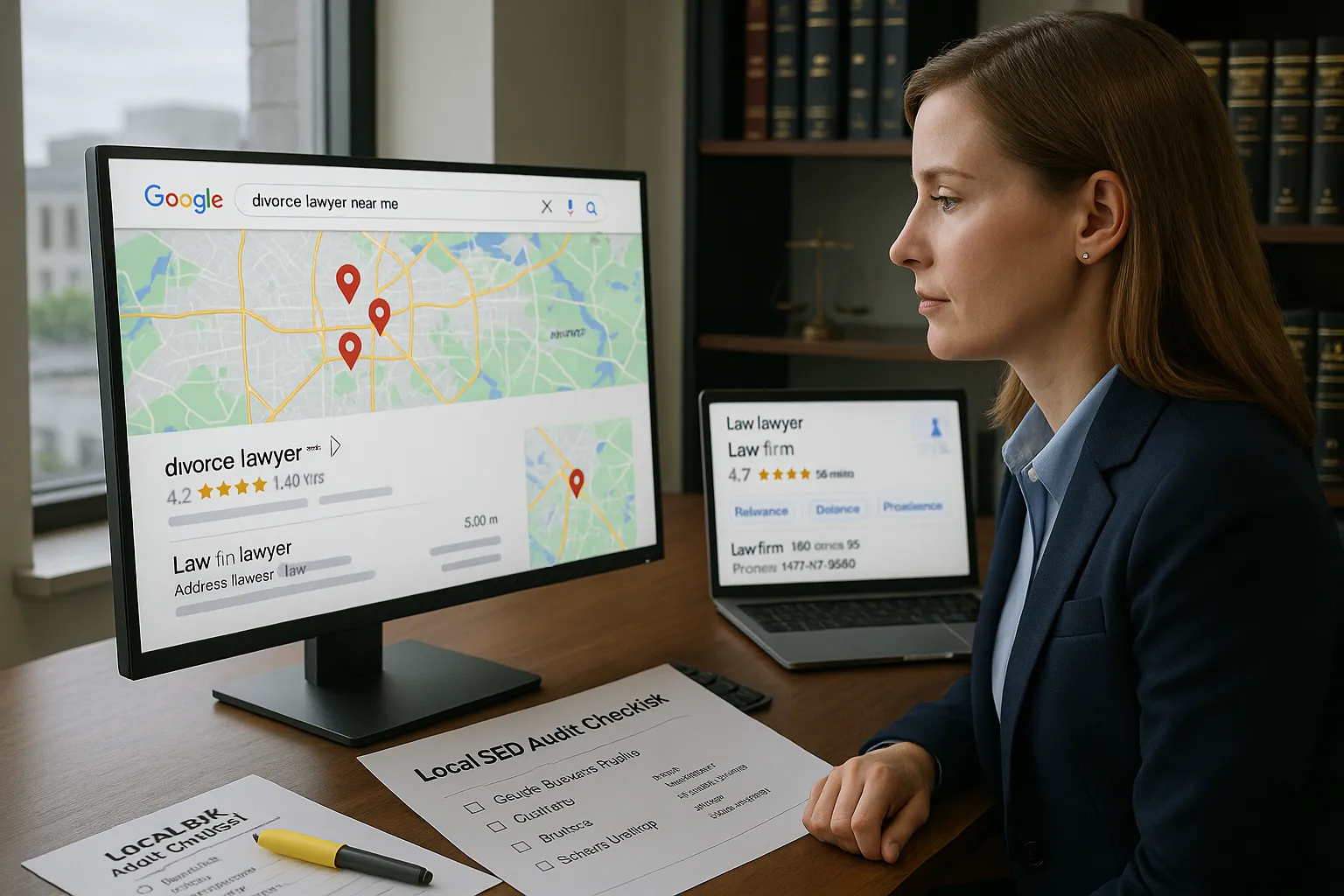
Local SEO for law firms focuses on one question first: when someone nearby searches “divorce lawyer near me“ or “DUI attorney [city]“, do we show up in the map pack and organic results. That matters more than ranking nationwide for broad terms.
Local rankings rely on three main factors. Google calls them relevance, distance, and prominence. Relevance is how closely our profile and pages match the search. Distance is how close our office is to the searcher. Prominence is our overall presence online, including reviews, links, and mentions.
Here is the key. For most firms, we can influence all three through better Google Business Profile work, stronger on-page signals, and consistent citations. National SEO can feel abstract. Local SEO turns into very specific moves that win within a few miles of our office.
If we already have a site and some presence, we often start with a quick technical review. A simple local SEO audit of our site and profiles reveals crawl issues, duplicate listings, and missing schema. A structured local SEO checklist helps keep changes organized instead of random.
Identifying Your Ideal Local Client And Service Areas

Before we tune anything, we need to decide who we want to show up for and where. Many firms skip this and end up sending mixed signals to Google and to potential clients.
Start with three lists:
- Core practice areas we actually want more of this year. Maybe family law, criminal defense, estate planning, or personal injury.
- Geographic targets such as cities, neighborhoods, and suburbs we can realistically serve.
- Client types and situations such as “first-time DUI with professional license at risk“ or “parents seeking joint custody.”
We then map each practice area to specific locations and intent phrases. Think “estate planning attorney in Plano“ or “car accident lawyer downtown Chicago.“ This helps our site and our Google Business Profile send clear signals.
When we know our ideal client and service areas, local SEO for law firms stops feeling like guesswork. Every page, photo, and review request now supports that same story about who we serve and where we are the right choice.
Optimizing Your Google Business Profile For Maximum Visibility
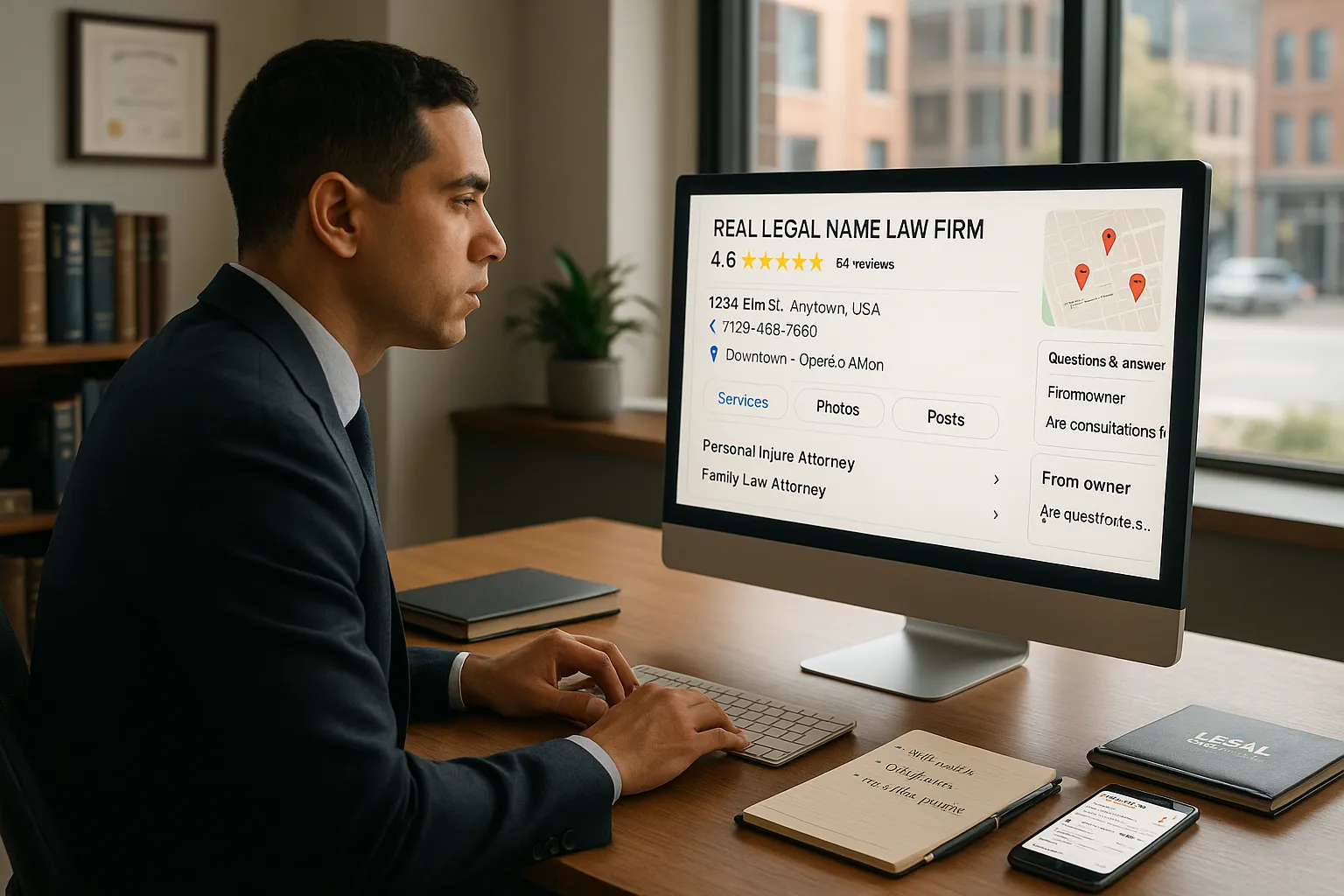
Our Google Business Profile often decides whether we even make the map pack. It is not a set-and-forget directory listing. It is a living local asset.
Here is how we improve it:
- Business name: Use our real legal name only. Avoid stuffing keywords. Google may suspend listings that push it.
- Categories: Pick a main category such as “Personal injury attorney“ or “Family law attorney“ plus a few related ones.
- Address and hours: Make sure NAP (name, address, phone) matches our website and legal documents. Add accurate hours.
- Services and description: List concrete services and write a clear, client-focused description that includes our target locations in natural language.
- Photos and videos: Upload real office photos, team photos, and short clips. Profiles with photos get more clicks according to Google’s own guidance.
We also post short updates about recent wins, FAQs, or community involvement. Regular activity helps local SEO for law firms because it signals that we are active and responsive, not a forgotten listing from five years ago.
Building A High-Converting, Local-Friendly Law Firm Website
Once our profile and map presence draw attention, our website must close the loop. A strong local SEO strategy loses money if the site confuses visitors or loads slowly on a phone.
Start with structure. Create clear practice area pages such as “Criminal Defense Lawyer in Dallas“ or “Estate Planning Attorney in Miami“ that target one service and one region. Add supporting FAQ sections that answer real questions clients ask in consults.
Speed and mobile design matter. Google reports that people are more likely to leave sites that take longer than a few seconds to load on mobile. We run a basic performance test and fix large images, cluttered scripts, and slow hosting.
Trust signals belong above the fold. Show phone numbers, office location, bar memberships, ratings, and a short proof-driven line about the type of work we do. Scatter clear calls to action: call, book a consult, or send a short intake form.
Internal links between practice pages, location pages, and our blog help both users and crawlers find their way through the site.
Creating Localized Content That Ranks And Builds Trust
Content is where local SEO for law firms moves from “we exist” to “we are the obvious choice nearby.“ We want content that answers local questions faster and clearer than anyone else.
Ideas that tend to perform well:
- Guides like “What happens after a car accident in Phoenix“ that reference local roads, courts, and insurers.
- Explainers about how local judges or counties handle certain matters.
- Checklists tailored to our city, such as “Steps after a first DUI in Orlando.”
We weave in local entities: courthouse names, nearby hospitals, law enforcement agencies, and neighborhoods. This helps search engines connect our pages with our region.
Think about search intent. Someone in crisis does not want theory. They want next steps, plain language, and reassurance that we have seen this before. Content that meets that need tends to earn natural links and shares, which boosts local visibility.
On our own site, we can build supporting hubs like a local SEO checklist page or resources about digital marketing for attorneys that cross-link related topics.
Earning Reviews, Citations, And Local Links For Authority
Local SEO for law firms does not work without social proof. Reviews, citations, and links act as public votes of confidence.
Reviews. After a positive outcome, we ask clients if they feel comfortable leaving a review. We provide a direct Google review link in a short follow up email or text. Harvard Business Review has reported that star ratings and review volume influence trust almost instantly for most consumers.
Citations. We claim and clean up listings on Avvo, Justia, FindLaw, Yelp, the state bar directory, and local chambers of commerce. The goal is consistent NAP across the web.
Local links. These include mentions from local news outlets, charities we support, schools, or neighborhood blogs. Sponsoring a youth sports team, teaching a free clinic at the library, or commenting on local legal developments can all lead to natural mentions.
We track reviews and citations over time. A steady flow of new, honest reviews matters more than a single perfect rating that never changes.
Tracking Local SEO Results And Prioritizing Next Steps
Without tracking, we just guess. Local SEO for law firms needs a light but consistent measurement habit.
We start with basics:
- Google Search Console for queries, impressions, and click through rate for our local pages.
- Google Business Profile Insights for calls, directions, and profile views.
- Simple rank tracking for a short list of target phrases like “family lawyer [city].”
Then we connect the numbers to real cases. Intake staff ask “How did you find us“ and log answers. We match that with online data to see which channels truly drive signed clients.
Every quarter, we choose one or two focus areas. Maybe we push reviews, clean up citations, or add one new local content hub. This keeps efforts realistic for a busy practice.
As our site grows, we can add advanced steps like structured data for legal services or a full seo audit for technical health, but the basics usually deliver the largest early gains.
Conclusion
Local SEO for law firms works best when we treat it like a steady habit, not a one-time project. We claim and strengthen our presence where nearby clients already look, we answer their questions with clarity, and we back that up with real-world reputation.
If we do nothing else this month, we can pick one step from each area. Clean up our Google Business Profile. Fix the most obvious issues on our main practice page. Publish one deeply helpful local guide. Ask three happy clients for honest reviews.
Those simple moves compound. Six months from now, our map rankings, traffic, and call volume will tell us a clear story. And we will know that nearby people who need our help have a much easier path to finding us when it matters most.
Sources
- Improve your local ranking on Google. Google Business Profile Help, Google. Accessed 2025. https://support.google.com/business/answer/7091
- Think with Google: Why mobile speed matters. Google Marketing Platform, 2017. https://www.thinkwithgoogle.com/marketing-strategies/app-and-mobile/mobile-page-speed-new-industry-benchmarks/
- How Online Reviews Influence Sales. Harvard Business Review, 2018. https://hbr.org/2018/02/how-online-reviews-influence-sales
Local SEO for Law Firms: Frequently Asked Questions
What is local SEO for law firms and why does it matter?
Local SEO for law firms is the process of helping your practice appear in Google’s local map pack and nearby organic results for searches like “divorce lawyer near me.” It matters because most potential clients search locally and often choose from the firms they see first on Google.
How do I optimize my Google Business Profile for local SEO for law firms?
Focus on accurate NAP details, the correct primary category (e.g., “Personal injury attorney”), clear hours, and a client-focused description that mentions your key locations naturally. Add real photos, list services, and post short updates. Consistent activity signals you’re active and improves visibility in local search.
What type of content works best for local SEO for law firms?
Localized, practical content performs best. Examples include guides like “What happens after a car accident in Phoenix,” city-specific checklists for DUIs, and explainers on how local courts handle cases. Referencing local roads, courts, hospitals, and neighborhoods helps Google associate your firm with a specific region.
How can law firms earn more reviews, citations, and local links?
Ask happy clients for Google reviews via a direct link in a brief follow-up email or text. Claim and standardize listings on Avvo, Justia, FindLaw, Yelp, and bar directories. Build local links by sponsoring community events, supporting charities, teaching clinics, or contributing commentary to local news outlets.
How long does local SEO for law firms take to show results?
Most law firms start seeing early movement in local rankings and calls within 2–3 months if they consistently improve profiles, site content, and reviews. More competitive practice areas or cities may take 6–12 months to achieve strong map pack visibility, especially if you’re starting from a weak online presence.
What are the most important local SEO ranking factors for law firms?
For law firms, Google emphasizes relevance, distance, and prominence. Relevance comes from well-optimized pages and profiles that match specific legal queries. Distance reflects how close your office is to the searcher. Prominence is built through reviews, consistent citations, local links, and strong overall online authority.
Some of the links shared in this post are affiliate links. If you click on the link & make any purchase, we will receive an affiliate commission at no extra cost of you.
