
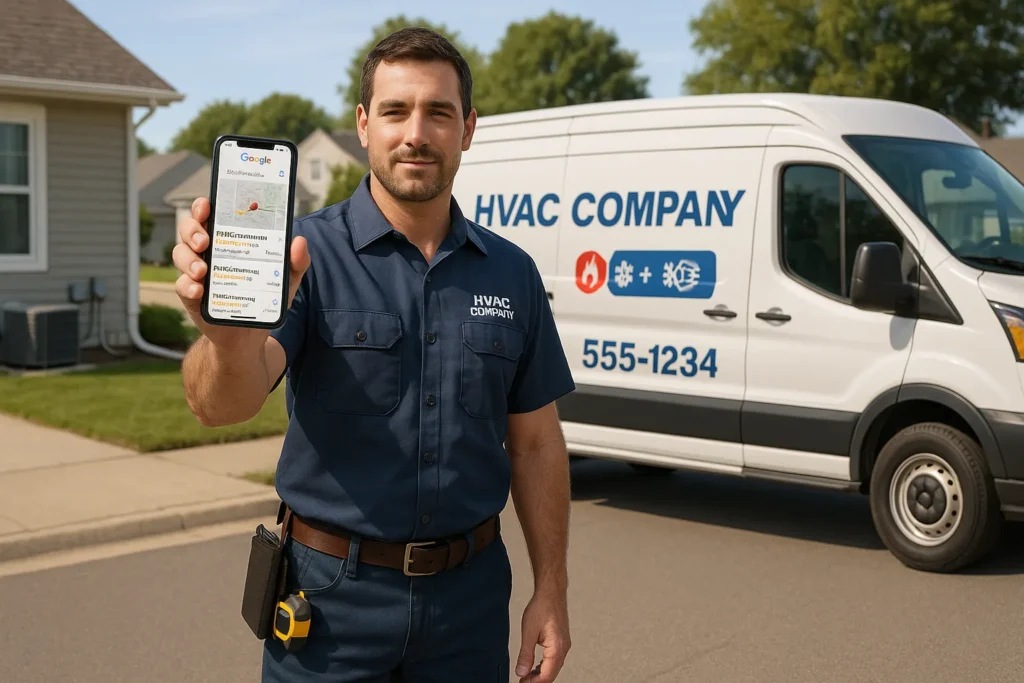
Local SEO for HVAC is often the difference between a silent phone and a day packed with service calls from homeowners right in our city. Picture this: two HVAC companies side by side, same trucks, same tools, same skills, but one dominates Google and the other barely shows. The gap is not luck. It is local search strategy. In this guide, we walk through what actually moves the needle for HVAC companies that want more local customers from Google without wasting time or ad spend.
Key Takeaways
- Local SEO for HVAC turns urgent “near me” searches into steady service calls by boosting your visibility in Google’s map pack and organic results.
- Optimizing your Google Business Profile with accurate NAP details, targeted HVAC categories, service areas, photos, and posts is the foundation of strong local rankings.
- A localized HVAC website with city- and service-specific pages, clear on-page SEO, fast mobile performance, and strong calls to action converts searchers into booked jobs.
- Reviews, consistent citations, and local backlinks build the authority and trust signals Google uses to rank HVAC companies in local search results.
- Tracking rankings, calls, and booked jobs—and refining your local SEO for HVAC over time or with professional help—keeps you ahead of nearby competitors.
Why Local SEO Matters For HVAC Businesses
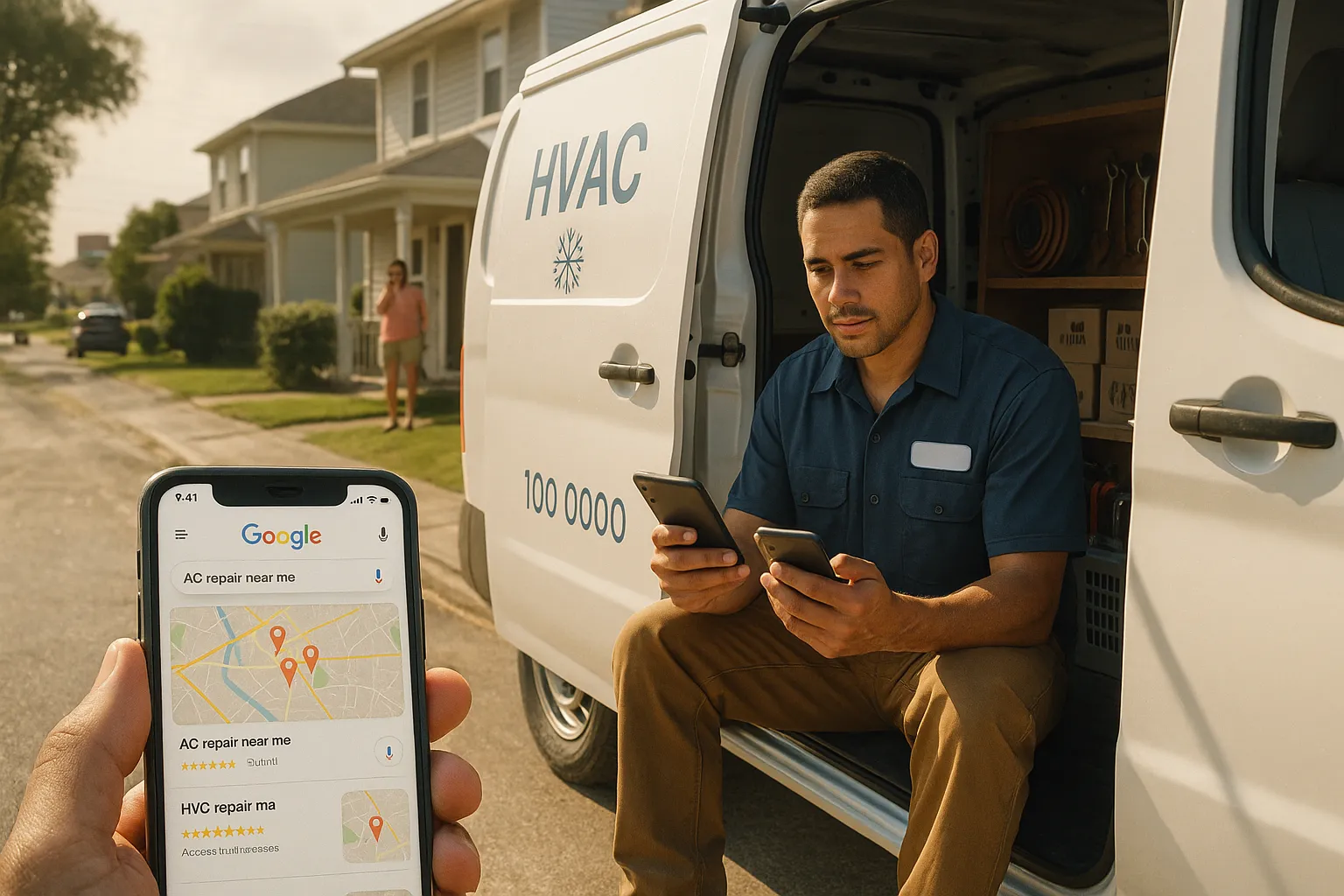
Local search is where urgent HVAC decisions happen. When an AC dies in August or a furnace quits in January, people grab their phone and type “AC repair near me” or “furnace repair + city name.” Whoever shows near the top in the map and organic results gets the call.
Local SEO for HVAC helps us:
- Show up when people search by city, neighborhood, or “near me”
- Turn Google into a steady source of calls and form leads
- Lower dependence on paid ads and lead resellers
Google’s own data shows that nearly half of all searches carry local intent, and a large share of those lead to a visit or call within a day (Think With Google, Google LLC, 2016, https://www.thinkwithgoogle.com). HVAC is even more local than most trades, since customers usually pick someone within 30 to 45 minutes of their home.
If we do not take local SEO seriously, those calls do not disappear. They go to the competitor down the street who invested in their presence in search.
How Google Decides Which HVAC Companies Show Up Locally
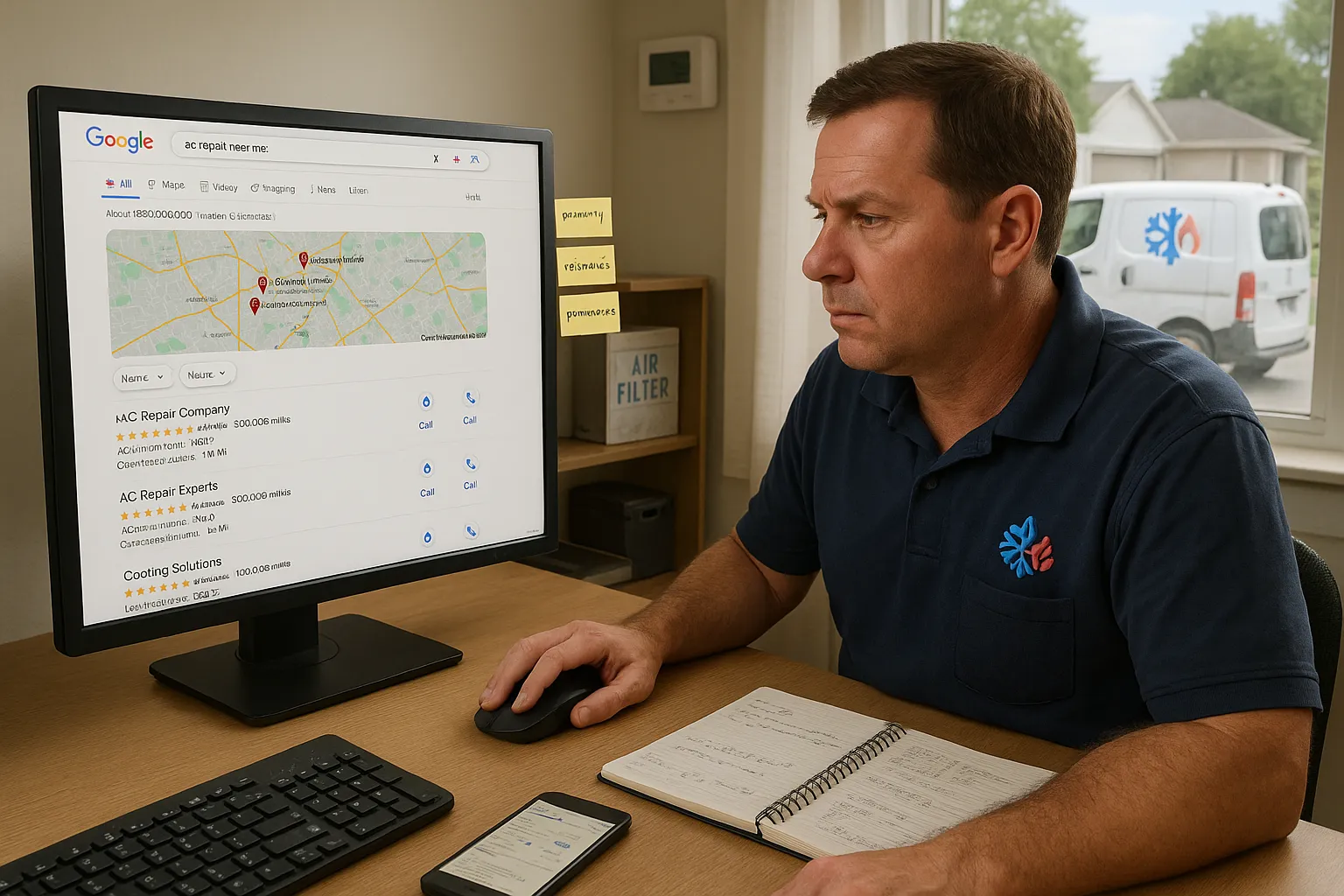
Google tries to answer one basic question: “Which HVAC company is the best choice for this person, in this place, right now?” It does that by weighing three main factors.
The Role Of Proximity, Relevance, And Prominence
Google’s local algorithm looks at:
- Proximity: How close our business is to the searcher or the city center.
- Relevance: How closely our profile, website, and content match what they typed.
- Prominence: How well known and trusted we appear across the web.
Moz’s Local Search Ranking Factors report lists these three as the main drivers for local pack rankings in trades like HVAC (Local Search Ranking Factors, Moz, 2023, https://moz.com). We cannot move our office next to every customer, but we can send strong signals of relevance and prominence.
Key Local Search Result Types For HVAC
When someone searches for HVAC services, we usually see three result types:
- Local Pack: The three map results with stars, hours, and “Call” buttons. This is prime real estate.
- Local Finder: The expanded list when someone clicks “More businesses.”
- Organic Results: Regular blue links below the map, often local HVAC pages, directories, and review sites.
We want visibility in all three. Our Google Business Profile drives the map results. Our website and off-site mentions support both the map and organic results.
Optimize Your Google Business Profile For HVAC Searches
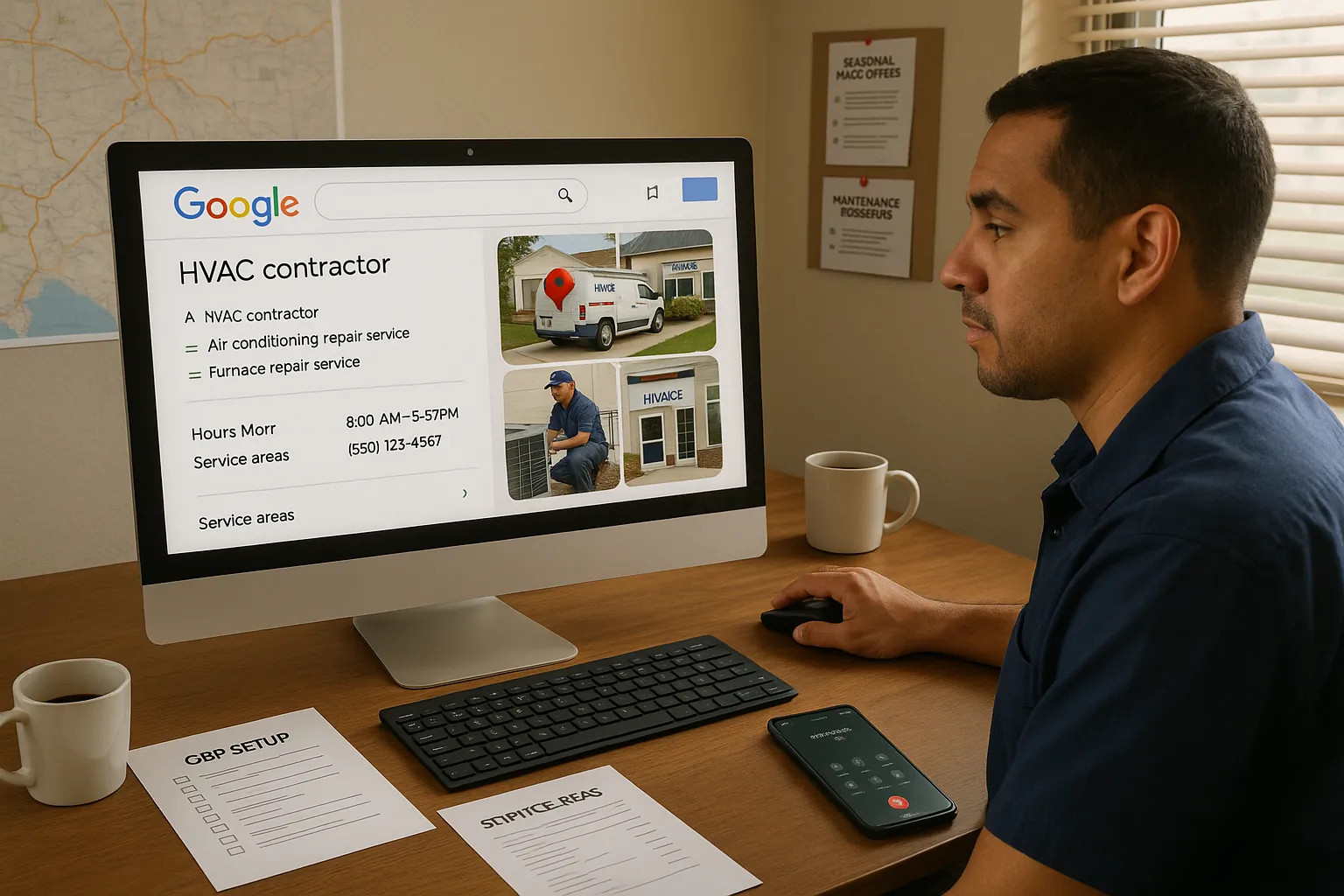
Our Google Business Profile, or GBP, often becomes the first impression people see. Google also uses it as one of the strongest local signals for HVAC searches.
Set Up And Verify Your Profile Correctly
We start with a complete, accurate profile:
- Exact business name as used offline
- Local phone number with area code
- Consistent address or service area
- Correct business hours, including emergency service if we offer it
We verify the profile through Google’s process so our information appears on Maps and Search. Google explains the full process in its Business Profile Help Center (Business Profile verification, Google LLC, 2024, https://support.google.com/business).
Choose Categories, Services, And Service Areas Strategically
Our primary category should match the main service, such as “HVAC contractor” or “Air conditioning repair service.” We can add supporting categories like “Furnace repair service” or “Air duct cleaning” if they are real services.
In the Services section, we list specific jobs: AC installation, heat pump repair, ductless mini split, seasonal tune up, and so on. We add short, natural descriptions that mention the city or suburb.
Service areas should reflect where we actually send trucks. We resist the urge to add 40 cities if we only work in 8.
Use Photos, Descriptions, And Posts To Stand Out
We upload real photos of our trucks, techs, office, and jobsites. People want to see who might walk into their home.
In the business description, we write a short story about who we serve and what makes us different, using phrases like “AC repair in Phoenix” or “furnace installation in Plano” without stuffing.
Regular GBP posts help us stay active. We can share seasonal offers, maintenance reminders, and safety tips, each with a call to call or visit our site. A post can also point readers to a deeper resource, like a local HVAC checklist or a guide to HVAC marketing.
Build A Localized HVAC Website That Ranks
Our website supports everything we do in local search. It backs up what Google sees in our profile and answers the questions customers bring to search.
Research High-Intent HVAC Local Keywords
We start with the phrases buyers use when they are close to calling:
- “AC repair near me”
- “furnace repair [city]”
- “HVAC contractor [suburb]”
- “heat pump installation [county]”
We use tools like Google Keyword Planner or Semrush to check search volume and variations. Then we match pages on our site to these phrases, without forcing the wording.
Create City- And Service-Specific Pages
Instead of one vague “services” page, we build:
- Individual pages for AC repair, furnace repair, installation, maintenance, and ductless
- Local pages for major cities or neighborhoods we serve
Each page should feel written for that place and service, not just a template swap of city names. We can mention local landmarks, common system types, or weather issues.
Optimize On-Page Elements For Local Signals
Every important page deserves:
- A clear title tag mentioning the service and city
- A meta description that encourages clicks and mentions our brand
- A strong H1 heading that lines up with the search intent
- Natural mentions of city names in the copy, headings, and image alt text
We also link internally to related content, such as a local SEO checklist or HVAC website tips where that helps readers.
Mobile Speed, Calls To Action, And Conversion Basics
Most HVAC searches now happen on phones. Our pages should load quickly, with clear “Call now” and “Schedule” buttons that are easy to tap.
We keep forms short. Name, phone, email, zip, and a short message usually work well. Every service page should make it obvious what to do next.
Earn Local Authority With Reviews, Citations, And Links
Once our profile and site look solid, we need proof that real people trust us. That is where reviews, citations, and links come in.
Generate, Respond To, And Showcase Reviews
Reviews are one of the strongest local ranking signals for HVAC, and they influence click and call rates. A BrightLocal study found that 98 percent of people read online reviews for local businesses, and 49 percent trust them as much as personal recommendations (Local Consumer Review Survey, BrightLocal, 2023, https://www.brightlocal.com).
We ask happy customers for Google reviews right after a job, through text or email with a direct link. We respond to every review, good or bad, in a calm, professional voice that mentions our city and service when it feels natural.
We then feature those reviews on our website, especially on city and service pages, using badges or text snippets.
Build Consistent Local Citations
Citations are mentions of our business name, address, and phone on sites like Yelp, Angi, HomeAdvisor, and local chamber directories. Consistency matters. Our NAP details should match across:
- Google Business Profile
- Website
- Major directories
- Trade associations and local groups
We correct old or duplicate listings so Google sees one clear version of our business.
Earn Local Links And Partnerships
Local links tell Google that people in our area know and trust us. Strong sources for HVAC include:
- Sponsoring youth sports teams or community events
- Partnering with local builders, property managers, or realtors
- Writing seasonal heating and cooling tips for local news sites or blogs
Each of these can lead to a natural link back to our site, which boosts both local and organic presence.
Track, Test, And Refine Your Local SEO Strategy
Local SEO for HVAC is not a one-time project. Search behavior, competitors, and even Google’s rules change over time. We win by tracking what matters and adjusting.
Monitor Rankings, Traffic, And Calls
We can track:
- Map rankings for priority keywords in our city
- Organic positions for service and city pages
- Organic traffic in Google Analytics
- Calls and form fills from organic and local results
Local rank tracking tools let us see how we appear from different zip codes instead of just one location.
Use Call Tracking And CRM Data To Measure Quality
Not every lead is equal. Call tracking numbers can show which pages, keywords, and locations produce real booked jobs.
We connect our phone system and CRM so we can see:
- Which city pages produce high-value installations
- Which searches bring in more price shoppers than buyers
Over time, we shape our content and service areas around the leads that turn into revenue.
When To Consider Professional Local SEO Help
We can go far with this playbook on our own. At some point, it may make sense to bring in a local SEO partner that knows home services and HVAC.
Good partners usually:
- Share clear reports in plain language
- Focus on revenue and booked jobs, not vanity metrics
- Have a track record with trades like plumbing, HVAC, and electrical
If we feel stuck on page two, or if competitors always outrank us even though strong service, that is usually the signal to ask for outside help.
Conclusion
Local SEO for HVAC comes down to a simple idea: show Google and real people that we are the best choice for this area and these services. When we treat our Google Business Profile like a storefront, our website like a trusted advisor, and reviews like word of mouth, search starts to work with us instead of against us.
If we pick a few steps from this guide and apply them each week, we can build steady visibility and a healthier pipeline of local customers. The phone does not ring by accident. It rings because we did the quiet, patient work that earns trust with both Google and our neighbors.
Frequently Asked Questions About Local SEO for HVAC Companies
What is local SEO for HVAC and why does it matter for my business?
Local SEO for HVAC is the process of optimizing your Google Business Profile, website, and online reputation so you show up when people search things like “AC repair near me.” It matters because most HVAC customers choose a company within 30–45 minutes and call whoever appears near the top.
How do I optimize my Google Business Profile for HVAC local SEO?
Use your exact business name, a local phone number, and accurate address or service areas. Choose the right primary category, list real services, upload photos of your team and trucks, write a localized description, and post offers or tips regularly. Then actively collect and respond to Google reviews.
What kind of pages should an HVAC website have for better local SEO?
Create separate service pages for AC repair, furnace repair, installation, maintenance, and ductless systems, plus city or neighborhood pages for each key area you serve. Each page should include localized content, a clear title tag and H1, internal links, and strong calls to call or schedule service.
How important are reviews and citations for HVAC local SEO rankings?
Reviews and citations are major trust and ranking signals. A steady flow of Google reviews improves click-through and call rates, while consistent name, address, and phone details across sites like Yelp, Angi, and local directories help Google verify your business and support map and organic visibility.
How long does local SEO for HVAC take to show results?
Most HVAC companies see early improvements in 2–3 months once they optimize their Google Business Profile, clean up citations, and improve key service pages. Strong, lasting results typically take 6–12 months of ongoing work: earning reviews, building local links, posting content, and refining based on tracked calls and rankings.
Some of the links shared in this post are affiliate links. If you click on the link & make any purchase, we will receive an affiliate commission at no extra cost of you.
