
The last time we spoke with a small dental practice owner who checked their own name on Google, they paused and said, “Why is a clinic across town showing above us?“ That moment feels a bit like spotting a cavity on your own x‑ray. It looks small, but you know it only gets worse if you ignore it. In this guide, we walk through local SEO for dentist practices in plain language, so more nearby patients find you first instead of the clinic down the street and help you to attract more patients.
Key Takeaways
- Local SEO for dentist practices helps your clinic appear in the Google map pack for high-intent searches like “dentist near me,” driving more visits and calls from nearby patients.
- A fully verified and optimized Google Business Profile with accurate categories, services, photos, and updates is the foundation of strong local visibility for any dental office.
- A clear, localized website structure—with dedicated service and location pages, optimized titles and headers, and natural use of city or suburb keywords—improves both patient experience and search rankings.
- Consistent NAP details across directories, plus listings on key dental and local sites and a few quality local backlinks, strengthen your practice’s authority in local search.
- Building a steady stream of honest Google reviews and responding professionally to all feedback boosts local SEO for dentist searches and significantly increases patient trust.
- Tracking calls, direction requests, form fills, and keyword rankings with simple tools like GBP Insights, GA4, and Search Console turns local SEO into an ongoing, measurable growth channel.
Why Local SEO Matters So Much For Dental Practices
Understanding How Patients Search for Dentists Near Them
Most patients search on a phone with a simple phrase like “dentist near me“ or “emergency dentist open now.“ Google then shows a map pack and a handful of local results.
Here is why this matters. If we do not appear in that map pack, a large share of potential patients never even see our name. According to Google, 76% of people who search for something nearby visit a business within a day, and 28% of those searches result in a purchase or visit.
So strong local SEO for dentist practices helps us:
- Show up in the map pack for “dentist near me“ searches.
- Appear when people search by neighborhood, suburb, or city.
- Reach higher intent patients, like “same day crown“ or “dental implants near me.”
When we match how people actually search, we stop relying on luck and start treating search as a predictable channel for new patients.
Local SEO vs. Traditional Advertising for Dentists
Local SEO and traditional advertising play different roles.
Print, direct mail, and radio push our message out to people who might not be ready for treatment. Local SEO catches people already looking for a dentist, often with a specific need and timeline.
Local SEO for dentist practices tends to:
- Cost less per new patient over time than repeated mailers.
- Drive more trackable actions: calls, form fills, online bookings.
- Keep working after we stop paying for individual clicks.
Traditional ads still help with awareness. But if we have to choose where to invest first, ranking where people actively search usually pays off faster and more clearly.
Set Up And Optimize Your Google Business Profile
Claiming and Verifying Your Listing
Our Google Business Profile (GBP) is the foundation of local SEO for dentist offices.
Steps:
- Go to google.com/business and sign in with a practice email.
- Search for our clinic name. Claim it if it exists or create a new listing.
- Enter our exact practice name, address, and phone.
- Verify by postcard, phone, or video, following Google’s prompts.
Without a verified GBP, we are very unlikely to appear in the map pack, no matter how strong our website is.
Choosing the Right Categories, Services, and Attributes
Next, we tune our profile so Google understands what we do.
- Primary category: “Dentist” or “Dental clinic.”
- Additional categories: “Cosmetic dentist,“ “Pediatric dentist,“ “Emergency dental service,“ when they truly fit.
- Add services such as “dental implants,“ “Invisalign,“ “root canal treatment,“ “teeth whitening,“ and “dental veneers.”
- Turn on attributes like wheelchair access, evening hours, or language options.
Clear, honest categories and services help us rank for more specific local searches and improve local SEO for dentist searches in our city.
Photos, Business Description, and Posting Updates
Patients look at photos before they call.
We should upload:
- Exterior shots so people recognize the building.
- Reception, waiting room, and treatment rooms.
- Team headshots and candid photos with consent.
Then we write a short description that mentions our city, suburbs we serve, and focus areas (such as family dentistry or implants).
We can also post weekly updates about offers, new equipment, or educational tips. These fresh signals tell Google our practice is active and help our profile stand out against other local dentists.
Build A Localized, Patient-Friendly Dental Website
Essential Pages Every Dental Website Should Have
Local SEO for dentist practices improves when our site answers patient questions clearly.
At minimum, we want:
- Home page with city, suburb, and main services.
- About page with dentist bios, photos, and credentials.
- Services hub plus separate pages for high value services.
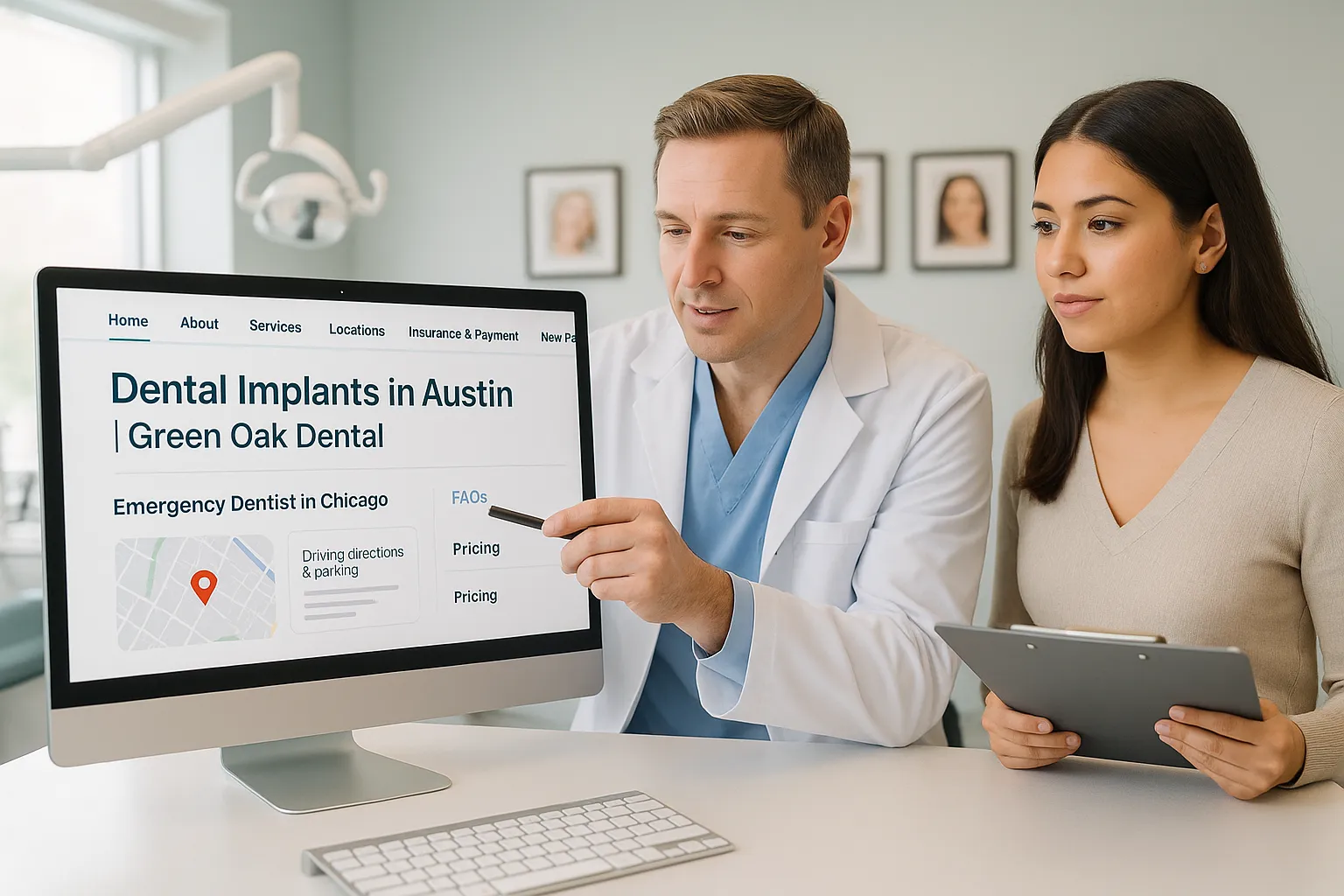
- Location / contact page with map, directions, parking, and hours.
- Insurance and payment options page.
- New patient info and forms.
That structure helps both patients and search engines understand our practice.
On-Page SEO Basics: Titles, Meta Descriptions, and Headers
Each page needs a clear focus.
- Title tags: Include main service and city, such as “Dental Implants in Austin | Green Oak Dental.”
- Meta descriptions: Write short, persuasive copy that mentions the service and city and invites clicks.
- Headers (H1, H2): Use natural phrases like “Emergency Dentist in Chicago“ where they fit.
Creating Location and Service Pages That Rank
If we serve multiple suburbs, we can create separate location pages that:
- Mention the suburb and nearby landmarks.
- Include driving directions and parking notes.
- Highlight which services patients from that area choose most.
Each major service should have its own page. That gives us room to explain benefits, process, pricing ranges, and FAQs.
Clear, honest copy on these pages improves local SEO for dentist clinics and helps patients feel confident enough to contact us.
Use Local Keywords That Real Patients Type Into Google
Finding Local Keywords for Dental Services
We want to mirror patient language.
Simple ways to gather ideas:
- Start typing “dentist” plus our city into Google and check autocomplete.
- Scroll to “related searches” at the bottom of search results.
- Use tools such as Google Keyword Planner or Ubersuggest.
Common patterns:
- “dentist near me”
- “family dentist [city]”
- “[city] Invisalign“
- “emergency dentist [suburb]”
We then group these by intent, such as general checkups, cosmetic treatments, and urgent care.
Incorporating Keywords Naturally Into Your Content
We avoid stuffing keywords.
Instead, we:
- Use the main phrase in the page title and first paragraph.
- Sprinkle variations in headers and body copy.
- Add city or suburb names where they sound natural.
For example, a paragraph might start with “We help nervous patients in Phoenix get gentle, same day emergency dental care.“ That line covers service, emotion, and local SEO for dentist searches without sounding forced.
Strengthen Your Local Presence With Citations And Links
Consistent NAP (Name, Address, Phone) Across the Web
Citations are mentions of our practice name, address, and phone on other sites.
We keep them consistent on:
- Google Business Profile
- Facebook and Instagram
- Apple Maps and Bing Places
- Our website footer and contact page
Any mismatch confuses search engines. A consistent NAP supports local SEO for dentist offices and reduces ranking issues.
Dental Directories and Local Business Listings That Matter
We claim and update our listings on:
- Healthgrades
- Zocdoc
- WebMD’s physician directory
- Local Chamber of Commerce
- Yelp and Nextdoor
We add links to our site, correct hours, and descriptions that match our main message.
Local Backlinks From Community and Professional Partners
Quality backlinks still matter.
Some ideas that fit a dental practice:
- Sponsor a youth sports team and ask for a website link.
- Write a short oral health article for a local news site.
- Swap links with nearby specialists, like oral surgeons or orthodontists.
Each relevant local link tells Google that our clinic is a trusted part of the community.
Generate And Manage Online Reviews Ethically
How Reviews Impact Local Rankings and Patient Trust
Reviews affect both rankings and human trust.
Google has stated that review count and score influence local results for nearby searches. A BrightLocal survey in 2024 found that 87% of consumers read Google reviews for local businesses before a visit.
So a strong review profile:
- Boosts local SEO for dentist searches.
- Builds confidence for anxious or price sensitive patients.
- Sets us apart from nearby clinics with weak or old reviews.
Simple Systems To Request Reviews From Happy Patients
We make reviews part of our routine.
Ideas:
- Train front desk staff to ask for a review when a patient compliments the visit.
- Send a short follow up text with a direct link to our Google review page.
- Place a small card at checkout with a QR code.
We never offer cash or gifts in exchange for reviews, since that can break platform rules and local advertising laws.
Responding Professionally to Positive and Negative Reviews
We answer every review.
For positive reviews, we thank the patient, mention the specific treatment if appropriate, and invite them back.
For negative reviews, we:
- Stay calm and polite.
- Apologize when something went wrong.
- Move details offline and invite the person to call the office.
Future patients read these threads. A calm, human response can turn a rough moment into proof that we care about service and safety.
Track Your Local SEO Results And Make Ongoing Improvements
Key Metrics: Calls, Directions, Form Fills, and Rankings
We cannot improve what we never measure.
At a basic level, we track:
- Calls and direction requests from Google Business Profile.
- Contact form submissions and online bookings from the website.
- Rankings for our priority keywords in our city.
We review these monthly, then adjust pages or content that are underperforming.
Simple Tools Dentists Can Use To Monitor Performance
We do not need complex software.
Start with:
- Google Business Profile Insights for calls, views, and direction requests.
- Google Analytics 4 for traffic and conversions.
- Google Search Console for queries and average positions.
If we want more detail, tools such as Semrush or Ahrefs help track rankings for “dentist near me“ and other target phrases.
Local SEO for dentist practices is not a one time project. We treat it like oral hygiene, with regular checks and small improvements so our practice stays visible and healthy.
Conclusion
Local SEO for dentist clinics rewards consistency more than quick tricks. When we keep our Google Business Profile accurate, our website clear, our citations clean, and our reviews growing, we build a real advantage over other practices in our area.
If we pick one step this week, start by claiming and improving our Google Business Profile. Then move to website pages, citations, and reviews over the next few months. Small, steady effort turns local search from a mystery into a reliable source of new patients.
Sources
- “How digital is changing the way we work“ (section: “Think with Google: Local search“), Google, accessed 2024, https://www.thinkwithgoogle.com
- “Local Consumer Review Survey 2024,“ BrightLocal, 2024, https://www.brightlocal.com/research/local-consumer-review-survey/
Local SEO for Dentists: Frequently Asked Questions
What is local SEO for dentist practices and why is it so important?
Local SEO for dentist practices is the process of improving how your clinic appears in local search results and the Google Map Pack. It matters because most patients search “dentist near me” on their phones, and a large share visit a nearby practice within 24 hours when they find a good match.
How do I optimize my Google Business Profile for local SEO as a dentist?
Start by claiming and verifying your Google Business Profile, then add accurate name, address, and phone details. Choose a primary category like “Dentist,” list real services, upload quality photos, write a location‑specific description, enable relevant attributes, and post updates regularly to signal activity and improve visibility.
What pages should a dental website include to support local SEO for dentist clinics?
A strong dental website should have a city‑focused home page, an About page with dentist bios, a services hub plus key service pages, a dedicated location/contact page with map and directions, insurance and payment details, and new patient information. This structure helps search engines and patients quickly understand your practice.
How can dentists ethically get more Google reviews to boost local SEO?
Dentists can grow reviews by asking happy patients in person, sending follow‑up texts with a direct review link, and placing QR codes at checkout. Always avoid offering money or gifts. Respond to every review—positive and negative—to show professionalism and build trust with future patients reading your profile.
How long does local SEO for dentist offices usually take to show results?
Most dental practices start seeing early improvements in calls, directions, and rankings within 3–6 months of consistent local SEO work. Timeframes vary by competition, website quality, and review strength. Treat it like ongoing oral hygiene—regular updates to your profile, content, and citations keep results growing over time.
