
Local SEO for banks is the quiet reason one branch lobby is packed while another, a mile away, stays oddly calm. We see it every week when search results decide which institution feels “local” and which feels invisible. In this guide, we walk through how banks like ours can turn that invisible line on Google Maps into a steady stream of real customers.
Key Takeaways
- Local SEO for banks makes each branch visible when nearby customers search intent-driven phrases like “bank near me” or “business checking in [city],” turning online discovery into in-person visits and account openings.
- Optimizing Google Business Profiles for every branch and ATM cluster—with accurate NAP, categories, hours, photos, and UTM-tracked URLs—is the foundation of effective local SEO for banks.
- Dedicated, location-optimized branch landing pages that include local copy, services, staff, and schema markup act as digital storefronts and significantly improve local search relevance and conversions.
- Reviews, local backlinks, and community-focused content build trust signals that help your bank outrank competitors and prove it is embedded in the local community, not just present in it.
- A branch-by-branch reporting dashboard that tracks profile actions, organic traffic, conversions, and review health ensures local SEO for banks becomes a predictable, scalable acquisition channel rather than a one-off campaign.
Why Local SEO Matters For Modern Banks
Local SEO for banks controls how often nearby customers find us at the exact moment they need a checking account, car loan, or mortgage pre‑approval. People rarely search for “bank” in the abstract. They type “bank near me,” “business checking in [city],” or “24 hour ATM in [neighborhood].” If we do not appear in those results, our branch might as well be on another planet.
Here is why this matters. Search is now the first touchpoint for many financial decisions. A strong presence in local results means:
- More calls from high‑intent prospects.
- More direction requests straight into our branch.
- More website visits from people close enough to open an account in person.
Local SEO for banks also reinforces brand trust. When users see consistent branch information, reviews, photos, and useful local content, they feel safer choosing us over a faceless national competitor. In a regulated industry where trust and compliance matter, that local footprint in search results becomes part of our reputation.
For banks that still rely mainly on signage, mailers, or drive‑by traffic, local SEO is the missing piece that links digital behavior to branch growth.
Defining Local SEO In A Banking Context
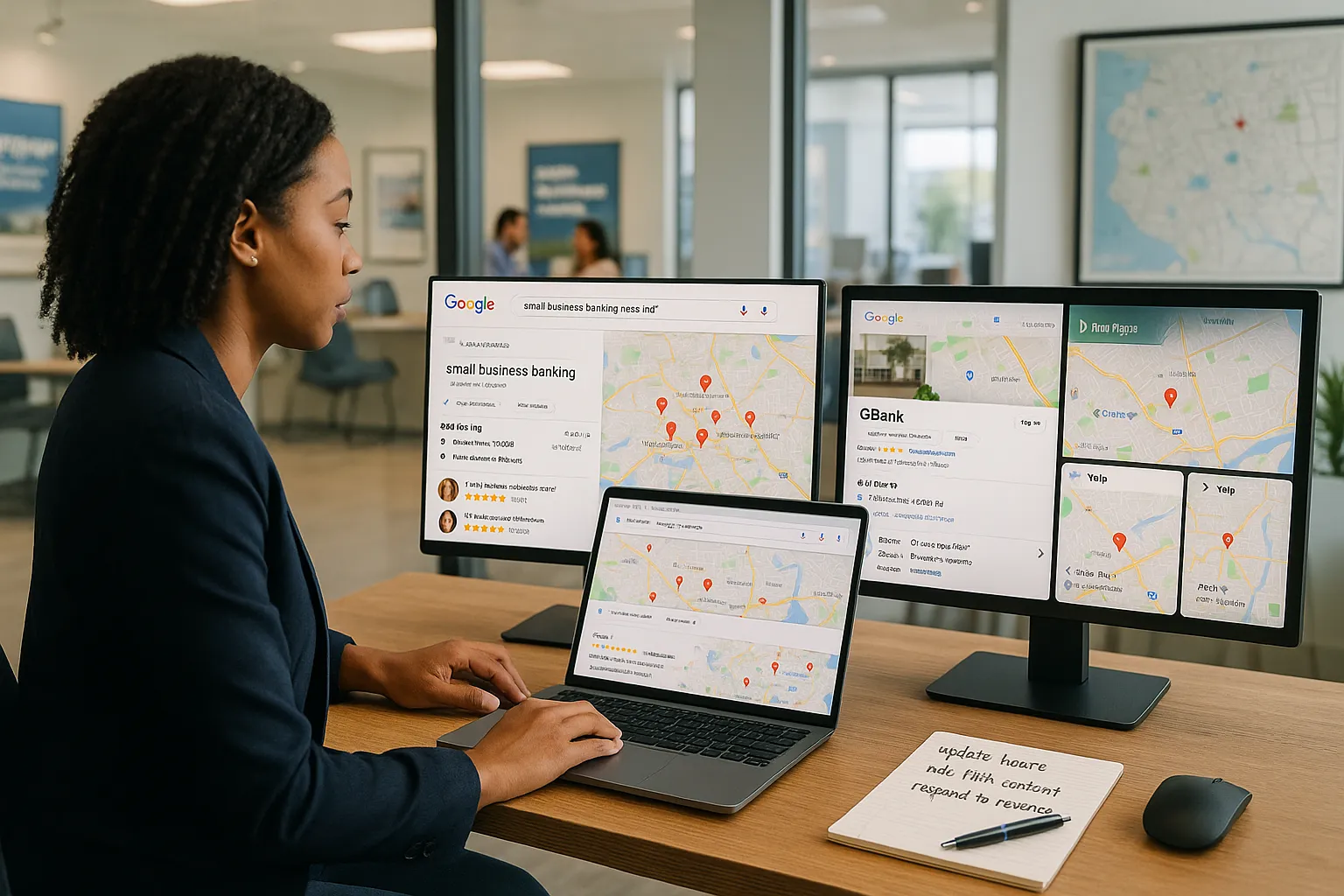
Local SEO for banks is the practice of making each branch easy to find in search for people in that specific service area. It touches our Google Business Profiles, branch landing pages, reviews, local citations, and even how we talk about communities on our site.
In a banking context, local SEO focuses on three big goals:
- Accuracy. Every branch must show the correct name, address, phone, hours, and services across Google, Apple Maps, Bing, Yelp, and data aggregators.
- Proximity and relevance. Our content and profiles need to reflect the neighborhoods, cities, and use cases people search, like “small business banking in [district]” or “FHA lender in [county].”
- Trust signals. Reviews, ratings, response quality, and third‑party mentions convince customers that our local team is responsive and reliable.
This is not only about more traffic. Done well, local SEO for banks raises the share of traffic that actually converts into accounts and loans, because we meet users when they are already comparing local options. If we pair this work with clear product pages and simple online applications, search turns into a consistent acquisition engine.
If we want a deeper foundation on technical SEO topics, we can connect this with content that covers items like schema markup and crawl control, such as a dedicated guide on structured data for financial services at /blog/financial-services-schema-guide.
Optimizing Your Google Business Profile For Each Branch
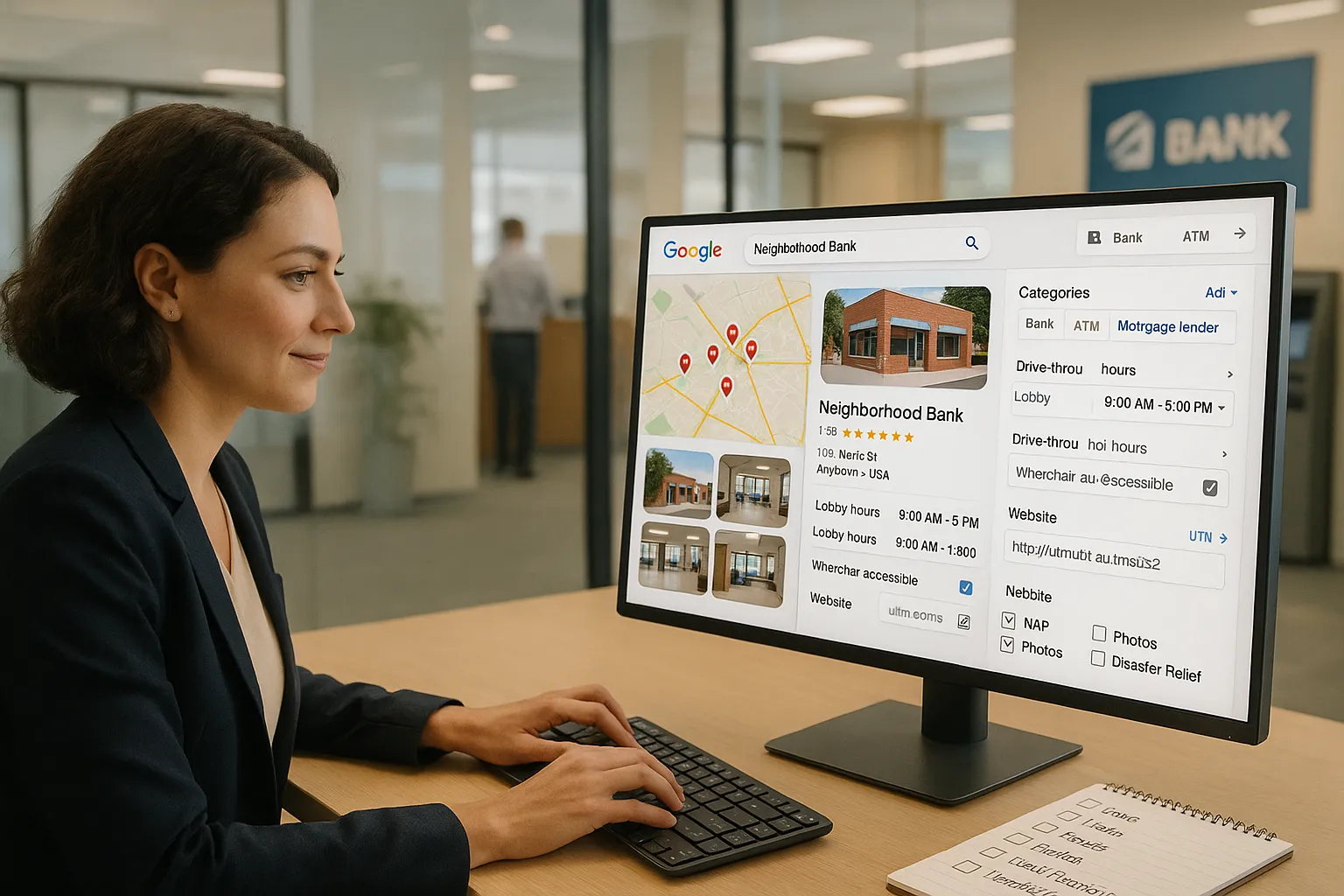
Local SEO for banks starts with accurate and rich Google Business Profiles, one for each physical branch and ATM cluster. These profiles feed Google Maps, the local pack, and many branded searches.
We focus on a repeatable checklist for every branch:
- Exact NAP data. Use the official branch name, precise address formatting, and a call tracking number only if it still forwards to the local branch line.
- Categories. Choose “Bank,” “ATM,” and relevant specialty categories like “Mortgage lender” only where they reflect real services.
- Hours and attributes. Maintain lobby, drive‑through, and holiday hours. Add attributes such as wheelchair access or language support if they apply.
- Photos and videos. Upload exterior shots, lobby interiors, teller windows, and local events. Real images help users feel the branch before they visit.
- UTM‑tagged links. Point the website URL to that branch’s landing page with UTM tags so we can track traffic and conversions.
We also use the Posts feature for time‑bound content. Examples include local promotions, financial education events, or disaster relief support for the area. Consistent activity and strong engagement around each profile signal that our bank is active in that neighborhood, which supports local SEO for banks more broadly.
Building Location-Optimized Bank Landing Pages
Each branch deserves its own location page that connects search intent to real services. Local SEO for banks works best when these pages feel like digital storefronts, not thin contact cards.
Here is our baseline structure for a strong branch page:
- H1 with city and branch name, such as “Downtown Austin Branch – [Bank Name].”
- Short intro that covers what this branch is known for, like business banking or home lending.
- Address, map embed, phone, and hours above the fold.
- List of services with internal links to product pages, for example small business checking, HELOCs, and CDs.
- Staff photos or short bios to humanize the branch.
- Unique local content, like nearby landmarks, parking tips, and community partners.
We weave local SEO for banks into the copy by mentioning neighborhoods, cities, and local search phrases naturally. Instead of stuffing “bank near me” everywhere, we speak in normal language that includes phrases customers actually use.
On the technical side, we add LocalBusiness or Bank schema markup, clean URL structures such as /branches/city-branch-name, and internal links from city or state hub pages. A broader article on internal linking strategies at /blog/internal-linking-for-seo can support this work and help us connect these pages in a thoughtful way.
Earning Trust With Reviews, Local Links, And Community Content
Search visibility gets us seen. Reviews, local links, and content convince people to choose us. Local SEO for banks depends heavily on these trust signals.
Reviews
We encourage real, honest reviews from customers after meaningful moments, like closing on a mortgage or opening a first business account. We avoid incentives that could cause compliance problems and instead focus on easy review links and clear asks. Our team responds to every review, good or bad, with empathy and clear next steps.
Local links and mentions
Strong local SEO for banks usually correlates with connections to chambers of commerce, local media, schools, and nonprofits. When we sponsor a charity run or host a money‑management workshop, we request a link from the event page or partner site back to the relevant branch or community page. Over time, these mentions tell search engines that our bank is part of the local fabric, not an isolated building.
Community content
We publish guides that solve local financial questions. Examples include “How first‑time homebuyers in [city] can prepare for property taxes” or “Grants and funding sources for small businesses in [county].” Each piece supports local SEO for banks and gives our branch staff a helpful handout to share.
We can support this with a broader content hub, such as a “local business banking resources” page at /blog/local-business-banking-resources, which ties together our educational pieces and branch pages.
Tracking Local SEO Performance And Avoiding Common Pitfalls
We cannot improve local SEO for banks if we do not measure it branch by branch. That means building a simple dashboard that blends Google Business Profile data, Google Analytics, and CRM or account opening stats.
We watch:
- Impressions and clicks from branch profiles.
- Directions, calls, and website clicks by location.
- Organic traffic and conversions on each branch page.
- Review volume, star rating, and response times.
From there, we test changes. New photos, updated descriptions, revised title tags, and fresh local content can lift results over a few months.
A few pitfalls often slow banks down:
- Centralized phone numbers that route every call through a single center, which weakens local relevance.
- Duplicate or outdated branch listings that confuse users and search engines.
- Thin, copy‑pasted branch pages with no unique local content.
- Ignored reviews, which send a clear signal that customer care is not a focus.
Local SEO for banks rewards consistency more than clever tricks. Small, steady updates across all branches beat one‑time campaigns that no one maintains.
Conclusion
Local SEO for banks is not abstract theory. It is the set of habits that decide whether someone nearby walks into our branch or a competitor’s. When we treat each branch as a distinct local presence, with accurate listings, rich landing pages, reviews, and real community content, search begins to mirror our physical footprint.
If we start with one pilot market, prove the lift in calls and account openings, then roll those steps across our network, local search stops feeling like a mystery and starts feeling like a predictable acquisition channel.
Sources
- “How Organic Search Influences Consumer Purchase Behavior,” Think with Google, Google, 2017, https://www.thinkwithgoogle.com.
- “Improve Your Local Ranking on Google,” Google Business Profile Help, Google, updated 2023, https://support.google.com/business.
Local SEO for Banks: Frequently Asked Questions
What is local SEO for banks and why does it matter?
Local SEO for banks is the practice of making each branch easy to find in search results for people in its service area. It matters because most users search phrases like “bank near me” or “business checking in [city],” and strong visibility leads to more calls, directions, and in‑branch account openings.
How do Google Business Profiles impact local SEO for banks?
Google Business Profiles are the backbone of local SEO for banks. Each branch needs its own accurate profile with correct NAP details, hours, photos, categories, and UTM‑tagged URLs. These profiles feed Google Maps and the local pack, strongly influencing who appears when someone searches for nearby banking services.
What should a bank branch landing page include for better local SEO?
A strong branch landing page should have a city- and branch-specific H1, address and map above the fold, local hours, service lists with internal links, staff photos, and unique local content like landmarks and parking tips. Adding relevant schema markup and clean URLs helps search engines understand and rank the page.
How can banks use reviews and community involvement to boost local SEO?
Banks can ask customers for honest reviews after meaningful moments and respond to every review with empathy and clear next steps. Sponsoring local events, partnering with nonprofits, and earning links from chambers of commerce and local media signal real community involvement, strengthening local SEO and customer trust.
What are the best ways to start improving local SEO for banks across multiple branches?
Start by auditing all branch listings for NAP accuracy, duplicates, and missing profiles. Then, prioritize complete Google Business Profiles and build unique, location-optimized landing pages. Roll out review-collection processes branch by branch, track calls and directions, and use a pilot market to prove results before scaling bank-wide.
Some of the links shared in this post are affiliate links. If you click on the link & make any purchase, we will receive an affiliate commission at no extra cost of you.
