
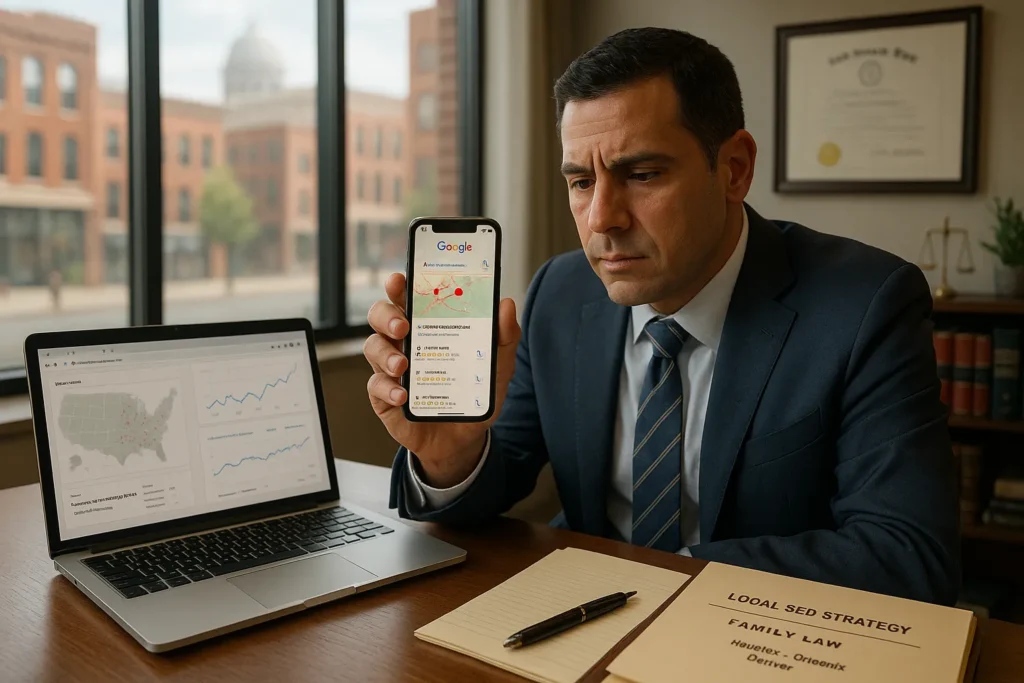
Local SEO for attorneys is often the difference between phones ringing and a quiet office. We win or lose many cases long before a consultation, at the moment a stressed person types “divorce lawyer near me“ into Google. In this guide we walk through how to show up in those local searches, earn trust on the results page, and turn nearby searches into real, qualified clients who actually show up and sign.
Key Takeaways
- Local SEO for attorneys helps law firms appear in high-intent searches like “lawyer near me,” driving more qualified calls and consultations without relying solely on paid ads.
- Strong local rankings depend on relevance, distance, and prominence, which you improve through targeted practice-area pages, accurate contact details, and authority signals like reviews and links.
- Your website is the hub of local SEO for attorneys, so create location-specific practice pages, use city-based keywords in titles and headings, and maintain clear internal links between related services.
- An optimized Google Business Profile—with correct categories, detailed services, compelling photos, and consistent NAP data—boosts visibility in the map pack and builds trust with potential clients.
- Systematic review generation, consistent legal directory citations, and real local backlinks from community organizations all strengthen local SEO for attorneys and increase case-generating visibility.
- Tracking calls, forms, and conversions by page and location lets you measure ROI from local SEO efforts and double down on the practice areas and cities that bring in the most cases.
Why Local SEO Matters So Much For Law Firms
How Local Search Works For Legal Services
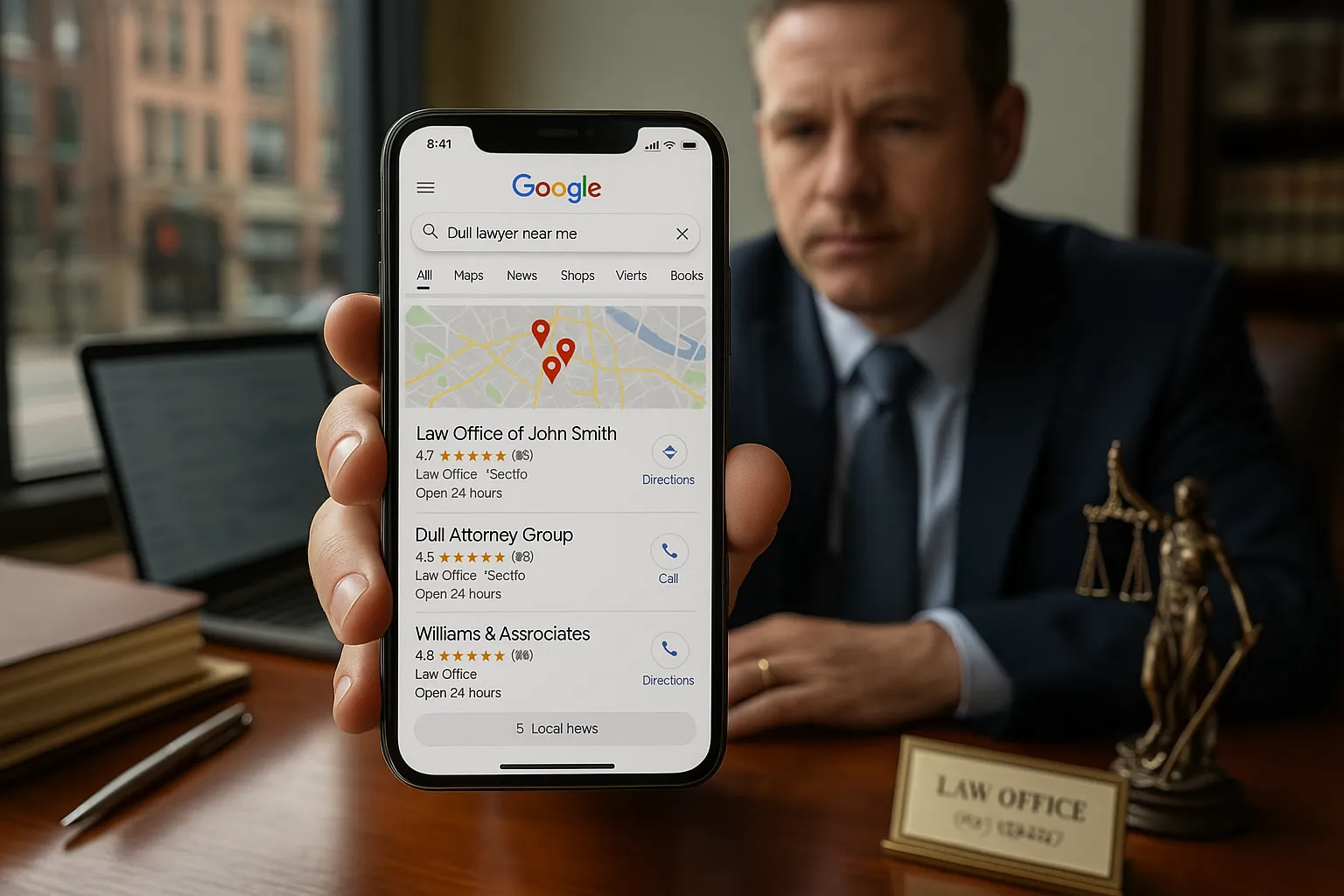
Local search engines, especially Google, try to match nearby users with nearby attorneys who look credible and relevant. When someone searches “personal injury lawyer Boston“ or just “DUI lawyer near me,“ Google pulls results from two places: the Google Business Profile 3-pack and the organic results under it.
The 3-pack often gets the most clicks, especially on mobile. A 2023 StatCounter report showed mobile accounts for about 60% of global web traffic, which means that compact local box on a phone screen often becomes our entire first impression. [Mobile & Tablet Internet Usage Stats, StatCounter, 2023, https://gs.statcounter.com/platform-market-share/desktop-mobile-tablet]
Here is why this matters for us as attorneys. Searchers in that moment usually have immediate intent. They are not just reading about the law. They want to call, book a consult, or fill out a form. When we rank well in both the map pack and the organic results, we capture that intent and reduce the need for paid ads.
Key Local SEO Ranking Factors For Attorneys
Google has shared that local results revolve around three core ideas: relevance, distance, and prominence. [How Google determines local ranking, Google, accessed 2025, https://support.google.com/business/answer/7091]
In practice for law firms, that turns into:
- Relevance: How closely our page, content, and categories match the query, like “estate planning attorney“ or “criminal defense lawyer.”
- Distance: How close our office is to the searcher’s location or the city in the query.
- Prominence: Our overall authority signals: reviews, links from legal sites, mentions on local sites, and consistent citations.
Local SEO for attorneys improves each of these factors. We fine tune practice area pages, build out a complete Google Business Profile, earn credible reviews, and maintain consistent contact info across the web. When we do that, we usually see better map rankings, higher organic positions, and more engaged local traffic.
Building A Strong Local SEO Foundation For Your Practice
Choosing The Right Local Keywords And Practice Areas
We start local SEO for attorneys with keywords that match what real clients type into search. That means pairing practice types with cities, neighborhoods, and intent words like “lawyer,“ “attorney,“ and “law firm.“
A simple way to build this list:
- Take each practice area: “family law,“ “bankruptcy,“ “immigration,“ “business contracts.”
- Add your city and nearby areas: “Chicago,“ “Evanston,“ “Cook County.”
- Mix in intent phrases: “near me,“ “free consultation,“ “top rated,“ “Spanish speaking.”
We can use tools like Google Keyword Planner or Google Search Console queries to see which combinations already get impressions. [About Keyword Planner, Google Ads Help, accessed 2025, https://support.google.com/google-ads/answer/7337243]
Then we group keywords by practice area and location so each group maps to a specific page on the site.
Optimizing Your Law Firm Website For Local Search
Our website becomes the hub for local SEO for attorneys. Each main practice area should have its own page, and in many cases its own local version. A car accident page for “Atlanta” and another for “Marietta” often makes sense when we want to rank in both.
On each page we should:
- Use the main keyword in the title tag and H1, like “Houston Personal Injury Attorney.”
- Mention the city and nearby landmarks naturally in the copy.
- Add our full firm name, address, and phone in the footer and on a contact page.
- Embed a Google Map on the contact page.
We also want internal links between related pages. A child custody page should link to a main family law page, and both can link to related resources such as a local FAQ hub or a guide on schema markup for law firms so search engines understand our practice in more detail.
Google Business Profile Optimization For Lawyers
Setting Up And Verifying Your Profile The Right Way
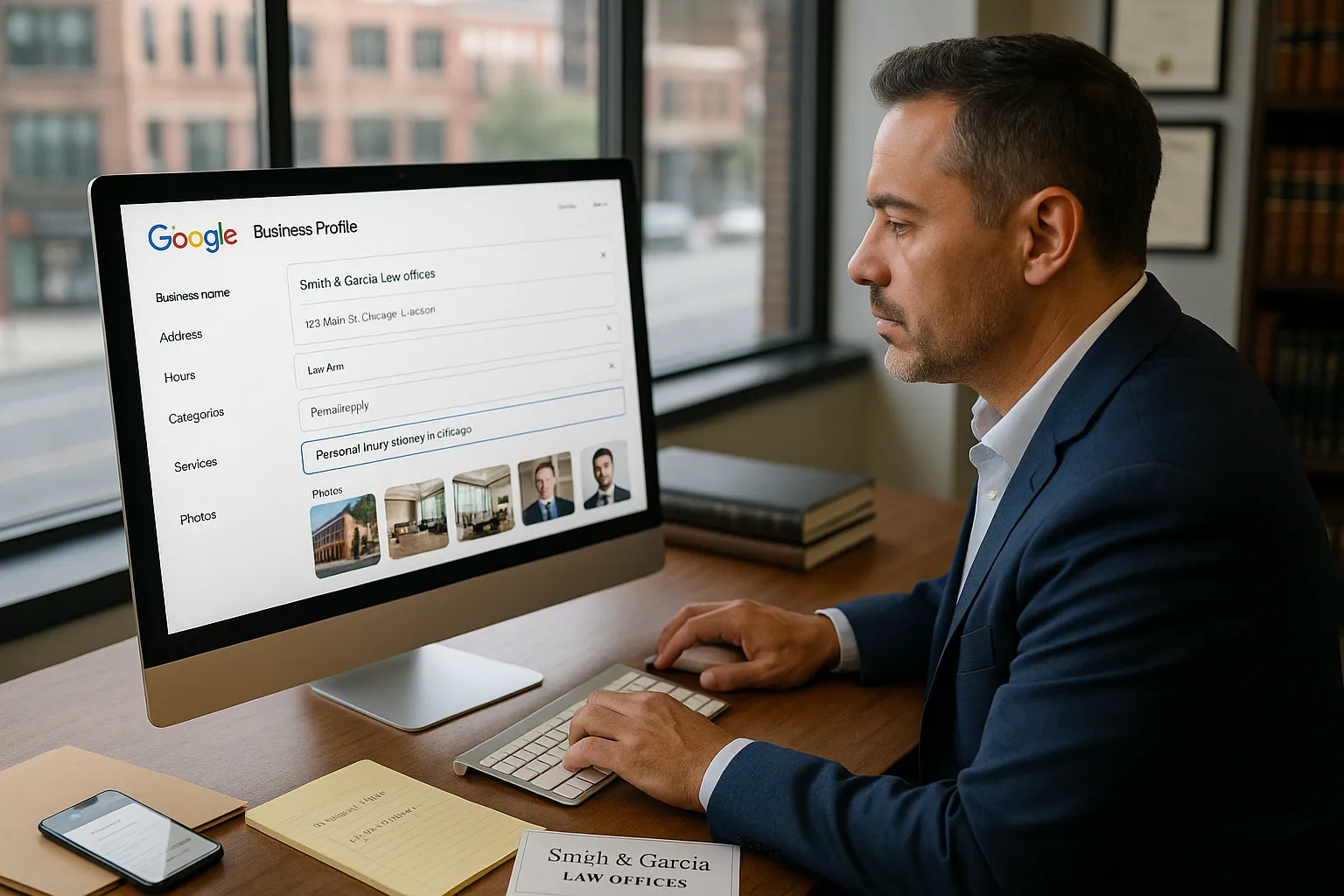
For most local search terms, the Google Business Profile (GBP) is our main local asset. We claim or create it at google.com/business, choose the exact legal business name that matches our signage and website, and use our actual office address.
Verification often happens by postcard, video, or phone. We follow Google’s prompts carefully, since mismatched names or addresses can delay approval. Once verified, we complete every field we can: hours, special hours, phone, website, appointment URL, and service areas.
Categories, Services, And Descriptions That Convert
Our primary category should match how clients describe us, like “Personal injury attorney,“ “Family law attorney,“ or “Criminal justice attorney.“ We then add related categories that fit our practice, not every possible option.
Services let us list things like “Car accident representation“ or “Green card applications“ with short, plain language descriptions. In the business description, we mention our city, key practice areas, and what sets our firm apart, such as languages spoken or 24/7 phone coverage.
This is one of the best places to weave in local SEO for attorneys without sounding spammy. We keep it human and helpful.
Photos, Posts, And Messaging To Stand Out From Competitors
Clients want to see that we are real people. High quality photos of the office exterior, waiting area, conference room, and attorney headshots build trust.
We also use Google Posts to share short updates: case types we handle, community events, or new guides. These posts show on our profile and can increase engagement. Messaging, if we enable it, needs fast replies, so we set clear internal rules about who answers and when.
Internal links from our site to the GBP, such as a “Review us on Google“ button on our thank-you page, help close the loop between our web presence and our profile.
Earning Local Authority: Reviews, Citations, And Backlinks
Systematically Generating High-Quality Client Reviews
Reviews influence both rankings and conversions in local SEO for attorneys. A 2024 BrightLocal survey found that 87% of consumers used Google reviews to evaluate local businesses. [Local Consumer Review Survey 2024, BrightLocal, 2024, https://www.brightlocal.com]
We cannot offer incentives, but we can ask consistently. A simple system:
- Ask happy clients at the end of a matter if they feel comfortable leaving a review.
- Send a short follow-up email with a direct review link.
- Train staff to remind clients at key touchpoints.
We respond to every review, positive or negative, with professional, compliant language.
Legal Directories, Citations, And NAP Consistency
Citations are mentions of our firm name, address, and phone on other sites. Legal directories like Avvo, FindLaw, Justia, and state bar listings help search engines confirm that our contact info is accurate.
We keep our name, address, and phone (NAP) consistent across these sites and across general directories like Yelp and Bing Places. Even small differences, like “Suite 200” versus “Ste 200,“ can create confusion at scale.
We also link from these profiles back to our site when allowed, which supports local SEO for attorneys by reinforcing our authority.
Local Link Building And Community Visibility
Local links from real community sites send strong signals. We look for chances such as:
- Sponsoring neighborhood sports teams and asking for a site mention.
- Speaking at local business groups and providing a bio link.
- Contributing guest articles to city blogs about legal questions residents face.
We avoid spammy schemes or link networks. Instead, we focus on relationships that already matter to the firm and gently turn those into digital signals.
Content And On-Page Tactics That Drive Local Cases
Creating Practice Area Pages For Each Location You Serve
When we want to rank in multiple nearby cities, local SEO for attorneys works best when we build location-focused practice pages. Each page should truly serve that city, not just swap names.
A solid structure:
- H1: “Denver Divorce Attorney“ or similar.
- Introduction that speaks to local courts, timelines, or rules.
- Sections about common client situations in that city.
- Directions to the office from major local landmarks.
We avoid duplicate content, even across nearby city pages. If needed, we mention different judges, filing offices, or local statistics to keep each page unique and helpful.
Using Localized Blog Content To Answer Client Questions
Blog content gives us a place to answer specific questions we hear every week. That supports long-tail local SEO for attorneys and builds trust with anxious searchers.
Ideas:
- “What happens at an arraignment in Travis County?”
- “How child custody works in Cook County court.”
- “Timeline for a Chapter 7 bankruptcy in Phoenix.”
Each article can link to our main practice page and to supporting resources like a local SEO checklist for law firms. Over time this web of internal links helps search engines see our site as an authority on local legal issues, not just generic law topics.
Technical And Tracking Essentials For Attorney Local SEO
Mobile Experience, Site Speed, And Core Web Vitals
Clients often reach us from a phone in a stressful moment, maybe outside a police station or hospital. If our site loads slowly or the tap targets are tiny, they hit back and pick another attorney.
Google’s Core Web Vitals focus on loading speed, visual stability, and interactivity. Improving them usually raises engagement and sometimes rankings. [Core Web Vitals & Page Experience, Google Search Central, 2023, https://developers.google.com/search/docs/appearance/core-web-vitals]
We keep designs clean, compress images, and avoid heavy scripts where possible. Clear mobile calls to action like “Call now” and “Schedule a consultation“ should appear early on each page.
Call Tracking, Form Tracking, And Measuring ROI
To know whether local SEO for attorneys truly works, we track outcomes, not just visits.
At minimum we:
- Use call tracking numbers per channel while keeping the main number consistent in citations.
- Track form submissions with Google Analytics or similar tools.
- Tag goals so we know which pages and queries lead to consults.
Over a few months we often see patterns. Certain practice pages or cities convert better. We can then invest more content and link building into those areas and refine or cut what does not bring in cases.
Conclusion
Local SEO for attorneys is not about gaming an algorithm. It is about showing up clearly and credibly when our neighbors need legal help the most.
When we combine a strong local website, a complete Google Business Profile, steady reviews, accurate citations, and clear tracking, we create a system that feeds our practice month after month. If we treat search visibility like another courtroom, with preparation, structure, and patience, we give our firm a real edge right in our own backyard.
Frequently Asked Questions About Local SEO for Attorneys
What is local SEO for attorneys and why does it matter for law firms?
Local SEO for attorneys is the process of helping your law firm show up in nearby Google searches like “divorce lawyer near me.” It focuses on ranking in the Google Business Profile map pack and local organic results so stressed, ready-to-hire prospects find, trust, and contact your firm first.
What are the most important local SEO ranking factors for attorneys?
For law firms, Google’s local rankings revolve around relevance, distance, and prominence. That means clearly targeted practice area pages, an accurate address near your ideal clients, and strong authority signals such as Google reviews, legal directory citations, and local backlinks that consistently show your firm’s name, address, and phone number.
How should attorneys optimize their Google Business Profile for local search?
Attorneys should use their true firm name and office address, pick a precise primary category (like “Personal injury attorney”), add relevant secondary categories, list services with plain-language descriptions, and fully complete hours, phone, website, and appointment URLs. High-quality photos, regular Google Posts, and fast responses to messages help increase engagement and trust.
How long does local SEO for attorneys take to start working?
Local SEO for attorneys typically takes 3–6 months to show consistent movement, depending on competition, your starting point, and how aggressively you optimize your site, Google Business Profile, reviews, and links. Highly competitive practice areas or big cities can take longer, but improvements often appear gradually rather than all at once.
Is local SEO or Google Ads better for attorneys trying to get more clients?
Both can work, but they serve different roles. Google Ads can generate leads quickly as long as you keep paying. Local SEO for attorneys builds long-term visibility in the map pack and organic results, often lowering reliance on ads over time. Many firms use SEO for foundation and ads for supplemental volume or testing.
Some of the links shared in this post are affiliate links. If you click on the link & make any purchase, we will receive an affiliate commission at no extra cost of you.
