
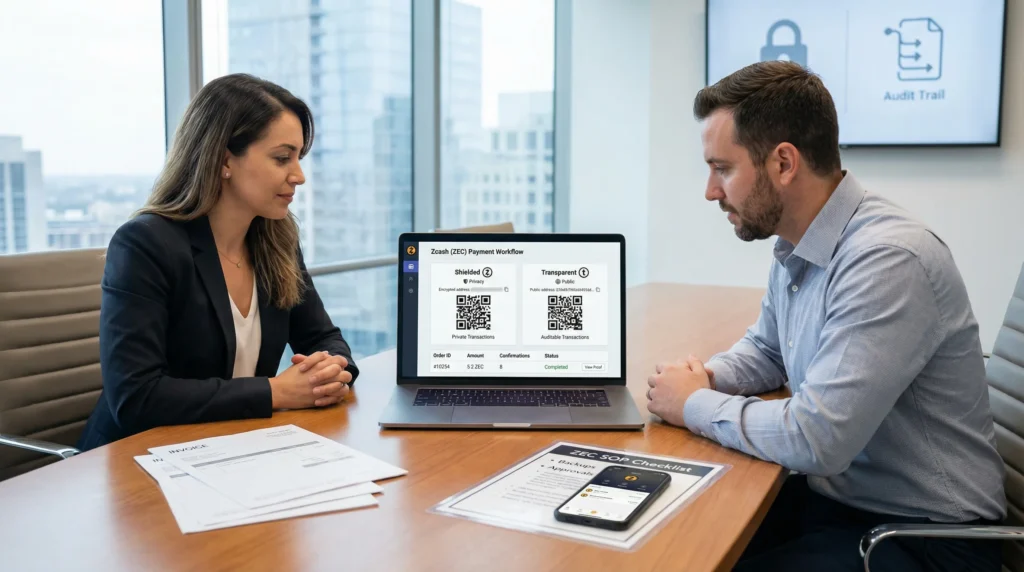
How to use Zcash (ZEC) usually becomes urgent the same way it did for us: a client asks for privacy-friendly payments, and everyone goes quiet for a second. Not because it is hard. Because it is easy to do it wrong.
Quick answer: Zcash lets you choose between shielded payments (private) and transparent payments (public), so you can match each transaction to the level of disclosure your business actually needs.
Key Takeaways
- Zcash (ZEC) lets you choose shielded (private) or transparent (public) transactions, so you can match each payment to the disclosure level your business actually needs.
- Use shielded Zcash (z-address to z-address) to protect customer relationships, revenue data, and donor or payroll privacy by hiding the sender, receiver, and amount.
- Avoid repeatedly moving funds between transparent and shielded pools because t↔z transfers can reveal amounts and create traceable “breadcrumbs” that weaken privacy.
- Start safely with a simple Zcash workflow: pick a shielded-capable wallet, back up the recovery phrase offline, buy ZEC, send a small test payment, then document the routine for your team.
- To accept Zcash on a website, separate checkout from payment confirmation and verify whether your gateway (e.g., ZGo) supports shielded payments and how it handles confirmations and customer data.
- Reduce operational risk with guardrails—log every transfer, keep refunds human-reviewed with a clear policy, minimize stored customer data, and plan for taxes and compliance even when using Zcash (ZEC).
What Zcash Is (And What Makes It Different)
Zcash is a cryptocurrency network that supports optional privacy. That single word, optional, changes how you can use it in business.
On many blockchains, the ledger shows who paid whom and how much. Zcash can hide those details when you use shielded addresses and shielded transactions.
Here is why that matters: public ledgers -> expose transaction graphs -> invite stalking, pricing intel, and targeted scams. Zcash gives you a way to reduce that exposure while still sending normal payments.
ZEC Basics: Wallets, Addresses, And Fees
ZEC is the currency on the Zcash network. To use it, you need a wallet and an address.
Zcash uses two address types:
- Shielded addresses usually start with “z”. Shielded transfers can hide sender, receiver, and amount.
- Transparent addresses usually start with “t”. Transparent transfers look like Bitcoin. Anyone can view sender, receiver, and amount.
Wallets that support shielded use (the thing people actually want) include Zashi, Nighthawk Wallet, and ZecWallet.
Fees: Zcash fees exist on every transaction. Even when you use shielded transfers, the network still accounts for fees.
Next steps: pick a wallet that supports shielded addresses before you buy anything. Some exchanges only let you withdraw to a transparent address, and that changes your privacy story from the start.
Shielded Zcash Vs Transparent Zcash: What You Actually Share
This is the part most “quick guides” skip, then you find out later when your bookkeeper asks questions.
- Shielded (z-to-z) transactions -> hide sender, receiver, and amount -> protect relationships and revenue data.
- Transparent (t-to-t) transactions -> show sender, receiver, and amount -> make public audit trails easy.
Mixing types creates visible edges:
- t-to-z (shielding) -> reveals the amount entering the shielded pool -> can create a traceable breadcrumb.
- z-to-t (deshielding) -> reveals the amount leaving -> can also create a breadcrumb.
So our rule of thumb is simple: if you want privacy, stay shielded for that “stream of funds” as much as you can.
Sources: Zcash: What is Zcash? • Zcash Documentation: Addresses • Electric Coin Co.: Zashi
Why People Use Zcash: Privacy, Optional Transparency, And Real-World Payments
People use Zcash for a very practical reason: it lets them control what they disclose.
A normal card payment tells processors, banks, and sometimes tools in your stack about your customer. A transparent crypto payment tells the whole internet about the payment forever. Zcash can reduce both forms of exposure when you use shielded transfers.
When Privacy Helps (Creators, Payroll, Donations, And Sensitive Purchases)
Privacy is not about hiding crimes. It is often about lowering risk.
Common business cases we see:
- Creators and influencers who do not want their income mapped by strangers.
- Donations where supporters want privacy (think advocacy, community aid, personal causes).
- Payroll and contractor payments where public amounts create internal drama.
- Sensitive purchases (medical, legal, safety-related) where disclosure can cause real harm.
Cause and effect stays simple:
- Public transaction history -> reveals customer lists -> enables targeting and social engineering.
- Shielded payments -> reduce exposed metadata -> lower the “attack surface” for scams.
When Transparency Helps (Invoices, Proof Of Payment, And Accounting)
Sometimes you want the receipt trail to be easy.
Transparent Zcash can help when you need:
- Proof of payment that anyone can verify without sharing wallet access.
- Simple invoicing with one address per invoice.
- A straightforward accounting trail for a small team that does not want to manage privacy tooling.
A good compromise exists: you can accept a transparent payment for an invoice, then move funds into shielded storage as a separate operational step. Just know that the move can reveal the amount on chain.
Sources: Zcash: What is Zcash? • Zcash Documentation: Addresses
How To Use Zcash Step By Step
If you want the simplest path, treat Zcash like a workflow, not a science project.
Quick answer: Wallet -> backup -> buy ZEC -> test payment -> pick address type -> document the routine.
Choose A Wallet And Set Up Backup And Recovery
Pick a wallet that supports shielded addresses.
Then do the boring step you will thank yourself for later:
- Write down your recovery phrase offline.
- Store it in a place your team can access under a clear policy (not Slack, not email).
- Decide who has signing power. One person is fast. Two people is safer.
If you run a business, we also suggest a simple access checklist:
- Who creates new addresses?
- Who approves outgoing payments?
- Where do you store transaction notes for accounting?
Get ZEC, Send A Test Payment, Then Scale Up
Buy ZEC through an exchange or a broker your business can use.
Then send a small test payment first. We mean small enough that you can laugh if you lose it.
- Confirm the address type (z vs t).
- Confirm the network fee.
- Confirm the recipient sees the payment.
Once the test clears, repeat with the real amount.
Use The Right Address Type For The Job (Shielded Or Transparent)
Here is a clean decision rule:
- Use shielded Zcash for customer payments, donations, and anything tied to personal safety or business confidentiality.
- Use transparent Zcash for public invoices and simple proof-of-payment situations.
And one warning we give every team: do not bounce the same funds back and forth between transparent and shielded pools unless you have a reason and a record. Mixed flows can leak patterns.
Sources: Electric Coin Co.: Zashi • Zcash Documentation: Addresses
How To Accept Zcash On A Website Or Checkout
Accepting Zcash on a website becomes much easier when you separate two jobs:
- Checkout -> collects order details and shows payment instructions.
- Wallet or gateway -> receives ZEC and confirms payment.
If you run WordPress (most of our clients do), you want a setup that does not break your fulfillment flow.
ZGo Payment Gateway For Zcash (ZEC): When It Fits And How It Works
ZGo Payment Gateway for Zcash (ZEC) fits when you want a hosted flow that helps you accept ZEC without building your own wallet monitoring system.
In plain terms:
- Your site shows a ZGo payment option.
- The customer pays.
- You confirm payment and deliver.
Ask these questions before you pick any gateway:
- Does it support shielded payments or only transparent flows?
- How does it handle confirmations and “paid” status?
- What data does it collect about customers?
If you want, we can map this as a trigger-input-output flow so your team knows who does what at each step.
WordPress And WooCommerce Considerations: Checkout Flow, Receipts, And Customer Support
WooCommerce adds three real-world needs that crypto tutorials ignore:
- Order status logic
- You need a clear rule for when an order moves from “on-hold” to “processing.”
- Confirmations reduce fraud -> slow checkout. Pick a number and document it.
- Receipts and customer emails
- Your receipt should show: order ID, amount in USD (or base currency), amount in ZEC, timestamp, and the payment address used.
- Support scripts
- Customers paste the wrong address. It happens.
- Customers underpay because of exchange rate movement. It also happens.
We often pair payment setup with checkout copy and support macros. If your store runs on WordPress, this is the same workstream as speed, security, and SEO. If you want a starting point, see our guides on WooCommerce site structure and product SEO and WordPress security basics for small businesses.
Sources: WooCommerce Docs
Safety, Compliance, And Operational Guardrails
Crypto payments can reduce chargebacks. They can also create new kinds of mistakes. Guardrails keep the wins and cut the regrets.
Quick answer: set privacy boundaries, keep humans in the loop, log every transfer, and write a refund policy you can follow on a bad day.
Data Minimization And Privacy Boundaries For Teams
Start with a simple rule: your team should handle the least sensitive data possible.
- Do not paste wallet seeds into ticket tools.
- Do not screenshot QR codes and store them in shared drives.
- Do not collect more customer identity data “just in case.”
Cause and effect is blunt:
- More stored customer data -> raises breach impact -> raises legal exposure.
If you need a team SOP, write it like this:
- What data can go in email?
- What data can go in a help desk?
- Who can see wallet balances?
Human Review, Logging, And Refund Handling
We like automation, but refunds need a human.
Set up:
- A transaction log with: order ID, address used, tx ID, amount, who approved, who sent.
- A refund rule: when you refund, you refund to the original address or you require a signed message and identity check. Pick one and stick to it.
Also decide how you handle price swings:
- Do you lock the ZEC amount at checkout?
- Do you give customers a time window?
Write the rule on the checkout page so support does not have to freestyle.
Tax And Policy Notes For Regulated Or High-Risk Industries
If you operate in legal, medical, finance, or insurance, do not treat Zcash as a “skip compliance” button. It is not.
Do this instead:
- Ask your tax pro how you will track cost basis and revenue.
- Create a policy for when you reject payments.
- Keep a human review step for large orders, controlled items, or unusual patterns.
In the US, tax agencies treat crypto as taxable property in many contexts. So your bookkeeping still matters, even if the payment uses shielded Zcash.
Sources: IRS: Virtual Currencies • FTC: Advertising and Marketing on the Internet
Conclusion
Zcash works best when you treat it like a set of choices, not a badge. Shielded Zcash vs transparent Zcash is not a debate. It is a routing decision.
If you want a safe starting plan, run a small pilot: one product, one wallet, one written SOP, one log. Keep the first week boring on purpose.
If you want help fitting Zcash into WordPress or WooCommerce without breaking checkout, support, or accounting, we can map the workflow with you and keep humans in the loop. You can also browse our WordPress growth notes at Zuleika LLC and build from there.
Frequently Asked Questions About Using Zcash (ZEC)
How to use Zcash (ZEC) for payments step by step?
To use Zcash (ZEC), pick a wallet that supports shielded addresses, back up your recovery phrase offline, buy ZEC, and send a small test payment first. Then choose the right address type (shielded “z” or transparent “t”) and document who approves, sends, and logs each transfer.
What’s the difference between shielded and transparent Zcash (ZEC) transactions?
Shielded (z-to-z) transactions hide the sender, receiver, and amount, which protects customer relationships and revenue data. Transparent (t-to-t) transactions are public like Bitcoin, showing those details on-chain. Mixing types (t-to-z or z-to-t) can reveal amounts entering or leaving, creating traceable “breadcrumbs.”
Why do people use Zcash (ZEC) instead of other cryptocurrencies?
People use Zcash (ZEC) because its privacy is optional: you can choose shielded payments to reduce exposure of customer lists, pricing intel, and transaction graphs, or use transparent payments when you need public proof of payment. That flexibility helps businesses match each transaction to the disclosure they actually need.
How can I accept Zcash (ZEC) on a website or WooCommerce checkout?
Treat acceptance as two parts: checkout collects order details and displays payment instructions, while a wallet or gateway receives ZEC and confirms payment. For WooCommerce, define confirmation rules for order status, include clear receipt details (order ID, fiat and ZEC amounts, timestamp, address), and prepare support scripts for wrong-address and underpayment issues.
Can I buy ZEC on an exchange and withdraw it to a shielded (z) address?
Sometimes, but not always—some exchanges only support withdrawals to transparent (t) addresses, which changes your privacy from the start. A practical approach is to choose a wallet that supports shielded addresses before buying, then verify the exchange’s withdrawal options so you can keep funds shielded when privacy is the goal.
Is using Zcash (ZEC) legal, and how is it taxed in the US?
Using Zcash (ZEC) can be legal, but it doesn’t replace compliance—especially in regulated industries. In the US, crypto is commonly treated as taxable property, so you still need bookkeeping for revenue and cost basis. Set policies for rejecting payments, add human review for large orders, and document refund and logging procedures.
Some of the links shared in this post are affiliate links. If you click on the link & make any purchase, we will receive an affiliate commission at no extra cost of you.
We improve our products and advertising by using Microsoft Clarity to see how you use our website. By using our site, you agree that we and Microsoft can collect and use this data. Our privacy policy has more details.
