
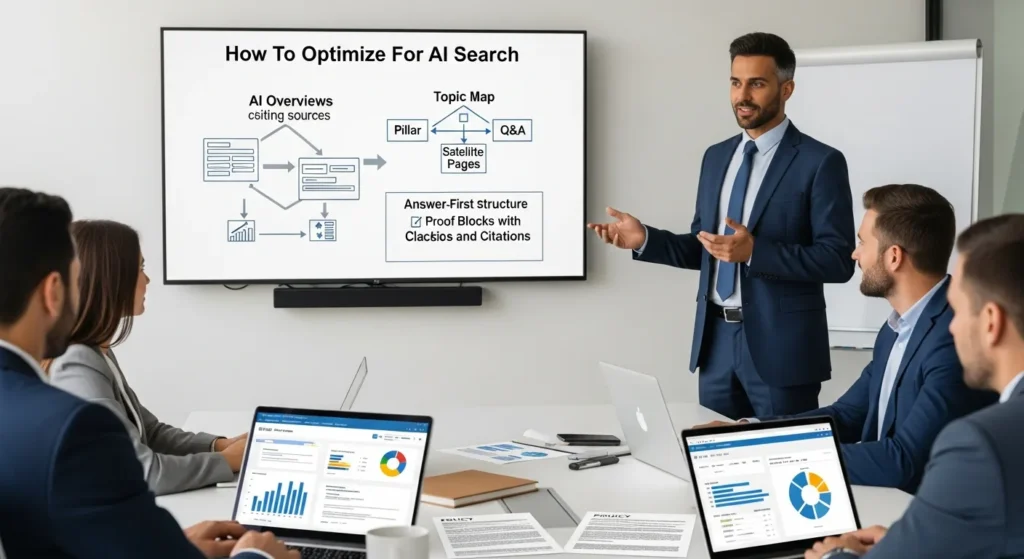
How to optimize for AI search is the question we hear right after a client sees their traffic dip while their competitors show up inside Google’s AI answers. One founder told us, “People still buy, but fewer people click.” We get it. The rules did not vanish, but the retrieval layer changed, and it rewards clarity, proof, and clean site structure.
Key Takeaways
- To optimize for AI search, aim for passage-level visibility by writing quotable paragraphs that AI Overviews can safely cite—even when the full page doesn’t rank #1.
- Keep classic SEO fundamentals (crawlability, indexing, internal linking, and topical focus) because AI search still starts with Google’s index.
- Build a simple topic map with one pillar page per core offer and supporting “satellite” pages that answer specific sub-questions created by query fan-out.
- Use an answer-first format (one-sentence answer, 2–5 bullets, then a proof block) and define key terms so both readers and AI systems can extract accurate passages.
- Add trust hooks—author info, last-updated dates, reputable citations, and policy links—so your claims feel verifiable and low-risk to quote in AI search.
- Measure beyond clicks by tracking citations/mentions, Search Console impressions and query mix, and conversions, then iterate with small, reversible pilots on high-intent questions.
What “AI Search” Means In Practice (And How It Differs From Classic Google SEO)
AI search means a system reads, slices, and recombines content into an answer. Classic SEO still tries to earn a list position and a click. AI search tries to earn a citation inside a generated response.
Quick answer: you still need rankings, but you also need quotable passages that a model can trust.
When we plan for AI search, we plan for passage-level retrieval. A single paragraph can win you a mention, even if the whole page does not rank #1. That shifts how you write and how you structure WordPress pages.
How AI Overviews And Chat Assistants Choose Sources
AI assistants choose sources that reduce risk for them. Clear claims reduce hallucinations. Verifiable facts reduce blame. Strong entity signals reduce confusion.
Here is what that means in practice:
- Your page -> provides a direct answer -> the model can quote it.
- Your page -> names the right entities -> the system matches it to the question.
- Your page -> cites credible sources -> the system trusts the claim.
You will also see “query fan-out” behavior. The system breaks one question into several smaller ones, then stitches the answer. Google described this behavior in its AI Overviews messaging, and third-party testing keeps showing it.
So if your page only ranks for one narrow keyword, you can still lose citations to a competitor that covers the full set of sub-questions.
Where Traditional Rankings Still Matter
Rankings still matter because retrieval starts with the index. If Google cannot crawl and understand your pages, AI Overviews cannot cite them.
A practical mental model we use:
- Classic SEO -> gets your page discovered and trusted by the index.
- AI search -> selects passages that match intent and feel safe to quote.
So do not “ditch SEO.” Keep your technical basics, internal linking, and topical focus. Then add answer-first structure and proof so the AI layer picks you.
Sources
- About Google AI Overviews and AI Mode, Google, 2025, https://support.google.com/websearch/answer/13572151
- Google Search Central: Helpful content system, Google, 2023, https://developers.google.com/search/docs/fundamentals/creating-helpful-content
- Search Quality Rater Guidelines, Google, 2023, https://static.googleusercontent.com/media/guidelines.raterhub.com/en//searchqualityevaluatorguidelines.pdf
Map Your Content For Retrieval: Topics, Entities, And Intent
If you want AI answers to cite you, you need a map. Not a spreadsheet that gathers dust. A simple topic map that links your services, your proof, and the questions your buyers ask.
Quick answer: build one pillar page per core offer, then support it with smaller pages that answer one question each.
When we build WordPress sites for businesses, we treat the site like a knowledge base with a sales engine attached. That helps both humans and machines.
Build A Simple Topic Map For Your Site
Start with three lists:
- Offers (what you sell): WordPress builds, WooCommerce, maintenance, SEO, compliance-friendly workflows.
- Audiences (who buys): law firms, clinics, trades, creators, SaaS teams.
- Entities (what must be named): WordPress, WooCommerce, Google Search Console, schema types, policies, locations, industry terms.
Then connect them:
- A “WordPress ecommerce” pillar page -> links -> “WooCommerce product schema,” “shipping FAQ,” “returns policy template,” “PCI and payment handling basics.”
- A “medical practice website” pillar page -> links -> “HIPAA-friendly contact forms,” “tracking pixel rules,” “review process for AI-written copy.”
Those satellites feed the pillar. The pillar feeds the satellites. Internal links help Google understand your site theme, and they help AI retrieval find a clean passage fast.
If you want a deeper workflow that ties prompts, guardrails, and measurement to this content map, we laid it out in our guide on improving AI optimization for modern professionals.
Write For Real Questions With Clear, Verifiable Answers
Write pages that answer questions your buyers say out loud. The easiest sources come from:
- Sales calls and support tickets
- Google “People also ask” boxes
- Your own site search logs
Then write in an answer-first pattern:
- One-sentence answer (no throat clearing)
- 2 to 5 bullets with steps or criteria
- A short proof block (a source, a screenshot, a policy link, a number)
That structure -> reduces model uncertainty -> increases citations.
Also: define your terms. If you use “AI search,” define it in one line. If you use “schema,” define it in one line. Machines love definitions. Busy readers do, too.
Sources
- Google Search Central: Creating helpful, reliable, people-first content, Google, 2023, https://developers.google.com/search/docs/fundamentals/creating-helpful-content
- Search Quality Rater Guidelines, Google, 2023, https://static.googleusercontent.com/media/guidelines.raterhub.com/en//searchqualityevaluatorguidelines.pdf
Make Your Pages Easy To Quote: Structure, Clarity, And Proof
AI systems quote passages that sound like an answer key. If your page reads like a brand manifesto, the model struggles to extract it.
Quick answer: use short sections, plain claims, and proof right next to the claim.
We aim for “copy that survives copy-paste.” If a paragraph gets pulled into an AI answer with no other context, it still needs to stand up.
Use Scannable Sections, Definitions, And Stepwise Instructions
Use sections that each do one job. Keep them small. Keep them direct.
A simple pattern that works across industries:
- Definition: “AI search is …”
- Why it matters: “AI Overviews reduce clicks because …”
- Steps: “Do these 5 things …”
- Pitfalls: “Do not do these 3 things …”
And write steps like a checklist:
- Put the main answer in the first sentence.
- List the criteria you used.
- Name the tool or standard.
- State the limit or warning.
This format -> increases extraction accuracy -> increases citation odds.
Add “Trust Hooks”: Author Info, Dates, Sources, And Policies
AI assistants filter out content that feels ungrounded. Trust hooks make your content feel safe to quote.
Add these elements to content that matters:
- Author name and role (and why they know the topic)
- Last updated date (and a real update cadence)
- Citations to primary or reputable sources
- Policy links (privacy, editorial policy, refunds, shipping)
If you are in a sensitive field, you also want a human review statement. Simple line, no drama: “A human reviewed this page for accuracy on [date].”
We also suggest keeping a small “sources and notes” section per article. It helps you refresh content faster. It helps models see that you did your assignments.
Sources
- FTC: Guides Concerning the Use of Endorsements and Testimonials in Advertising, Federal Trade Commission, 2023, https://www.ftc.gov/business-guidance/resources/ftcs-endorsement-guides-what-people-are-asking
- Google Search Central: E-E-A-T and quality signals (via rater guidelines reference), Google, 2023, https://static.googleusercontent.com/media/guidelines.raterhub.com/en//searchqualityevaluatorguidelines.pdf
Strengthen Your Technical Foundation In WordPress
Content can only get cited if it gets crawled, indexed, and understood. WordPress can do this well, but only if you keep the plumbing clean.
Quick answer: fix indexing signals first, then add schema that matches your content.
Indexing, Canonicals, And Crawl Hygiene
Here is the short list we check on most WordPress builds:
- Indexing: Your important pages -> allow crawling -> Google can retrieve them.
- Canonicals: Duplicate URLs -> point to one canonical -> the index picks the right page.
- Sitemaps: The sitemap -> lists your key URLs -> Google finds updates.
- Thin pages: Low-value pages -> get noindexed or improved -> crawl budget stays focused.
Use Google Search Console to confirm coverage issues and canonical selection. Keep plugins in check, too. Plugin bloat -> adds scripts -> slows pages -> reduces crawl and user satisfaction.
If you want to connect this to the on-page experience layer, our guide on search experience improvements lays out the UX and intent signals that support both SEO and AI citations.
Schema Markup That Helps Machines Understand Your Content
Schema does not guarantee citations, but it reduces ambiguity.
Good fits for business sites:
- Organization and LocalBusiness for brand identity
- Product, Offer, and Review for WooCommerce
- FAQPage for tight Q&A sections
- Article with author and dates for publish signals
Match schema to visible content. If you mark up FAQs, show the questions on the page. Structured data -> matches content -> reduces mismatch risk.
We usually automate JSON-LD in WordPress with a plugin plus light theme or plugin work when needed. Then we test it with Google’s Rich Results Test.
Sources
- Google Search Central: Sitemaps overview, Google, 2024, https://developers.google.com/search/docs/crawling-indexing/sitemaps/overview
- Google Search Central: Canonicalization, Google, 2024, https://developers.google.com/search/docs/crawling-indexing/consolidate-duplicate-urls
- Google Search Central: Structured data guidelines, Google, 2024, https://developers.google.com/search/docs/appearance/structured-data/intro-structured-data
Governance For AI-Era Content: Accuracy, Disclosure, And Data Handling
AI search raises the stakes because your content can travel without you. A model can quote you in a context you did not expect. That puts pressure on accuracy and on your data handling.
Quick answer: treat AI-assisted content like a controlled process, not a creative free-for-all.
Human-In-The-Loop Review And Update Cadence
We set a simple review chain:
- Writer or model -> drafts the passage -> creates speed.
- Editor -> checks claims -> prevents errors.
- Subject reviewer -> approves sensitive parts -> reduces liability.
Then we schedule updates. Stale pages -> cause wrong answers -> damage trust.
A light cadence that works for many businesses:
- Money pages: review every quarter
- Regulated pages: review every month or after any policy change
- Evergreen guides: review every 6 to 12 months
Log the review. Keep a changelog note. Your team -> follows the log -> keeps output consistent.
Privacy Boundaries For Regulated Or Sensitive Industries
Do not paste sensitive data into chat tools. That includes patient details, legal case facts, financial account info, and private HR data.
Set boundaries your team can follow:
- Use redaction rules for examples.
- Use synthetic data for demos.
- Keep client identifiers out of prompts.
- Store prompts and outputs in your internal system, not in random inbox threads.
If you operate in healthcare, follow HIPAA rules and your BAAs. If you operate in the EU, follow GDPR principles like data minimization. Your content process -> respects privacy limits -> protects your business.
Sources
- HIPAA Privacy Rule, U.S. Department of Health and Human Services, 2013 (current page), https://www.hhs.gov/hipaa/for-professionals/privacy/index.html
- EDPB Guidelines 05/2020 on consent (GDPR), European Data Protection Board, 2020, https://edpb.europa.eu/our-work-tools/our-documents/guidelines/guidelines-052020-consent-under-regulation_en
Measure What Is Working And Iterate Safely
If you only measure clicks, AI search will feel like a mystery movie with no ending. You need new signals.
Quick answer: track citations and visibility, then run small pilots that you can roll back.
Track Visibility Signals Beyond Clicks
What we track with clients depends on their stack, but these signals help:
- Brand mentions inside AI answers (manual spot checks on priority queries)
- Citation frequency (how often your pages get referenced)
- Impressions and query mix in Google Search Console
- Engaged sessions and conversions (because mentions without sales feel nice and pay nothing)
Tie each content update to a note. “We added a definition and two sources” -> you can correlate changes -> you can repeat wins.
Run Low-Risk Pilots Before You Scale Automation
Start small. Pick one workflow. Keep it reversible.
A safe pilot we like:
- Choose 10 high-intent questions.
- Publish answer-first pages with sources.
- Run the workflow in shadow mode for two weeks.
- Review outputs with a human.
- Expand to the next cluster.
This approach -> limits risk -> builds confidence. And it keeps your compliance posture intact.
Sources
- Google Search Console help: Performance report, Google, 2024, https://support.google.com/webmasters/answer/7576553
- About Google AI Overviews and AI Mode, Google, 2025, https://support.google.com/websearch/answer/13572151
Conclusion
AI search will keep changing, but the winning pattern stays calm and boring: clear answers, named entities, proof, and clean WordPress tech. If you sell services, products, or expertise, your job is to become the easiest source to quote on the questions that drive revenue.
If you want help, we usually start with a one-hour mapping session. We pick a topic cluster, set guardrails, and ship a small pilot. You get new visibility without gambling your SEO or your compliance posture.
Frequently Asked Questions About How To Optimize For AI Search
How to optimize for AI search without ditching classic SEO?
How to optimize for AI search starts with keeping classic SEO fundamentals: crawlability, indexing, internal linking, and topical focus. Then add answer-first sections and proof so AI systems can safely quote you. Rankings still matter because AI retrieval often begins with Google’s index.
What does “AI search” mean, and how is it different from traditional Google SEO?
AI search systems read and recombine content into a generated answer, aiming to cite reliable sources. Traditional SEO mainly targets blue-link rankings and clicks. In AI search, a single quotable paragraph can earn a citation even if the page isn’t #1, so passage-level clarity matters.
Why do AI Overviews cite some pages and ignore others?
AI Overviews tend to choose sources that feel low-risk to quote: direct claims, verifiable facts, strong entity mentions, and credible citations. If your content is vague or promotional, extraction is harder. Adding definitions, sources, dates, and clear steps reduces uncertainty and boosts citation odds.
How do I structure content so AI assistants can quote it more easily?
Use an answer-first pattern: lead with a one-sentence direct answer, follow with 2–5 bullets for steps or criteria, then add a short proof block (source link, policy, screenshot, or number). Keep sections small and specific so the passage still makes sense when copied alone.
What WordPress technical fixes help with AI search visibility?
How to optimize for AI search in WordPress includes strong crawl and indexing signals: clean canonicals, accurate XML sitemaps, and pruning or improving thin pages. Add schema that matches visible content (Article, Organization, FAQPage, Product). Test markup in Google’s Rich Results Test and monitor Search Console coverage.
How can I measure AI search success if clicks are going down?
Go beyond clicks by tracking visibility signals: brand mentions inside AI answers (spot-check priority queries), citation frequency, and shifts in impressions and query mix in Google Search Console. Pair that with engaged sessions and conversions. Log each content update so you can correlate changes with visibility gains.
Some of the links shared in this post are affiliate links. If you click on the link & make any purchase, we will receive an affiliate commission at no extra cost of you.
We improve our products and advertising by using Microsoft Clarity to see how you use our website. By using our site, you agree that we and Microsoft can collect and use this data. Our privacy policy has more details.
