
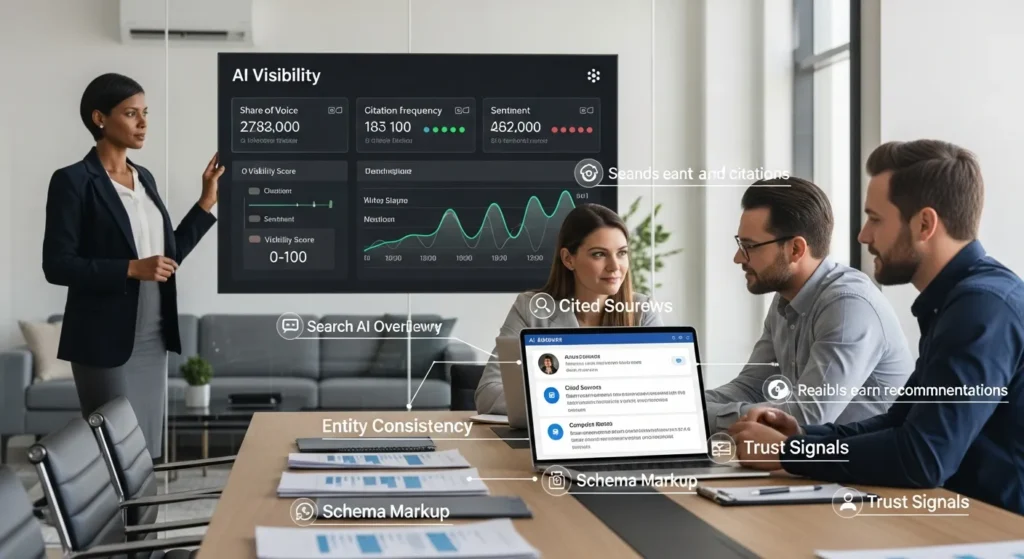
AI visibility is the new “why didn’t they pick us?” moment, and we felt it the first time a client asked why ChatGPT named three competitors but skipped their brand. Our SEO numbers looked fine. Rankings held. Yet the conversation shifted to AI answers, citations, and recommendations. Quick answer: AI visibility means you get mentioned (and cited) inside AI-generated responses, and you earn that spot by making your business easy to verify, easy to quote, and hard to misunderstand.
Key Takeaways
- AI visibility measures whether your brand gets mentioned or cited in AI-generated answers (ChatGPT, Perplexity, Gemini, Grok), not just where you rank in blue-link search results.
- Win AI visibility by making your business easy to verify and quote through clear entities (who you are), strong citations (proof pages), and trust signals (authorship, consistent facts).
- Publish buyer-critical basics—pricing ranges, process, policies, FAQs, and case studies—because vague pages force AI to guess, and guessing often leads to no mention at all.
- Strengthen machine readability with WordPress fundamentals: clean information architecture, consistent service naming, internal linking to “money pages,” and schema (Organization, Product, FAQ, Article) to reduce ambiguity.
- Build content for decision support—comparisons, alternatives, use cases, and “good fit/bad fit” criteria—so AI can confidently recommend you in high-intent prompts.
- Track AI visibility safely using a repeatable prompt set (branded + category), share of voice, citation quality, and sentiment, then log outputs for human review while enforcing privacy boundaries and data minimization.
What “AI Visibility” Means (And How It Differs From Traditional SEO)
AI visibility measures how often your brand, products, or services appear in AI-generated answers from tools like ChatGPT, Perplexity, Google Gemini, and Grok. It cares less about blue-link rank and more about mentions, citations, and recommendations.
Traditional SEO still matters. It feeds the web ecosystem. But the goalpost moved:
- Traditional SEO -> drives -> clicks from search results
- AI visibility -> shapes -> what people believe before they click
So you start tracking different signals:
- Citation frequency (how often an AI cites your site or your brand)
- Share of voice (SOV) (how often you get mentioned across a set of category prompts)
- Sentiment (are you recommended or warned against)
Some platforms now roll this into an “AI visibility score” style metric (often 0–100). Treat it like a trend line, not a truth meter.
Where Visibility Happens Now: AI Overviews, Chatbots, And Answer Engines
Visibility now shows up in three main places:
- AI overviews inside search (Google’s AI Overviews and similar experiences)
- Chatbots (ChatGPT, Gemini) where users ask for best options
- Answer engines (Perplexity-style systems) that cite sources directly
A buyer can ask, “Best WooCommerce developer for a small manufacturing company,” and never open ten tabs. If your brand does not appear in that answer, you can lose the deal without knowing you were in the running.
The New Ranking Inputs: Entities, Citations, And Trust Signals
AI systems tend to reward what they can verify.
- Entities -> help -> models identify who you are (company name, location, founders, services, products)
- Citations -> support -> claims (pricing pages, policies, case studies, docs)
- Trust signals -> reduce -> risk of bad recommendations (clear authorship, reputation, consistent info)
You will still hear “E-E-A-T” (Experience, Expertise, Authoritativeness, Trust). Google uses it as a quality concept in its Search Quality Rater Guidelines, and the underlying idea maps well to AI answers too: low-trust sources get ignored or treated carefully. See: Google Search Quality Rater Guidelines (Google publishes related guidance across its docs: the full PDF is linked from Google resources in many places).
If the model cannot connect your brand to stable facts, it hesitates. If it finds consistent facts across sources, it gets confident and mentions you.
How AI Systems “See” Your Business: The Visibility Stack To Map First
Before we touch tools, we map the visibility stack. We treat it like a system diagram, not a content sprint.
Here is the plain version:
- Your website -> becomes -> a source of truth
- Off-site mentions -> create -> corroboration
- Structured data -> gives -> machine-readable meaning
Trigger, Input, Model Job, Output, Guardrails: A Simple Workflow Lens
We like this lens because it forces clarity:
- Trigger: A user query like “best WordPress ecommerce agency for a restaurant group”
- Input: Public web pages, databases, reviews, knowledge graphs, prior training data, and allowed retrieval sources
- Model job: Summarize, compare, and recommend
- Output: A ranked answer, often with citations
- Guardrails: Rules that push the model to cite sources, avoid unsafe advice, or refuse sensitive requests
This matters because your job is not “write more content.” Your job is “make the inputs easy to retrieve and safe to cite.”
On-Site Sources AI Pulls From: Pages, Products, FAQs, And Policies
On your site, AI systems tend to pull from pages that answer buyer questions fast:
- Service pages (what you do, who it is for, what it costs)
- Product pages (if ecommerce)
- FAQs (shipping, returns, timelines, support)
- Policy pages (privacy, refunds, warranties)
- Case studies (what changed, by how much, in what timeframe)
If you want AI visibility, do not hide the basics. A vague “Contact us for pricing” page forces the model to guess. Guessing leads to silence.
Off-Site Sources That Shape Mentions: Reviews, Directories, PR, And Forums
Off-site signals act like witnesses.
- Reviews -> affect -> recommendation confidence
- Directory listings -> affect -> entity consistency
- PR and interviews -> affect -> perceived authority
- Forums and community threads -> affect -> real-world reputation
For local and service businesses, consistent NAP (name, address, phone) still matters. For ecommerce, product reviews and policy clarity matter more.
If your brand name appears three different ways across the web, AI systems struggle to connect the dots. One brand -> creates -> many entities. That hurts.
WordPress Foundations That Improve AI Readability
We build on WordPress a lot, so we will say this plainly: AI visibility starts with boring website fundamentals. Not glamorous. Very profitable.
Information Architecture For Humans And Crawlers
Good information architecture makes your site readable to people and parsers.
What we aim for:
- One clear “money page” per service or product category
- Support pages that answer one question each
- Internal links that point back to the money page
- Consistent naming for services (do not call it “Web Growth System” on one page and “WordPress SEO” on another)
Structure -> affects -> retrieval. If a crawler cannot find it fast, an answer engine will not cite it.
If you want a practical starting point, we often begin with a simple content inventory and URL map. We also keep maintenance in view since broken plugins and theme updates can quietly damage crawlability. (Related reading on our site: WordPress website development and website maintenance services.)
Schema Markup That Actually Helps: Organization, Product, FAQ, Article
Schema helps machines understand meaning. It does not magically boost you, but it reduces ambiguity.
Focus on the schemas that match buying decisions:
- Organization schema for your company identity
- Product schema for ecommerce items (price, availability, brand)
- FAQ schema for common questions (when used appropriately)
- Article schema for guides and explainers with authorship
Google documents structured data types and guidelines here: Google Search Central: Structured data.
Technical Hygiene: Indexing, Canonicals, Performance, And Accessibility
Technical issues often block AI visibility in boring ways.
- Indexing errors -> reduce -> eligible pages
- Bad canonicals -> confuse -> which page is “the” source
- Slow performance -> reduces -> crawl frequency and user trust
- Poor accessibility -> reduces -> usable text and semantics
Use Google’s docs as your north star for crawl and indexing basics: Google Search Central: Crawling and indexing.
Content Patterns That Earn Mentions And Citations
AI systems cite what reads like a source. Your content has to act like one.
Publish The Proof: Pricing, Process, Results, And Clear Claims
Proof lowers risk. Risk affects recommendations.
Publish:
- Starting prices or price ranges (even “most projects fall between X and Y” helps)
- Your process (steps, timeline, what you need from the client)
- Outcomes with context (what you improved, what you did not change)
- Clear claims with boundaries (“We build custom WordPress websites for WooCommerce brands” beats “We build digital experiences”)
A claim -> needs -> a backing page. Without that, AI tools hesitate to quote you.
Write For Comparison And Decision Support: Alternatives, Use Cases, Fit
Buyers ask comparison questions. AI tools love comparison questions.
Create pages that answer:
- “WordPress vs Shopify for a small catalog”
- “WooCommerce for subscription products: what breaks first”
- “Best CMS for regulated businesses that need approval workflows”
We also like “fit” statements:
- Good fit -> includes -> clear criteria
- Bad fit -> reduces -> refunds and disputes
This type of writing makes you look honest. Honest brands get cited more.
Build Topic Clusters Around Money Pages (Without Keyword Stuffing)
Topic clusters still work, but the goal is clarity, not keyword tricks.
A simple cluster:
- Money page: “WooCommerce development services”
- Support content: shipping rules, tax setup, refunds, subscriptions, performance, accessibility
- Proof content: case studies, checklists, timelines
Internal links -> create -> a learning path for crawlers and humans.
If you want to stay sane, keep one rule: each support post must point to one money page and answer one buyer question fully.
Authority And Trust: E-E-A-T Signals You Can Operationalize
Trust is not a vibe. Trust is a set of artifacts you can publish and maintain.
Author And Company Credibility: Bios, Credentials, And Editorial Policy
Authorship affects credibility.
Add:
- Real author pages with role, experience, and contact path
- Company “About” page with clear services and history
- Editorial policy that explains how you review content
For “your money or your life” topics (finance, medical, legal), this matters more. Google’s quality concepts focus heavily on trust and who created the content. Start here: Google Search Quality Rater Guidelines.
Review And Reputation Systems: Ask, Capture, Respond, And Showcase
A review system creates repeatable trust.
- Ask -> increases -> review volume
- Responses -> improve -> sentiment
- Showcasing -> increases -> conversion confidence
Keep it simple: send a link after project completion, respond to every review within a week, and publish a “Reviews” page that you keep current.
Compliance And Disclosure For Regulated Fields
If you operate in legal, healthcare, or finance, keep humans in the loop.
- Disclosures -> reduce -> liability risk
- Human review -> prevents -> unsafe advice
If you use endorsements or testimonials in marketing, follow FTC guidance. The FTC covers endorsements and disclosure expectations here: FTC Endorsement Guides.
Also: do not paste sensitive client data into AI tools. Your policy should say that out loud.
Measurement And Governance: How To Track AI Visibility Safely
If you cannot measure AI visibility, you cannot defend budget for it. If you do not govern it, you can create risk fast.
What To Monitor: Branded Prompts, Share Of Voice, And Citation Quality
We monitor with a small prompt set we can rerun monthly.
Track:
- Branded prompts (“Is Zuleika LLC good for WooCommerce?”)
- Category prompts (“best WordPress agency for restaurants”)
- SOV across 20–100 prompts
- Citation quality (do they cite your site or a random directory)
- Sentiment (recommended, neutral, warned against)
Tools like Semrush and Conductor now publish AI-focused visibility features. Treat tooling as a dashboard, then verify by hand.
Logging And Human Review: Preventing Hallucinated Claims
Models can invent details. Logging catches it.
- Logging -> reveals -> false claims
- Human review -> prevents -> public mistakes
We run a simple sheet:
- Prompt
- Date
- Tool (ChatGPT, Perplexity, Gemini)
- Answer snippet
- Citations
- Issues found
- Fix needed (site update, PR, clarification page)
This “shadow mode” approach keeps you safe while you learn.
Data Minimization And Privacy Boundaries For AI Tools
Data handling rules protect your clients and your team.
- Data minimization -> reduces -> exposure
- Redaction -> reduces -> accidental leaks
- Access control -> limits -> who can paste what
If you use AI tools with enterprise controls, read the vendor’s admin and privacy docs and set defaults. Start with a simple boundary: never include personal health info, payment details, or private contracts in prompts.
If you operate in the EU or serve EU residents, align practices with GDPR principles like data minimization. The European Data Protection Board outlines key guidance here: EDPB Guidelines.
Conclusion
AI visibility rewards brands that act like reliable sources. Clear pages -> create -> clear answers. Proof -> builds -> citation confidence. Governance -> prevents -> ugly surprises.
If you want the safest path, start small: pick one service, write one comparison page, add schema, and track 20 prompts for 30 days. You will learn faster than you will by rewriting your whole site.
If you want a second set of eyes, we do this work inside WordPress every week. We map the workflow, set guardrails, and build pages that AI tools can cite without guessing. You can start with our WordPress SEO services and a short visibility audit, then expand once the data looks real.
Frequently Asked Questions about AI Visibility
What is AI visibility, and why does it matter for brands?
AI visibility is how often your brand gets mentioned, cited, or recommended inside AI-generated answers (ChatGPT, Perplexity, Gemini, Grok, and AI Overviews). It matters because buyers increasingly decide who to trust before clicking links—so missing from AI answers can mean losing deals even with solid SEO rankings.
How is AI visibility different from traditional SEO?
Traditional SEO is optimized for blue-link rankings and clicks from search results. AI visibility is optimized for mentions and citations in AI answers, shaping what people believe before they visit any site. You still need SEO fundamentals, but you also need clear, verifiable facts that models can safely quote.
What metrics should I track to measure AI visibility?
Track citation frequency (how often AI cites you), share of voice across a repeatable set of category prompts, and sentiment (recommended vs. warned against). Some tools provide an “AI visibility score” (often 0–100), but treat it as a trend line. Re-run prompts monthly and verify outputs manually.
What content and pages help improve AI visibility the most?
AI systems tend to cite pages that answer buyer questions quickly: service/product pages, FAQs, policy pages (privacy, refunds, warranties), and case studies with measurable outcomes. Publishing pricing ranges, process steps, timelines, and clear claims reduces guessing. The easier your site is to verify and quote, the more you get mentioned.
Does schema markup improve AI visibility, and which types are most useful?
Schema won’t magically rank you, but it reduces ambiguity and helps machines interpret your site—supporting AI visibility. Prioritize Organization schema (identity), Product schema (price/availability/brand), FAQ schema (common buyer questions), and Article schema (authorship). Pair schema with consistent on-page facts and strong internal linking for best results.
How long does it take to see results from AI visibility optimization?
Timelines vary, but many teams learn fastest by running a 30-day pilot: pick one service, publish one comparison or decision-support page, add key schema, and track 20 prompts weekly. Mentions can improve as systems re-crawl and as off-site corroboration grows, but consistency across sources usually drives the biggest gains.
Some of the links shared in this post are affiliate links. If you click on the link & make any purchase, we will receive an affiliate commission at no extra cost of you.
We improve our products and advertising by using Microsoft Clarity to see how you use our website. By using our site, you agree that we and Microsoft can collect and use this data. Our privacy policy has more details.