
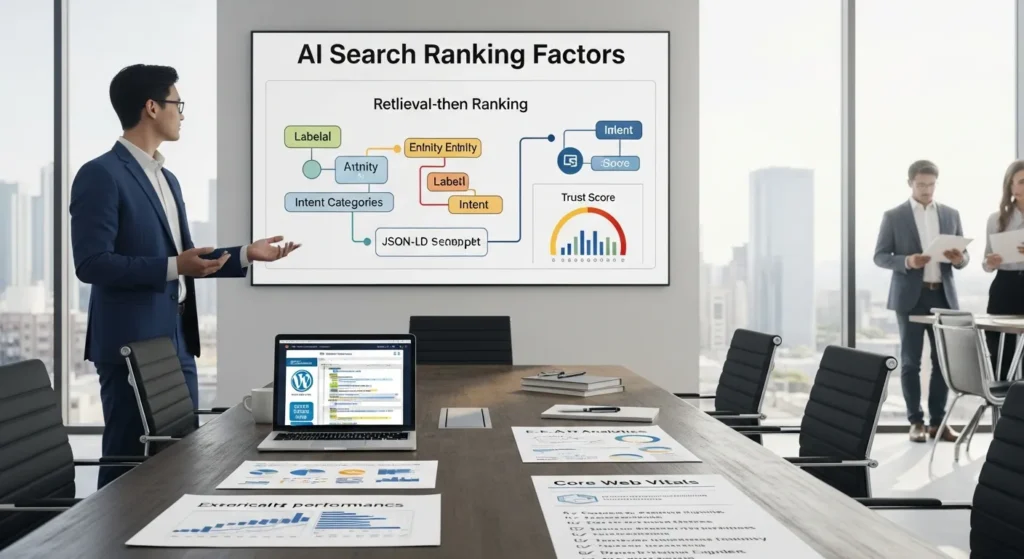
AI search ranking factors decide whether your page gets quoted, summarized, or ignored, and the shift feels brutal the first time you see it. We have watched a “perfectly optimized” product guide slide down the results while a smaller brand with clearer proof and cleaner structure jumped ahead. Quick answer: in 2026, AI search rewards pages that make intent obvious, name entities clearly, prove experience, and ship machine-readable structure, while the old signals (links, on-page, reviews) still count, just through a trust lens.
Key Takeaways
- In 2026, AI search ranking factors reward pages that make topic and intent obvious, name entities clearly, and deliver answers in a clean, scannable structure.
- Optimize for retrieval first (topical coverage, entity density, and internal linking) so your pages become candidates before ranking decides who wins.
- Prove E-E-A-T with first-party evidence, transparent sourcing, and named authorship because AI systems treat trust as the lens for classic SEO signals.
- Use machine-readable structure (descriptive headings, tight summaries, and accurate Schema like Product, Review, and FAQ) to make your content easier to quote, summarize, and cite.
- Protect visibility with strong technical hygiene—fast mobile UX, crawl efficiency, and duplication control via canonicals/noindex—so AI can access and trust your best URLs.
- Avoid risky shortcuts like scaled generic AI content and link schemes; instead, run a repeatable WordPress workflow with human review, change logs, and conversion-focused measurement.
How AI-Powered Search Decides What To Show
AI search does not “read” your page like a human. It builds a model of what your page is about, who it is for, and whether it should trust you.
Search systems do two big jobs:
- They retrieve candidates (a set of pages that might help).
- They rank and select what gets shown (blue links, AI Overviews, map packs, shopping panels, citations).
When you think in those two steps, your content work gets calmer. You stop chasing one magic trick and start feeding the system what it needs.
From Keywords To Entities, Intent, And Context
Keywords still help. The bigger move is entities and intent.
- Entities are the “things” in your topic: your brand, product types, locations, materials, people, conditions, standards, and tools.
- Intent is what the searcher wants to do: compare, buy, learn, fix, book, or confirm.
- Context includes device, location, and history.
Here is the cause-and-effect you can plan around:
- Clear page topic -> improves entity recognition -> increases the chance you get retrieved.
- Clear intent match -> improves satisfaction prediction -> increases ranking.
- Strong brand signals -> strengthens trust graphs -> increases citation likelihood.
A practical example from eCommerce: if a page says “running shoes” 30 times but never states pronation, trail vs road, heel drop, return policy, and shipping times, AI struggles to place it for “best trail running shoes for wide feet.” The page lacks the entities and the intent match.
The Retrieval-Then-Ranking Pipeline (And Where You Can Influence It)
Most teams focus on ranking. Retrieval matters first.
- Retrieval pulls pages that look semantically relevant and topically credible.
- Ranking then sorts based on completeness, trust, and predicted satisfaction.
The influence points we see most often on WordPress sites:
- Topic clusters and internal links tell the crawler which pages belong together.
- Page structure (headings, tables, summaries) tells the model what each section answers.
- Verification signals (sources, authorship, policies, proof) reduce risk for the system.
If you want a simple heuristic: retrieval likes coverage and entity density: ranking likes clarity, proof, and “this actually answered the question.”
One more cause chain that shows up constantly:
- Thin category descriptions -> weak topical footprint -> fewer candidate pages retrieved -> lower overall visibility even if product pages are good.
That is why we build the supporting pages, not just the money pages.
The Ranking Factors That Still Matter (Just Interpreted By AI)
Plenty of “classic SEO” still works. AI systems just interpret it with more context and more skepticism.
We still see four buckets matter across industries: on-page signals, links, reviews, and behavior. The difference is that AI uses them to estimate trust and usefulness, not just relevance.
Relevance Signals: Topic Coverage, On-Page Clarity, And Internal Linking
Relevance now looks like “Did you cover the full job the user hired you for?”
What we aim for:
- A page that states the primary promise fast.
- Sections that answer the next questions a human would ask.
- Internal links that connect the cluster so crawlers and models see the relationship.
On WordPress, internal linking is not busywork. Internal links -> increase crawl paths -> strengthen entity associations. That tends to raise retrieval rates.
If you want a checklist that maps intent to UX and content structure, our guide on turning searches into better on-site journeys fits here.
Simple structure that works:
- One sentence that defines the page.
- One short “who this is for” line.
- Headings that match real sub-questions.
- A short summary before long sections.
Quality Signals: E-E-A-T, Source Transparency, And Author Accountability
AI ranking systems punish vagueness. They also punish “no one is responsible for this.”
E-E-A-T becomes visible when you show:
- Experience: photos, screenshots, field notes, before/after, lessons learned.
- Expertise: correct terminology and correct steps.
- Author accountability: real author names, bios, and a way to contact.
- Transparency: what you tested, what you assume, and what you do not know.
Cause-and-effect in plain terms:
- Named author -> increases accountability -> improves trust prediction.
- Cited sources -> increases verifiability -> improves citation selection.
- First-party evidence -> reduces “generic content” risk -> improves ranking stability.
If you publish in legal, medical, finance, or insurance, treat this as non-negotiable.
Engagement And Satisfaction: When Clicks Matter (And When They Do Not)
Clicks matter most when the query has high intent.
- “Emergency plumber near me” -> calls and directions matter.
- “Best accounting software for contractors” -> click-through and time-to-answer matter.
For low-intent discovery queries, engagement can be noisy. People skim, bounce, and continue. AI systems expect that.
What we track instead of raw traffic:
- Did the page produce the next action (call, add-to-cart, form submit, booking)?
- Did users refine the query less after visiting (a sign they got the answer)?
Reviews also matter, but “velocity over volume” shows up a lot. A steady stream of real reviews -> improves trust signals -> helps map and local visibility.
If your site sells services, treat reviews as part of content, not a side quest.
AI-Era Factors You Need To Add To Your Checklist
If you only do classic SEO, you will feel stuck. These AI-era items tend to unlock the next step because they help machines parse and trust your content.
Structured Data And Machine Readability (Schema, Headings, Summaries)
Structure makes you easier to quote.
We like to think of it this way:
- Headings -> create answer slots -> help models extract clean snippets.
- Summaries -> reduce ambiguity -> improve “did this answer it?” scoring.
- Schema -> labels your entities -> reduces guessing.
Common Schema types that fit business sites:
- Organization, LocalBusiness, Product, Review, FAQ, Article
WordPress makes this doable, but do not spray Schema everywhere. Wrong markup -> creates contradictions -> lowers trust.
If you sell products, consistent Product schema with price, availability, and brand can help shopping surfaces match you correctly.
Original Evidence: First-Party Data, Photos, Demos, And Process Write-Ups
This is the part most competitors skip because it takes real work.
Original evidence can be simple:
- A photo of your team installing a heat pump.
- A screenshot of your WooCommerce setup for variable products.
- A table showing shipping times by region based on your own orders.
- A short “what we did and what broke” story.
Evidence -> increases uniqueness -> reduces duplicate-content similarity -> increases selection for AI answers.
If you create content for a product category, add one section called “What we see in real projects.” Write five bullets. That alone can separate you from the copycat pages.
Citation And Reference Readiness For AI Answers
AI systems need to verify claims. They also need to cite sources when they show generated answers.
So we write pages that make citation easy:
- Put the key claim near the top of the section.
- Add a supporting source right after it.
- Use clear labels and dates.
A tiny formatting habit that helps: use “Claim: … Evidence: … Source: …” style sentences. It reads clean. It also reduces misquotes.
When you cite, favor primary sources or strong publishers. Skip random blogs unless they report original data.
We keep a short internal rule: if you would not show the source to a regulator or a client’s legal team, do not use it.
Technical And Operational Signals That Quietly Win Rankings
We see good content lose to cleaner sites all the time. The reason is boring: performance and index control decide whether AI can even access your best work.
Performance, Mobile UX, And Crawl Efficiency
Fast sites win more often because they remove friction.
- Slow pages -> increase abandonment -> reduce satisfaction signals.
- Bloated themes -> reduce crawl efficiency -> fewer pages discovered.
For WordPress, the usual culprits are heavy page builders, oversized images, and too many script bundles.
We aim for:
- Compressed images (WebP where possible)
- A sane plugin stack
- Clean mobile layout with readable tap targets
Mobile UX -> reduces pogo-sticking -> supports ranking stability.
Indexation Control: Canonicals, Noindex, And Duplication Hygiene
AI search gets confused when you publish five near-identical pages.
Duplication causes this chain:
- Similar pages -> split signals -> weaker authority per URL -> lower retrieval and ranking.
Tools that help:
- Canonical tags for duplicates you must keep.
- Noindex for low-value pages (internal search results, thin tag archives, test pages).
- Parameter handling for filter URLs on eCommerce.
WooCommerce sites often leak crawl budget through filter combinations. Fixing that can boost discovery of your real category and product pages.
Content Operations: Freshness, Versioning, And Change Logs
Freshness is not “post daily.” Freshness is “update what matters.”
We use a simple ops loop:
- Review the top 20 pages quarterly.
- Update facts, screenshots, and pricing notes.
- Add one new example from recent work.
- Log the change.
Change logs -> signal active maintenance -> reduce staleness risk.
If you work in regulated niches, a visible update note also helps readers trust you. People want to know if the page reflects today’s rules, not last year’s guesses.
What To Avoid: Risky Shortcuts And Compliance Traps
AI ranking systems punish shortcuts harder now because they can spot patterns across huge sets of pages. And if you operate in healthcare, legal, finance, or insurance, the penalties are not only algorithmic. They can be real-world.
Scaled AI Content Without Governance
The fastest way to tank trust is to publish hundreds of pages that sound the same.
Scaled generic content -> increases similarity -> triggers quality filters -> reduces visibility sitewide.
If you use AI to draft, set guardrails:
- Never paste sensitive data.
- Require human review.
- Require a fact check for claims.
- Keep a prompt and change log.
Treat prompts like SOPs. If a junior marketer can follow it without guessing, you are safer.
Link Schemes, Parasite Pages, And Reputation Abuse
Bad links still work… until they do not.
Link schemes -> create unnatural patterns -> raise spam risk -> cause ranking volatility.
If you want link building that holds up, focus on real mentions, partnerships, and resources people cite.
If you want a grounded approach, our breakdown of earning and evaluating backlinks without chasing vanity scores covers the “safe and boring” path that usually wins.
Parasite pages and reputation abuse also carry legal and brand risk. You might get a spike. You also might get a manual action and a PR mess.
Sensitive Niches: Medical, Legal, And Financial Content Guardrails
For these niches, treat content like product safety.
Guardrails we use:
- Put scope limits on the page: what you cover and what you do not.
- Use licensed review where required.
- Avoid medical claims without sources.
- Avoid financial promises, timelines, or guarantees.
Human oversight -> reduces harm risk -> protects brand trust.
If your content advises diagnosis, treatment, or legal strategy, keep a qualified human in charge. Always.
A Practical WordPress Workflow To Improve AI Search Visibility
Most teams do not fail because they lack effort. They fail because the work stays fuzzy. We prefer a workflow you can repeat and audit.
Map The Workflow: Trigger → Inputs → Model Job → Output → Guardrails
Before you touch any tools, map the system.
- Trigger: What starts the work? (new product line, new service area, new regulation)
- Inputs: What data feeds the page? (pricing, specs, policies, customer questions)
- Model job: What does AI do? (outline, extract entities, draft FAQ, summarize reviews)
- Output: What ships? (draft post, updated category page, schema JSON-LD)
- Guardrails: What blocks bad output? (banned claims, privacy rules, human approval)
This map -> reduces surprises -> makes delegation safe.
Start In Shadow Mode: Human Review, Logging, And Rollback
We start “shadow mode” for 2 to 4 weeks.
Shadow mode means:
- AI drafts live in WordPress as drafts.
- A human editor checks facts, tone, and compliance.
- We log edits and errors.
- We keep rollback notes.
Logging -> exposes failure patterns -> improves prompts and templates.
This keeps you from publishing a confident-sounding mistake that costs trust for months.
Measure What Matters: Queries, Pages, And Conversions (Not Vanity Traffic)
We measure in three layers:
- Queries: Which intents pull you into results?
- Pages: Which URLs get impressions and citations?
- Conversions: Which pages create revenue or leads?
Traffic alone can lie. A page with 200 visits and 12 calls beats a page with 5,000 visits and zero action.
For WooCommerce, we also track:
- add-to-cart rate by landing page
- product view depth
- returns and support tickets tied to content (yes, content can reduce refunds)
Measurement -> improves prioritization -> compounds gains over time.
Conclusion
AI search ranking factors in 2026 reward clarity, proof, and structure, and that is good news for serious businesses. If you can explain what you do, show that you actually do it, and publish it in a format machines can parse, you can beat louder competitors.
If you want help turning this into a WordPress plan, we usually start with a low-risk pilot: one topic cluster, one conversion path, and one measurement dashboard. Then we expand only after the data says “yes.”
Sources
- Search Quality Evaluator Guidelines, Google, Updated 2024, https://developers.google.com/search/docs/fundamentals/creating-helpful-content
- AI Overviews and Search, Google Search Central Blog, 2024, https://blog.google/products/search/ai-overviews-search/
- Web Vitals, Google, Ongoing, https://web.dev/vitals/
- Schema.org Documentation, Schema.org, Ongoing, https://schema.org/docs/documents.html
- Disclosures 101 for Social Media Influencers, U.S. Federal Trade Commission, 2019, https://www.ftc.gov/business-guidance/resources/disclosures-101-social-media-influencers
Frequently Asked Questions About AI Search Ranking Factors
What are AI search ranking factors in 2026, and how are they different from classic SEO?
AI search ranking factors decide whether your page gets retrieved, ranked, and even quoted in AI summaries. In 2026, systems reward clear intent, entity clarity, E-E-A-T proof, and machine-readable structure. Classic signals like links, on-page SEO, and reviews still matter, but mainly through a trust-and-usefulness lens.
How does the retrieval-then-ranking pipeline affect AI search ranking factors?
AI search typically works in two steps: retrieval (finding candidate pages) and ranking (choosing what to show and cite). AI search ranking factors influence both: topical coverage and entity density help retrieval, while clarity, completeness, verification signals, and predicted satisfaction help ranking and citation selection.
Why do entities and intent matter more than repeating keywords for AI search ranking factors?
Keywords still help, but AI models rely heavily on entities (specific “things” like products, locations, standards) and intent (compare, buy, fix, confirm). If your page misses key entities and doesn’t match the searcher’s job-to-be-done, AI struggles to classify it and may skip it for more complete pages.
What structured data (Schema) best supports AI search ranking factors on business sites?
Schema improves machine readability by labeling entities clearly, which can support AI search ranking factors tied to understanding and trust. Common types for business sites include Organization, LocalBusiness, Product, Review, FAQ, and Article. Use it consistently and accurately—incorrect or contradictory markup can reduce trust and hurt visibility.
How can I create “original evidence” that improves AI search ranking factors?
Original evidence reduces “generic content” risk and can improve AI search ranking factors related to trust and uniqueness. Add first-party photos, screenshots, test notes, before/after results, shipping-time tables from your own orders, or short process write-ups. Simple “what we saw in real projects” bullets often outperform rewritten competitor content.
Do Core Web Vitals and site speed still matter for AI search ranking factors?
Yes. Performance and mobile UX still influence AI search ranking factors because slow, bloated pages increase abandonment and weaken satisfaction signals. Speed also affects crawl efficiency and discovery, especially on large WordPress or WooCommerce sites. Prioritize compressed images (e.g., WebP), a lean plugin stack, and clean mobile layouts.
Some of the links shared in this post are affiliate links. If you click on the link & make any purchase, we will receive an affiliate commission at no extra cost of you.
We improve our products and advertising by using Microsoft Clarity to see how you use our website. By using our site, you agree that we and Microsoft can collect and use this data. Our privacy policy has more details.
