
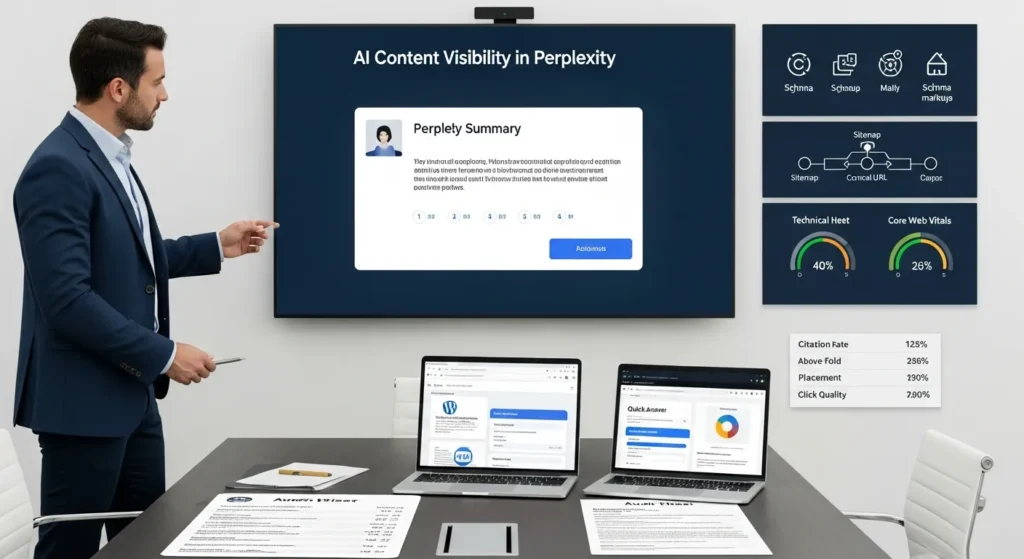
AI content visibility in Perplexity got real for us the day a client asked, “Why did Perplexity cite our competitor, not us?” We pulled up the answer, saw the footnotes, and felt that tiny stomach-drop you get when your work is good but still invisible.
Quick answer: Perplexity tends to cite pages that answer fast, prove claims, stay current, and look easy to quote. If your WordPress pages read like clean reference material, you show up more often.
Key Takeaways
- AI content visibility in Perplexity is about getting cited in answers, not ranking as the top blue link.
- Track citations, mentions, and link clicks separately, then monitor attribution rate, above-fold placement, quote tightness, and click quality to see real progress.
- Win citations by answering fast at the top, using specific and current claims, and adding clear trust signals like author credentials and honest update dates.
- Make WordPress pages “citation-ready” with a quick-answer block, tight H2/H3 question-style headings, bullets for steps, stable URLs, and no hidden accordion-only content.
- Boost AI content visibility in Perplexity with proof assets Perplexity can safely lift—tables, screenshots, checklists, templates, and simple before/after metrics.
- Run a repeatable 20–30 query audit in Perplexity, compare what gets cited, then update pages weekly in small “shadow mode” iterations to improve citation rate over time.
How Perplexity Surfaces Sources (And What “Visibility” Really Means)
Perplexity works like a research assistant with receipts. It generates a summary and shows sources as citations. That changes your goal.
Traditional SEO often aims for “rank #1.” AI content visibility in Perplexity aims for “get cited in the answer.” A citation puts your brand next to the model’s output, which builds trust and can send real referral clicks.
Here is what that means in practice: Perplexity does not need you to be the top blue link. It needs you to be the cleanest, most trustworthy source for a claim it wants to make.
Citations Vs. Mentions Vs. Links: What You Can Measure
You need three separate buckets, because each one tells a different story:
- Citation: Perplexity attributes a statement to your page, often as a footnote. Citation -> increases -> perceived authority.
- Mention: Perplexity references your brand or concept, but may not link. Mention -> increases -> brand recall.
- Link click: Perplexity includes a clickable link and the user taps it. Link -> drives -> referral traffic.
If you track only traffic, you miss wins. If you track only citations, you miss business value.
What we measure for AI content visibility in Perplexity on client sites:
- Attribution rate: your domain citations per target query set
- Above-fold placement: whether your citation appears in the first screen of sources
- Quote tightness: whether Perplexity pulls your definition, steps, table, or stat
- Click quality: time on page, scroll depth, and assisted conversions
What Typically Wins A Citation: Clarity, Specificity, And Sourceworthiness
Perplexity cites content that it can “lift” safely.
Pages win citations when they:
- Answer fast: definition or direct recommendation in the first lines
- Use specific claims: numbers, dates, named tools, and constraints
- Show signals of experience: author name, role, and update date
- Stay fresh: frequent updates tend to outperform stale guides
- Earn trust: reputable references and consistent editorial standards
Freshness -> affects -> citation likelihood because Perplexity tries to reduce outdated advice. Proof -> affects -> quote rate because the model can anchor its summary on something concrete.
Sources we lean on when we explain this internally:
- Perplexity Help Center, Perplexity, (accessed 2026-01-31), Perplexity Help Center
- Google Search Central: Structured data, Google, (accessed 2026-01-31), Understand structured data
- Core Web Vitals, Google, (accessed 2026-01-31), Web Vitals
Build “Citation-Ready” Pages On WordPress
If you want AI content visibility in Perplexity, you need pages that feel like reference cards, not diaries.
On WordPress, we treat each page like a mini knowledge base article:
- Trigger -> leads to -> question
- Page -> provides -> answer
- Proof -> supports -> answer
- Structure -> enables -> extraction
Answer-First Structure: Lead With The Definition, Steps, Or Recommendation
Perplexity skims. So should your layout.
Use this pattern at the top of the page:
- One-sentence definition (plain English)
- Who it is for and who it is not for
- Steps or decision rule
- Edge cases (the part that gets you cited)
On a WordPress build, we usually carry out this with:
- A short “Quick answer” block
- A table of contents (clean anchors)
- Tight H2 and H3 headings that match how people ask questions
This structure -> affects -> citation extraction because the model can grab the first clean answer without guessing.
Add Proof Assets: Original Data, Examples, Screenshots, And Tables
Perplexity likes content it can point at.
Proof assets that earn citations:
- A small table that compares options
- A screenshot of a setting page (WordPress, WooCommerce, Search Console)
- A simple before/after metric (even if it is internal)
- A short template (checklist, SOP, prompt)
If you run an eCommerce site, add product-level clarity:
- Shipping times, return windows, warranty terms
- Material specs and sizing charts
- Compliance notes (FDA, FTC, local licensing) when relevant
A table -> affects -> quote accuracy because Perplexity can cite discrete cells instead of paraphrasing a long paragraph.
Make It Easy To Extract: Headings, Lists, Stable URLs, And Clean HTML
WordPress makes it easy to publish. It also makes it easy to publish messy pages.
We aim for:
- Stable URLs: avoid changing slugs every month
- Clean heading order: one H1, then H2s, then H3s
- Short paragraphs: 2 to 4 lines
- Bullets for steps: no buried instructions
- No “accordion-only” content: hidden text gets missed
If you use page builders, keep an eye on output. Heavy wrappers -> affect -> parsing quality.
If you want help tightening structure without rebuilding the site, that is a common request in our WordPress SEO services work. We usually start with the pages that already rank and rewrite them for citation-readiness.
Technical SEO And Indexation: Make Your Content Retrievable
Perplexity cannot cite what it cannot fetch.
AI content visibility in Perplexity depends on crawl access, canonical clarity, and pages that render without drama.
Control Crawl And Canonicals: Sitemaps, Robots, Duplicates, And Parameters
Start with the boring checks. They pay rent.
- Submit your XML sitemap in Google Search Console and Bing Webmaster Tools
- Block trash URLs in robots.txt when they create infinite crawl paths
- Use canonicals when you have near-duplicate pages
- Control URL parameters (filters, sort orders) on eCommerce
Duplicate pages -> affect -> citation dilution because the model sees multiple versions and picks none with confidence.
Helpful references:
- Google Search Central: Canonicalization, Google, (accessed 2026-01-31), Learn about canonical URLs
- Robots.txt Specifications, Google, (accessed 2026-01-31), Robots.txt
Performance And Rendering: Core Web Vitals, JS Bloat, And Accessibility
Speed and readability still matter, even for AI.
- Large JS bundles -> slow -> rendering
- Layout shifts -> break -> reading flow
- Missing alt text -> reduces -> content clarity
We aim for solid Core Web Vitals because performance -> affects -> crawl success and user dwell time.
If your WordPress site uses WooCommerce, watch cart and product scripts. We often split scripts by page type and remove unused blocks.
Reference:
- Core Web Vitals, Google, (accessed 2026-01-31), Web Vitals
Structured Data That Helps: Organization, Article, FAQ Alternatives, And Product
Structured data gives machines labels. Labels reduce guesswork.
We often add:
- Organization schema: who you are, logo, contact
- Article schema: author, datePublished, dateModified
- Product schema: price, availability, reviews (when valid)
FAQ schema support has changed over time in Google, so we treat FAQs as a formatting pattern first: clear questions, clear answers.
Schema -> affects -> entity understanding because Perplexity can connect your page to your brand and author.
Reference:
- Google Search Central: Structured data, Google, (accessed 2026-01-31), Understand structured data
Trust Signals And Governance (Especially In Regulated Industries)
If you work in law, healthcare, finance, insurance, or mental health, AI content visibility in Perplexity comes with a second job: earn trust without overstepping.
Perplexity cites sources that look accountable.
Show Who Wrote It, Why You Are Qualified, And When It Was Updated
You want a human name attached to the page.
Add:
- Author bio with real credentials
- Editorial policy page
- “Last updated” date that you actually honor
- Contact info that matches your Organization schema
Identity -> affects -> trust because readers and systems can evaluate credibility.
Privacy-First Publishing: Data Minimization And No Sensitive Inputs
We tell clients this sentence a lot: do not paste sensitive data into tools you do not control.
On the publishing side:
- Remove client names from case studies unless you have written permission
- Avoid medical details that identify a person
- Redact invoices, screenshots, and email threads
Data minimization -> reduces -> exposure risk. It also makes your content easier to share and cite.
Helpful guidance:
- FTC Business Guidance, Federal Trade Commission, (accessed 2026-01-31), FTC guidance for businesses
Disclosures And Review: Human Oversight For Legal, Medical, And Financial Content
We keep humans in the loop, even when AI helps draft.
Set rules:
- A qualified reviewer signs off on regulated advice
- Disclosures explain limits (education vs advice)
- You cite primary sources when you make claims
Human review -> affects -> error rate. Lower error rate -> affects -> citation safety.
If you publish on WordPress, a simple workflow helps: draft -> review -> publish -> log updates. We often set this up with roles, checklists, and revision history in a website maintenance service engagement.
Distribution That Improves AI Discovery Without Chasing Hype
You cannot “SEO” your way into every Perplexity answer if nobody trusts your domain yet. Distribution fills that gap.
Earn References: Partner Mentions, Digital PR, And Credible Backlinks
We aim for references that make sense:
- Supplier and partner pages that list you
- Local chambers and professional directories
- Podcasts and webinars with show notes
- Industry publications that cite your data
A credible backlink -> affects -> perceived authority. Authority -> affects -> citation selection.
Skip spam. Perplexity cites sources people already trust.
Repurpose Into Source Formats: Checklists, Glossaries, And “Best Of” Pages
Perplexity loves pages that look like sources.
Formats that work well:
- Glossary pages: short definitions with examples
- Checklists: pre-flight steps people can copy
- “Best of” resource pages: curated tools with one-line reasons
If you serve many industries, build a few “anchor” pages that stay stable for years, then keep updating them. A stable hub -> affects -> repeat citations because Perplexity learns it as a reliable reference.
We often publish these as WordPress pillar pages and connect them with internal links, like a mini library. If your site structure needs help, our custom WordPress website development projects usually start with that information architecture work first.
Create A Testing Loop: Prompts, Queries, And Iterative Page Updates
Do not guess. Test.
AI content visibility in Perplexity improves when you treat prompts like a lab protocol.
Run A Simple Visibility Audit In Perplexity
Pick 20 to 30 queries that match revenue.
Examples:
- “best WooCommerce shipping setup for small business”
- “how to write a privacy policy for a therapy practice website”
- “WordPress SEO checklist 2026”
Then:
- Run each query in Perplexity.
- Record which domains get cited.
- Note the content format that wins (definition, list, table, fresh date).
- Compare your page to the winning page.
Gap -> affects -> revision plan. Revision plan -> affects -> future citations.
Track Outcomes: Query Set, Citation Rate, And Click Quality
We track three numbers weekly:
- Citation rate: citations / total queries
- Position quality: how high your citation appears
- Click quality: engaged sessions and conversions from Perplexity referrals
Then we update pages on a schedule. Even small edits help when they add clarity or fresh facts.
If you want the simplest loop, run “shadow mode” updates first: publish changes, watch citations, then roll the pattern across more pages. That keeps risk low while you learn what Perplexity prefers.
Conclusion
AI content visibility in Perplexity rewards a different kind of discipline. You write like a source, you publish like you expect to be quoted, and you run updates like you mean it.
If you take one move this week, do this: pick one money page on your WordPress site and rewrite the top 150 words into a clean definition plus steps, then add one proof asset. Perplexity can only cite what it can grab fast and trust.
If you want a second move, run the 20-query audit and keep a simple log. After two or three weekly passes, you will stop guessing and start steering.
Frequently Asked Questions (AI Content Visibility in Perplexity)
What does AI content visibility in Perplexity mean (and how is it different from SEO rankings)?
AI content visibility in Perplexity means getting cited as a source inside Perplexity’s generated answer, not simply ranking #1 in Google. Perplexity behaves like a research assistant with receipts, so the goal shifts to being the cleanest, most trustworthy page it can quote confidently.
Why did Perplexity cite my competitor instead of my site?
Perplexity often cites pages that answer fast, prove claims, and feel easy to extract and quote. Competitors may lead with a crisp definition, include specific numbers or dates, show an author and update date, and use tables or lists—signals that increase citation safety and clarity.
How can I make WordPress pages “citation-ready” for AI content visibility in Perplexity?
Use an answer-first layout: a one-sentence quick answer near the top, who it’s for, steps or a decision rule, and edge cases. Add a clean table of contents, tight H2/H3s, short paragraphs, and bullet steps. Avoid accordion-only hidden content and messy HTML output.
What should I track to measure AI content visibility in Perplexity?
Track more than traffic. Measure citation rate (citations per target query set), above-fold citation placement, quote tightness (whether Perplexity pulls your definitions, steps, tables, or stats), and click quality (time on page, scroll depth, assisted conversions). Citations, mentions, and link clicks tell different stories.
Does structured data help AI content visibility in Perplexity, and which schemas matter most?
Yes—structured data helps machines label your content, reducing guesswork and improving entity understanding. Prioritize Organization schema (identity), Article schema (author and dates), and Product schema (price, availability, reviews when valid). Treat FAQs mainly as a formatting pattern: clear questions with clear answers.
How often should I update content to improve AI content visibility in Perplexity?
Update when accuracy or freshness affects advice—especially on “money pages” and fast-changing topics. A practical approach is a weekly or biweekly testing loop: run a 20–30 query audit in Perplexity, log which sources win, then refresh your top sections and proof assets. Small, consistent edits can lift citations.
Some of the links shared in this post are affiliate links. If you click on the link & make any purchase, we will receive an affiliate commission at no extra cost of you.
We improve our products and advertising by using Microsoft Clarity to see how you use our website. By using our site, you agree that we and Microsoft can collect and use this data. Our privacy policy has more details.
